

The Science Behind a Changing Monsoon
Ipsa Tripathy
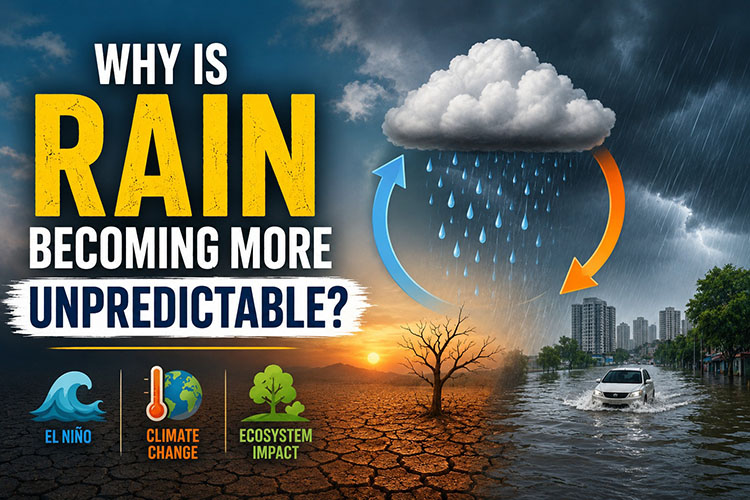
Bhubaneswar: For generations, the arrival of the monsoon was one of the most predictable events in India. Farmers knew when to prepare their fields, rivers filled almost on time, and people welcomed the rains as a season of hope. Today, that certainty is fading. Some years, the rains arrive late. Sometimes they begin on time but suddenly disappear for weeks. In other years, cities receive a month’s rainfall in just a few hours, leading to floods, while nearby districts remain dry.
The question many people are asking is simple: Why is the rain no longer behaving the way it used to? The answer lies in a combination of climate change, changing landscapes, and one of the world’s most powerful climate phenomena, El Niño.
The Monsoon Is More Complex Than We Think
Many people believe that the monsoon depends only on clouds. In reality, it is the result of a delicate interaction between the atmosphere, the oceans, and the land. During summer, the Indian landmass heats up much faster than the surrounding Indian Ocean. Warm air rises over the land, creating a low-pressure area. Moisture-laden winds from the Indian Ocean then move towards the Indian subcontinent. As these winds rise over land and mountains, the moisture condenses into clouds and falls as rain.
This process has supported agriculture and ecosystems across India for centuries. But the monsoon is also influenced by events happening thousands of kilometres away. One of the most important among them is El Niño.
What Exactly Is El Niño?
El Niño is a naturally occurring climate phenomenon that develops in the equatorial Pacific Ocean, far away from India. Normally, strong trade winds blow from east to west across the Pacific Ocean. These winds push warm surface water towards Indonesia and Australia, while colder water rises near the western coast of South America. This balance helps maintain global weather patterns.
During an El Niño event, these trade winds weaken. As a result, warm ocean water spreads eastward across the central and eastern Pacific. This shift may seem distant, but it changes atmospheric circulation across the globe. Scientists call this a teleconnection, a process where changes in one part of the world influence weather in another.
For India, the effects can be significant. A stronger El Niño often weakens the southwest monsoon by reducing the flow of moisture-carrying winds towards the Indian subcontinent. This can lead to below-normal rainfall, delayed monsoon onset, or long dry spells during the rainy season. It is important to note that El Niño does not cause every weak monsoon. Many other atmospheric and oceanic factors also influence rainfall. However, history shows that several drought years in India have coincided with strong El Niño events.
Climate Change Is Making Things More Complicated
While El Niño is a natural phenomenon, climate change is altering the background conditions in which it occurs. The Earth’s average temperature has increased because of greenhouse gases released from burning fossil fuels, deforestation, and industrial activities. A warmer atmosphere can hold about 7% more water vapour for every 1°C increase in temperature. This means there is more moisture available for rainfall.
But instead of producing gentle and evenly distributed rain, this extra moisture often results in short periods of extremely intense rainfall. That is why many regions now experience cloudbursts, flash floods, and heavy downpours, followed by long dry spells. In simple words, climate change is making the water cycle more intense. Scientists are still studying whether climate change is increasing the frequency of El Niño events, but there is growing evidence that warmer oceans may amplify their impacts on global weather.
The Role of Forests and Biodiversity
Weather begins in the atmosphere, but the land below also influences rainfall. Forests play an important role in regulating local climate. Trees absorb groundwater and release water vapour into the air through a process known as evapotranspiration. This moisture contributes to cloud formation and supports regional rainfall. Healthy forests also cool the surrounding environment and help retain soil moisture.
When forests are cleared for roads, mining, or urban expansion, these natural processes become weaker. Similarly, wetlands, lakes, and grasslands act like natural sponges. They store rainwater, recharge groundwater, and slowly release moisture back into the atmosphere. Although deforestation does not directly delay the Indian monsoon, scientists agree that degraded ecosystems reduce the land’s ability to recycle moisture and make local rainfall patterns more unstable.
Nature cannot control the monsoon. But it helps make every drop count.
The Impact on People
For millions of farmers, unpredictable rainfall means uncertainty. Delayed rains postpone sowing. Heavy rainfall can destroy young crops. Long dry spells reduce yields and increase dependence on irrigation. Cities face another challenge. A few hours of intense rainfall can overwhelm drainage systems, causing flash floods and traffic disruption. Yet the same cities may struggle with water shortages only weeks later because rainwater is not effectively stored.
Wildlife also feels the impact. Many birds, frogs, insects, and fish have evolved around seasonal rainfall. Changes in the timing of rain can affect breeding cycles, migration, food availability, and habitat conditions. The consequences extend beyond weather forecasts, they affect food security, biodiversity, water resources, and livelihoods.
Preparing for an Uncertain Future
India cannot prevent El Niño or control global weather systems. But it can prepare for their impacts. Protecting forests, restoring wetlands, conserving river catchments, improving rainwater harvesting, strengthening weather forecasting, and planning cities with climate resilience in mind can reduce vulnerability to changing rainfall.
The monsoon has always shaped India’s future. Today, science is helping us understand why that future is becoming less predictable. Rain will continue to fall. The real challenge is learning to adapt to a world where when, where, and how it falls is no longer as certain as it once was.
