

Ipsa Tripathy
Bhubaneswar: Every year, as winter approaches, something extraordinary happens in the skies above our planet. Without passports, maps, or GPS devices, millions of birds begin one of the longest journeys in the natural world. They cross continents, fly over mountain ranges taller than 8,000 metres, navigate vast oceans, survive storms and changing weather, and finally arrive at destinations they have never seen before, yet somehow know exactly where to go.
For centuries, bird migration remained one of nature’s greatest mysteries. Ancient civilizations believed birds hibernated underwater or transformed into different species during winter. Today, science has answered many of these questions, revealing migration as one of the most remarkable biological phenomena on Earth.
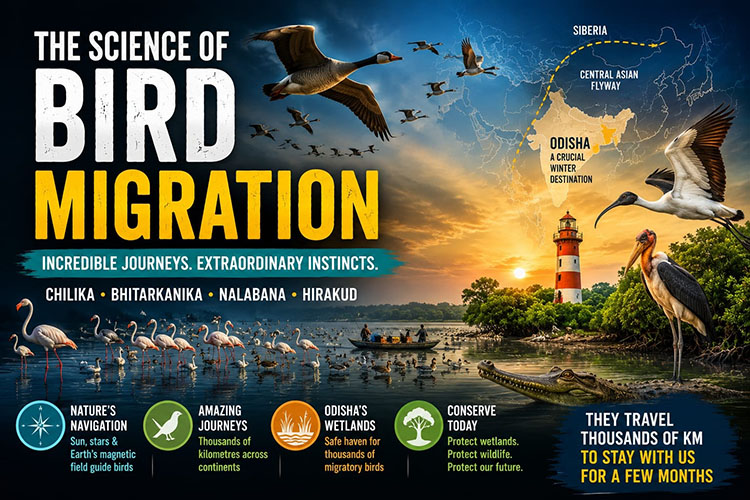
India, and particularly Odisha, has become one of the most important destinations along this incredible journey. From the sprawling waters of Chilika Lake to the mangrove forests of Bhitarkanika, thousands of migratory birds travel thousands of kilometres every year, making Odisha one of India’s richest winter bird habitats.
But as climate change, habitat loss and human disturbances increase, scientists are asking an important question: Will these birds continue to return in the decades to come?
Why Do Birds Migrate?
Migration is fundamentally about survival.Birds move seasonally in search of food, favourable weather and suitable breeding conditions. In northern regions such as Siberia, Mongolia, Central Asia and parts of Europe, harsh winters freeze lakes and wetlands, making food almost impossible to find. Rather than remaining in these inhospitable conditions, many species migrate south to warmer regions where wetlands remain productive and insects, fish and aquatic plants are abundant.
When spring returns, they begin the long journey back to their breeding grounds. This annual movement allows birds to exploit the best environmental conditions available during different seasons. Migration, therefore, is not random travel, it is an evolutionary strategy refined over millions of years.
How Do Birds Find Their Way?
One of the greatest scientific mysteries surrounding migration has always been navigation. How does a bird weighing less than 100 grams fly thousands of kilometres without getting lost? Research has shown that birds rely on multiple navigation systems. Many species use the Sun during the day and the stars at night as natural compasses.
Others detect the Earth’s magnetic field using specialised sensory mechanisms, allowing them to maintain direction even when visual landmarks disappear. Scientists believe certain proteins present in birds’ eyes may help them perceive magnetic fields, although research into this mechanism is still ongoing. Migratory birds also rely on familiar rivers, coastlines, mountain ranges and even their sense of smell to navigate. Perhaps most remarkably, many species return to the very same wetland, or even the same nesting location, year after year with astonishing accuracy.
Odisha: A Winter Home for Migratory Birds
Among India’s most important bird destinations, Odisha occupies a special place. Its wetlands, estuaries, mangrove forests and coastal ecosystems provide food, shelter and resting grounds for thousands of migratory birds arriving from across Eurasia. The state’s geographical location along the Central Asian Flyway makes it particularly significant. The Central Asian Flyway is one of the world’s major migratory routes, connecting Arctic and Central Asian breeding grounds with wintering habitats across South Asia. Odisha lies directly along this route.
Chilika Lake: Asia’s Great Bird Paradise
No discussion of bird migration in Odisha is complete without Chilika Lake. Recognised as Asia’s largest brackish water lagoon and designated as a Ramsar Wetland of International Importance, Chilika becomes a spectacular refuge every winter. According to the Chilika Development Authority, the lagoon regularly hosts more than one million migratory waterbirds, although numbers vary between seasons depending on environmental conditions. Recent annual bird censuses have recorded well over 180 species of birds, including both migratory and resident species.
Visitors may observe species such as:
- Northern Pintail
- Gadwall
- Eurasian Wigeon
- Common Teal
- Northern Shoveler
- Ruddy Shelduck
- Bar-headed Goose
- Black-tailed Godwit
- Eurasian Curlew
- Grey Plover
- Greater Flamingo (occasionally)
Many of these birds travel from Siberia, Russia, Kazakhstan, Mongolia and other parts of Central Asia. For them, Chilika is not simply a stopover.
It is a lifeline.
Bhitarkanika: Where Mangroves Meet Migratory Birds
While Chilika is famous for waterbirds, Bhitarkanika National Park offers a different ecological setting. Known primarily for its mangrove forests and estuarine crocodiles, Bhitarkanika is also one of eastern India’s most important bird habitats. More than 300 bird species have been recorded from the Bhitarkanika landscape, including both resident and migratory birds.
The park’s wetlands, mudflats and mangrove channels attract species such as:
- Asian Openbill
- Black-headed Ibis
- Oriental Darter
- Lesser Adjutant
- Spot-billed Pelican
- Egrets
- Herons
- Kingfishers
- Sandpipers
- Plovers
Bhitarkanika is also famous for one of India’s largest nesting colonies of waterbirds during the breeding season. The combination of mangrove forests, freshwater creeks and estuarine habitats creates ideal conditions for numerous species throughout the year.
Other Important Bird Habitats in Odisha
Although Chilika and Bhitarkanika receive the greatest attention, Odisha supports several other important bird habitats. Nalabana Bird Sanctuary, located within Chilika, is perhaps the state’s most important wintering ground for migratory waterfowl. Hirakud Reservoir, one of India’s largest artificial lakes, supports thousands of migratory ducks and shorebirds every winter.
Wetlands such as Ansupa Lake, Deras Dam, Mangalajodi, Satkosia, and numerous village ponds and marshes also provide valuable habitats. Collectively, these wetlands create a network that supports migratory birds throughout the state.
Why Bird Migration Matters
Migratory birds are far more than seasonal visitors. They are indicators of environmental health. A wetland capable of supporting thousands of migratory birds is usually rich in fish, aquatic vegetation, insects and clean water. When bird populations decline, scientists often investigate broader ecological changes occurring within the ecosystem.
Birds also perform important ecological functions. Many disperse seeds across large distances. Others control insect populations. Waterbirds contribute to nutrient cycling within wetlands. Their presence reflects the overall productivity of aquatic ecosystems. Bird migration is therefore not merely a wildlife event. It is evidence that ecosystems remain functional.
The Challenges Ahead
Despite Odisha’s rich bird diversity, these habitats face increasing pressure. Wetland degradation, encroachment, pollution, invasive aquatic plants, unsustainable fishing practices and climate change all influence migratory bird populations. Changing rainfall patterns can alter water levels.
Rising temperatures affect food availability. Human disturbance from unregulated tourism, boating and excessive noise may also reduce habitat quality in sensitive areas. Climate change presents perhaps the greatest long-term uncertainty.
Scientists have observed shifts in migration timing for several bird species worldwide. Some birds now arrive earlier or later than they once did, while others are altering traditional migration routes in response to changing environmental conditions. Because migration depends on precise seasonal timing, even small climatic changes can have significant ecological consequences.
What More Can Odisha Do?
Odisha has already taken important steps through the Chilika Development Authority, improved wetland management, regular bird censuses, habitat restoration and strengthened protection of Ramsar sites. These efforts have contributed significantly to the recovery of bird populations in several wetlands. However, future conservation requires even greater scientific planning.
Protecting wetlands beyond major protected areas should become a priority. Many smaller lakes and marshes act as important stopover sites but receive limited conservation attention. Regular monitoring using satellite imagery, drones and modern ecological tools can help detect habitat changes earlier.
Citizen science programmes involving birdwatchers and local communities can strengthen long-term monitoring while increasing public awareness. Promoting responsible bird tourism, regulating boating activities during sensitive seasons and preventing pollution of wetlands are equally important.
Perhaps most importantly, conservation planning should recognise that migratory birds do not belong to one country alone. They depend on international cooperation across the entire Central Asian Flyway.
Nature’s Greatest Travellers
Every winter, Odisha welcomes visitors unlike any other. They arrive without passports. They cross continents without borders. They return to the same wetlands with astonishing precision, guided by instincts refined through millions of years of evolution. Their journeys remind us that ecosystems are connected across nations, climates and landscapes.
The wetlands of Odisha are not isolated water bodies. They are vital links in one of Earth’s greatest natural networks. Protecting them is not simply about conserving birds. It is about safeguarding an ancient migration that has continued for thousands of years, a migration that tells us, every winter, whether our environment is still healthy enough to welcome its oldest travellers.
