

Ipsa Tripathy
Bhubaneswar: For decades, the story of mining has been one of extraction. The focus has always been on what lies beneath the ground, iron ore, bauxite, coal, chromite, manganese and other minerals that fuel industries, power economies and build modern cities. We celebrate the opening of new mines, the rise in mineral production and the revenue they generate. But very few people ask an equally important question.
What happens after the last truck leaves the mine?
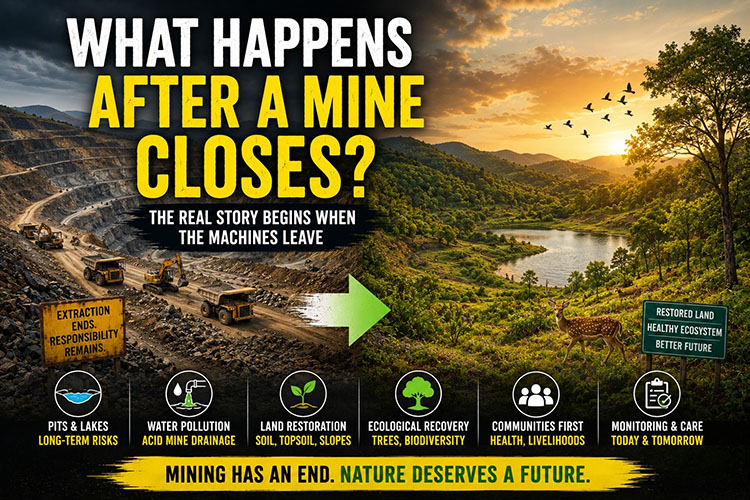
When the excavators fall silent, the blasting stops and the minerals are exhausted, does the land simply return to normal? The answer is no. A mine may stop producing minerals in a matter of years or decades, but its environmental footprint can remain for generations if closure is not scientifically planned.
For a mineral-rich state like Odisha, where mining has become one of the pillars of economic development, this question is becoming increasingly important. The state’s mineral wealth has transformed industries and created employment, but the long-term future of mined landscapes deserves just as much attention as the mining itself. Because the true test of responsible mining begins not when a mine opens, but when it closes.
Mining Has an End. Nature Does Not.
Every mine has a lifespan. Once economically recoverable minerals are exhausted, mining operations eventually come to an end. What remains behind, however, is often a landscape very different from the one that existed before extraction began. Large open pits, overburden dumps, waste rock, altered drainage systems and disturbed soil become part of the landscape.
If these sites are abandoned without proper restoration, they can pose environmental risks for decades. Mine closure is therefore not simply about shutting down machinery. It is a carefully planned process of restoring ecological stability, protecting nearby communities and ensuring that the land can support a sustainable future.
The Challenge Beneath the Surface
The environmental impacts of a closed mine are often invisible at first. One of the biggest concerns is groundwater. During mining operations, groundwater is frequently pumped out to keep excavation areas dry. Once mining stops, these underground water systems begin adjusting again. If not properly managed, abandoned pits may fill with contaminated water or alter natural groundwater flow.
Another concern is acid mine drainage, a problem associated with certain types of mining, particularly where sulphide-bearing rocks are exposed to air and water. This chemical reaction can produce acidic water capable of dissolving heavy metals and carrying them into nearby streams and rivers. Not every mine experiences acid mine drainage, but where it occurs, it can affect water quality long after mining has ceased. This is why environmental monitoring continues even after a mine closes.
A Forest Cannot Be Rebuilt Overnight
One of the greatest misconceptions is that planting a few thousand trees is enough to restore a mined landscape. Ecological restoration is far more complex. Mining removes not only vegetation but also the topsoil that contains microorganisms, fungi, seeds and nutrients essential for plant growth. Healthy forests depend on these invisible biological communities.
Without fertile soil, even planted saplings may struggle to survive. Scientists therefore begin restoration by stabilising slopes, rebuilding soil structure, conserving topsoil wherever possible and selecting native plant species suited to local ecosystems. Only then can ecological succession slowly begin. It may take several decades before restored land starts functioning like a natural ecosystem. An ancient forest cannot be recreated in a few years.
Odisha’s Responsibility
Odisha is among India’s richest mineral-producing states. The districts of Keonjhar, Sundargarh, Jajpur, Angul, Koraput, Jharsuguda, Dhenkanal and Mayurbhanj have contributed enormously to India’s production of iron ore, coal, chromite, bauxite and manganese. Mining has supported industries, generated government revenue and created employment opportunities across the state. But these landscapes are also home to forests, rivers, wildlife and indigenous communities whose lives remain closely connected with nature.
As mining expands, so does the responsibility to ensure that mined land is not left environmentally degraded. The challenge is not whether Odisha should mine its minerals. The challenge is ensuring that today’s development does not become tomorrow’s environmental burden.
What Does a Scientific Mine Closure Look Like?
Modern mine closure is no longer viewed as the final stage of mining. It is planned from the very beginning. Before extraction even starts, mining companies are required to prepare closure plans that describe how land will be restored after operations end.
These plans typically include:
- Stabilising waste dumps to prevent erosion.
- Replacing and conserving topsoil.
- Restoring natural drainage systems.
- Monitoring groundwater quality.
- Planting native vegetation.
- Preventing long-term pollution.
- Ensuring community safety.
Increasingly, mine restoration also focuses on creating productive landscapes rather than simply covering disturbed land with vegetation. Around the world, former mines have been converted into wetlands, forests, grazing lands, recreational parks and even solar energy projects. The objective is to ensure that the land continues serving society long after mining ends.
What Is India Doing?
India has strengthened its mine closure framework over the past two decades. The Ministry of Mines requires mining lease holders to prepare and periodically update mine closure plans. Financial assurance mechanisms are also intended to ensure that funds remain available for rehabilitation work. Environmental clearances issued under national regulations require companies to implement environmental management measures throughout the life of the mine, including closure and post-closure monitoring.
In Odisha, the Odisha Mineral Bearing Areas Development Corporation (OMBADC) and the District Mineral Foundation (DMF) have also become important institutions supporting infrastructure, environmental improvement and community welfare in mining-affected districts. While these initiatives have contributed positively, environmental experts argue that greater emphasis should now be placed on long-term ecological restoration, independent monitoring and transparent assessment of restoration outcomes.
Mine closure should not become a box-ticking exercise. Simply planting saplings or fencing abandoned land is not enough. Successful restoration should be measured scientifically. Are native birds returning? Has groundwater quality improved? Are soil microorganisms recovering? Can local communities safely use the restored landscape?
These are the questions that determine whether restoration has truly succeeded. Modern technologies such as drones, satellite monitoring, Geographic Information Systems (GIS) and ecological surveys now allow scientists to monitor mine restoration more effectively than ever before. The focus is gradually shifting from cosmetic rehabilitation to genuine ecosystem recovery.
The Future Begins After Mining Ends
Mining will remain essential for India’s development. The steel in bridges, the aluminium in aircraft, the minerals used in renewable energy technologies and electric vehicles all begin beneath the Earth’s surface. But every mineral extracted comes with a responsibility. A mine’s success should not be judged only by the quantity of ore it produced or the revenue it generated. It should also be measured by the condition of the land it leaves behind.
For Odisha, this is more than an environmental challenge. It is an opportunity. An opportunity to become a national leader in scientific mine restoration, demonstrating that economic development and ecological responsibility can move together. Because one day, every mine will close. The machines will stop. The trucks will disappear. The workers will leave. But the land will remain.
The question is whether that land will tell the story of environmental neglect, or one of responsible stewardship, where nature was given the chance to heal long after the last mineral was taken from beneath its soil.
