

Ipsa Tripathy
Bhubaneswar: Stand on the banks of a river that has flowed for centuries, and it is easy to believe that its course has always been the same. We often imagine rivers as permanent features of the landscape, fixed lines on a map that quietly carry water from the hills to the sea. But science tells a different story. Rivers are among the most dynamic systems on Earth. They are constantly shifting, carving new paths, depositing sediments, creating islands and floodplains, and reshaping the land around them. A river is not merely a channel filled with water; it is a living system that evolves over time.
Yet across India, many rivers are no longer free to follow their natural course. They have been confined by embankments, narrowed by urban expansion, interrupted by dams, and altered by sand mining. In many places, rivers seem to be asking a silent question: if given the chance, would they return to the paths they once knew? The answer lies in understanding how rivers behave, and why allowing them room to breathe is becoming increasingly important.
Rivers Were Never Meant to Stay Still
A river does not choose the shortest route to the sea. Instead, it follows the path shaped by gravity, soil, rocks, rainfall and sediment. As water flows downstream, it erodes one bank while depositing soil on another. Over years, decades and centuries, this process creates bends known as meanders. During floods, rivers may abandon old channels and carve new ones, leaving behind oxbow lakes and fertile floodplains.
This natural movement is not a sign of instability. It is how healthy rivers function. Floodplains, wetlands and sandbars are all products of this continuous reshaping. These landscapes support fish breeding, recharge groundwater, reduce flood intensity and provide habitat for countless species of birds, reptiles and aquatic life. In other words, a river’s ability to change course is part of its ecological identity.
What Happens When We Stop a River From Moving?
Modern development often demands certainty. Cities need stable riverbanks. Roads, bridges and buildings require fixed boundaries. To protect settlements and agricultural land, rivers are frequently constrained using embankments, concrete walls and channel modifications. While such interventions can reduce flooding in specific locations, they also change how rivers behave.
When a river is prevented from spreading into its natural floodplain, the force of flowing water becomes concentrated within a narrower channel. Sediment that would normally be deposited across floodplains accumulates elsewhere, gradually altering the riverbed. Over time, these changes may increase erosion in some areas while reducing the river’s natural capacity to absorb floodwaters.
A river may continue flowing. But it is no longer functioning as it once did.
Can Rivers Return to Their Original Course?
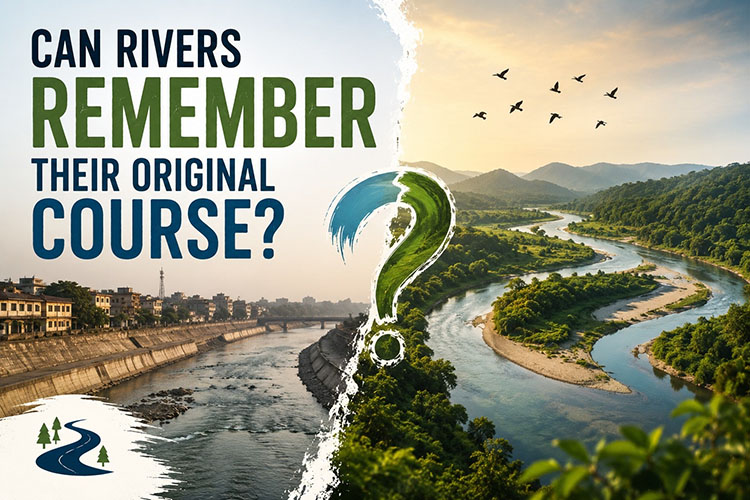
The phrase “remembering their original course” is not meant literally. Rivers do not possess memory. However, they do respond to the landscape. If barriers are removed or floodplains are restored, rivers often begin following the natural processes that shaped them for thousands of years. Scientists call this river restoration or river re-naturalisation.
Examples from Europe and North America show that when old embankments are removed and rivers are given space, they gradually reconnect with floodplains, restore wetlands and improve biodiversity. These projects demonstrate an important lesson. Nature retains an extraordinary capacity to heal, provided humans allow ecological processes to resume.
Odisha’s Rivers Are Changing
Odisha’s rivers have long shaped the state’s geography, agriculture and culture. The Mahanadi, along with rivers such as the Brahmani, Baitarani, Subarnarekha, Rushikulya and Vansadhara, supports millions of people while nourishing forests, wetlands and coastal ecosystems. Yet these rivers are facing increasing pressure. Rapid urbanisation around cities such as Cuttack and Bhubaneswar has transformed parts of their floodplains. Construction, encroachment and changing land use have reduced the natural space available for rivers during periods of high flow.
Sand mining has become another concern in several river systems. Sand is not merely a construction material, it forms part of a river’s natural structure. Excessive extraction can destabilise riverbanks, lower riverbeds and affect groundwater recharge. Pollution from untreated sewage, industrial discharge and solid waste further adds to the pressure. None of these changes happen overnight. They accumulate slowly, altering the character of rivers year after year.
Floodplains Are Not Empty Land
One of the biggest misconceptions about rivers is that floodplains are unused spaces waiting for development. Scientifically, floodplains are among the most productive ecosystems in a river basin. During floods, rivers spread across these areas, depositing nutrient-rich sediments that improve soil fertility. Floodplains also act as natural storage systems, temporarily holding excess water and reducing flood peaks downstream.
When floodplains are occupied by buildings, roads or permanent infrastructure, rivers lose this safety valve. The result is often more intense urban flooding, faster runoff and greater damage during extreme rainfall events. Climate change is making this challenge even more serious. As rainfall becomes more erratic and extreme, healthy floodplains are becoming increasingly valuable.
What Can Be Done?
The future of India’s rivers depends less on engineering alone and more on understanding river ecology. Protecting remaining floodplains should become a priority in urban planning. Sand mining must be scientifically regulated to maintain river stability. Wetlands connected to rivers should be restored rather than reclaimed. Equally important is improving wastewater treatment so that rivers are not forced to carry pollution alongside water.
Governments, scientists and local communities must work together to manage rivers as living ecosystems rather than drainage channels. River restoration does not always require returning landscapes to their exact historical condition. Instead, it aims to restore the natural processes that allow rivers to function sustainably.
A river never truly stands still. Even when it appears calm on the surface, it is constantly reshaping its bed, transporting sediment and responding to the landscape around it. Perhaps asking whether a river can remember its original course is really another way of asking whether we remember what a river is meant to be. It is not simply a source of water. It is not merely a boundary on a map. It is a living system that connects mountains to the sea, forests to wetlands, wildlife to people, and generations to one another. For centuries, rivers shaped the land without asking anything in return.
Today, they ask for something remarkably simple. Space to flow. And if we can give them that space once again, they may not return to exactly the paths they once followed but they can regain the natural rhythms that have sustained life for thousands of years.
