

Ipsa Tripathy
Bhubaneswar: Water has always been at the heart of human civilization. Ancient cities flourished along rivers, agriculture depended on seasonal rains, and communities built their lives around lakes, ponds and groundwater. For centuries, freshwater was often viewed as a resource that nature would replenish indefinitely. But that belief is rapidly changing.
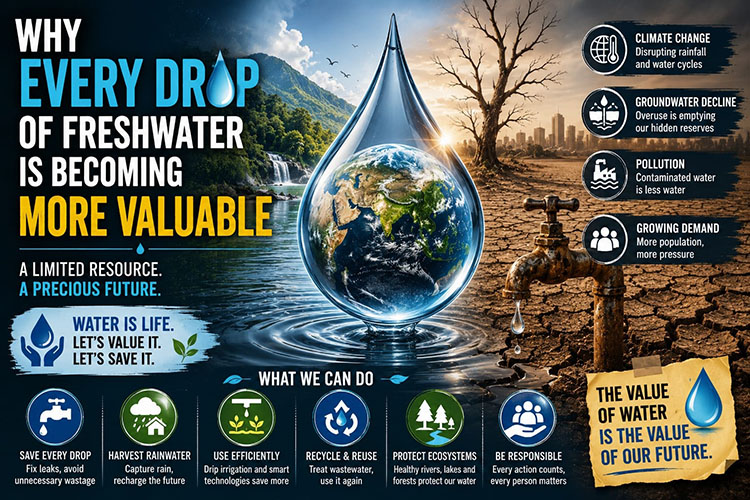
Today, freshwater is becoming one of the world’s most precious resources. Although nearly 71% of the Earth’s surface is covered by water, only about 2.5% is freshwater, and much of it is locked away in glaciers, ice caps or deep underground. The amount of water readily available for drinking, agriculture and industry is surprisingly limited. As climate change, population growth and unsustainable consumption reshape our planet, every drop of freshwater is becoming more valuable than ever before.
A Growing Demand for a Limited Resource
The world’s population has crossed eight billion, and with every new city, farm and factory comes an increasing demand for water. Agriculture alone accounts for nearly 70% of global freshwater withdrawals. Water is essential not only for growing crops but also for producing the food, clothing and energy that modern societies depend on. As economies expand and living standards improve, water consumption continues to rise. Yet the amount of freshwater on Earth has remained virtually unchanged for thousands of years. The challenge is no longer simply finding water, it is managing it wisely.
Climate Change Is Disrupting Nature’s Water Cycle
Climate change is making freshwater increasingly unpredictable. Warmer temperatures accelerate evaporation from rivers, lakes and reservoirs. At the same time, changing rainfall patterns are causing prolonged droughts in some regions while bringing intense floods to others. Ironically, heavy rainfall does not always solve water scarcity. Torrential downpours often flow rapidly into rivers and the sea before they can replenish groundwater reserves.
Melting glaciers add another layer of uncertainty. For millions of people, glaciers act as natural reservoirs, releasing freshwater gradually throughout the year. As glaciers shrink, this reliable source of water becomes less dependable, threatening communities that rely on glacier-fed rivers. The water cycle is no longer following the patterns that generations have depended upon.
Groundwater Is Running Dry
When rivers and lakes cannot meet growing demand, people turn to groundwater. Across many parts of the world, underground aquifers are being depleted faster than they can naturally recharge. India is among the world’s largest users of groundwater, with millions of farmers relying on tube wells for irrigation. In many regions, excessive extraction has caused groundwater levels to fall steadily, forcing wells to be dug deeper each year.
This silent depletion often goes unnoticed until wells begin to dry up, crops fail and drinking water becomes scarce. Groundwater may be hidden beneath our feet, but it is not an unlimited reserve.
Pollution Is Shrinking Our Freshwater Supply
Water scarcity is not only about quantity, it is also about quality. Industrial discharge, untreated sewage, agricultural runoff and plastic pollution contaminate rivers, lakes and wetlands, making freshwater unsafe for both humans and wildlife. Excess fertilisers carried into water bodies trigger algal blooms that reduce oxygen levels and threaten aquatic life. Heavy metals and toxic chemicals can persist in freshwater ecosystems for years, affecting biodiversity and public health. Every polluted river represents a loss of usable freshwater. Protecting water quality is therefore as important as conserving water itself.
The Cost Is Measured in Lives
For many communities, water scarcity is already a daily reality. Farmers face declining harvests when irrigation becomes unreliable. Women and children in water-stressed regions often spend hours each day collecting water from distant sources. Industries struggle during prolonged droughts, while cities face increasing pressure to supply safe drinking water to growing populations. Freshwater is closely linked to food security, economic development, public health and social stability. When water becomes scarce, its impacts extend far beyond the environment.
Every Individual Can Make a Difference
The responsibility for conserving freshwater does not rest solely with governments. Small actions by individuals can collectively make a significant difference. Repairing leaking taps, harvesting rainwater, using water-efficient appliances and avoiding unnecessary wastage all help reduce pressure on freshwater resources. Farmers can adopt drip irrigation and other efficient techniques that use less water while maintaining crop productivity.
Industries can recycle wastewater, improve treatment facilities and reduce pollution before it reaches natural water bodies. Protecting forests, wetlands and rivers also plays a crucial role. Healthy ecosystems naturally store, filter and regulate freshwater, providing benefits that no engineered system can fully replace.
Water Is More Than a Resource
It is easy to think of freshwater simply as something that flows from a tap. In reality, every glass of drinking water represents an extraordinary journey through clouds, rivers, wetlands, aquifers and ecosystems that have evolved over thousands of years. Every drop supports crops, wildlife, forests, industries and communities. It connects people with nature in ways we often overlook.
As climate change and human activities place increasing pressure on freshwater resources, the value of clean water will continue to grow. The future will not belong to the societies that consume the most water, but to those that manage it most wisely. Freshwater has never been more precious.
Protecting it is no longer just an environmental responsibility, it is an investment in our collective future. Because the next time we turn on a tap, it is worth remembering that every drop reaching our hands has travelled a long way. And in the years ahead, every one of those drops will matter even more.
