

Ipsa Tripathy
Bhubaneswar: Imagine a world where a devastating drought wipes out an entire crop, a deadly plant disease spreads across continents, or rising temperatures make once-fertile farmland unproductive. In such a future, rebuilding agriculture may depend not on what remains in our fields, but on what has been carefully preserved in secure vaults thousands of kilometres away. This is the purpose of seed banks, often called the world’s insurance policy for food security.
Hidden inside climate-controlled storage facilities are millions of seeds representing thousands of plant species. They may appear ordinary, but each seed carries a unique genetic blueprint that could help future generations overcome some of humanity’s greatest environmental challenges. As climate change, biodiversity loss and population growth place increasing pressure on global food systems, seed banks are emerging as one of the most important yet least understood tools for protecting our future.
Tiny Seeds, Enormous Responsibility
A seed is far more than the beginning of a plant. It contains thousands of years of evolution, adaptation and survival. Different varieties of rice, wheat, pulses and vegetables possess unique traits that allow them to tolerate drought, resist pests or survive harsh climatic conditions.
Unfortunately, modern agriculture increasingly depends on a relatively small number of high-yield crop varieties. While these crops have boosted food production, they have also reduced the diversity of plants grown across the world. When traditional crop varieties disappear, their valuable genetic characteristics disappear with them. Seed banks ensure that these genetic resources are never permanently lost.
Why Seed Diversity Matters
Nature thrives on diversity. If every farmer cultivated exactly the same variety of crop, a single disease or pest outbreak could spread rapidly, causing catastrophic losses. History has already shown the dangers of relying on limited genetic diversity, from the Irish Potato Famine to more recent crop diseases affecting bananas and wheat.
Genetic diversity gives scientists and plant breeders the ability to develop crops that can withstand new environmental pressures. As temperatures rise and rainfall patterns become increasingly unpredictable, this diversity may determine whether future crops succeed or fail. The seeds stored today could become the foundation of tomorrow’s agriculture.
Climate Change Is Rewriting Agriculture
Climate change is transforming farming across the globe. Heatwaves are becoming more frequent. Rainfall is growing increasingly erratic. Floods, droughts and salinity are affecting regions that once produced reliable harvests. Farmers now face conditions their ancestors never experienced. Developing climate-resilient crops is therefore becoming an urgent scientific priority.
Researchers often search seed banks for traditional plant varieties that possess natural resistance to drought, flooding, high temperatures or emerging diseases. These valuable traits can then be introduced into modern crop varieties through plant breeding programmes. In this way, seeds collected decades ago may help solve problems that did not even exist when they were first stored.
The World’s Most Secure Seed Vault
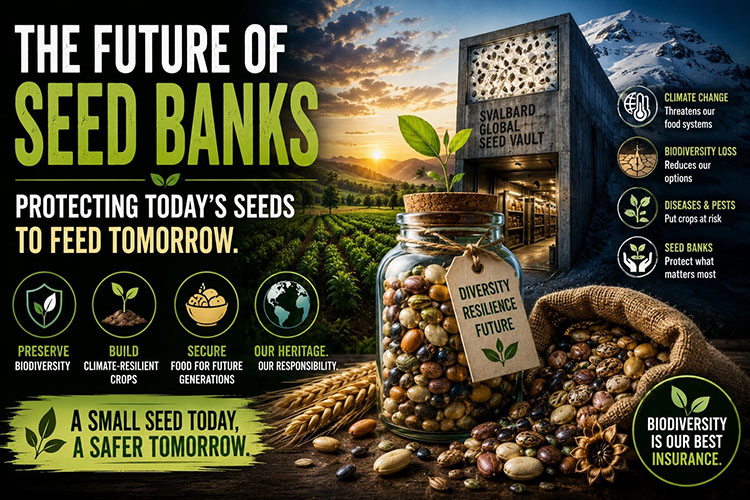
Perhaps the most famous seed bank is the Svalbard Global Seed Vault, located deep inside a mountain on the Norwegian island of Spitsbergen, just a few hundred kilometres from the Arctic Circle. Often called the “Doomsday Vault,” it stores backup copies of seed collections from gene banks around the world.
Built within permanently frozen rock, the facility provides an extra layer of protection against wars, natural disasters and equipment failures that could threaten national seed collections. Its purpose is not to replace local seed banks but to ensure that valuable crop diversity survives even during global crises. It is a reminder that food security is not only a national responsibility but a shared global concern.
India’s Own Seed Heritage
India is recognised as one of the world’s richest centres of agricultural biodiversity. From thousands of traditional rice varieties to indigenous millets, pulses and oilseeds, the country possesses an extraordinary wealth of plant genetic resources. Institutions such as the ICAR–National Bureau of Plant Genetic Resources (NBPGR) conserve these seeds for research, breeding and long-term preservation.
For a country where agriculture supports millions of livelihoods, protecting crop diversity is as important as protecting forests and wildlife. Traditional farmers, local communities and indigenous knowledge systems also play a vital role by continuing to cultivate native crop varieties that have adapted to local environments over centuries.
More Than Food Security
Seed banks protect much more than agriculture. They preserve medicinal plants, wild relatives of crops and species that may hold answers to future scientific discoveries. Some wild plants possess natural resistance to pests or extreme climates that cultivated crops have lost through selective breeding.
Others contain compounds that could contribute to future medicines or ecological restoration projects. Every seed represents possibilities that science has not yet fully explored. Destroying biodiversity today may mean losing solutions we have not yet discovered.
Investing in Tomorrow
Maintaining seed banks requires continuous scientific effort. Seeds must be regularly tested for viability, regenerated when necessary and carefully documented to preserve their genetic identity. As technologies such as DNA sequencing, cryopreservation and digital genetic databases advance, seed conservation is becoming more precise and effective.
However, no seed bank can replace healthy ecosystems or sustainable farming. Conservation must occur both inside storage facilities and in farmers’ fields, where plants continue to evolve naturally in response to changing environments. Protecting biodiversity is most successful when preservation and cultivation work together.
A Gift to Future Generations
Every generation inherits a natural legacy. Forests, rivers and wildlife are part of that inheritance. So are seeds. The seeds stored today may never be planted during our lifetime. Yet decades from now, they could help restore crops after disasters, feed growing populations or protect agriculture against an uncertain climate.
Perhaps that is the greatest lesson seed banks offer. True conservation is not only about solving today’s problems, it is about preparing wisely for tomorrow’s unknown challenges. Inside every carefully preserved seed lies the possibility of another harvest, another forest and another chance for humanity to adapt. Protecting those tiny seeds today may ultimately prove to be one of the greatest investments we make in the future of life on Earth.
