

Ipsa Tripathy
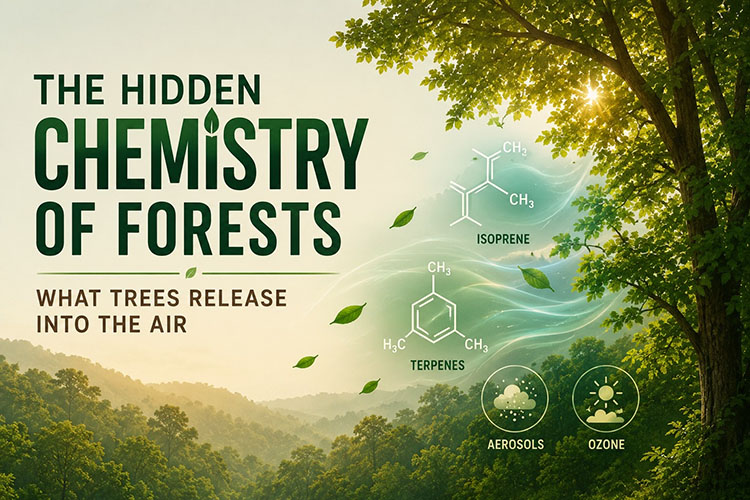
Bhubaneswar: A forest is often described as a natural carbon sink and a producer of oxygen. But trees also influence the atmosphere through a less familiar process: they continuously release a wide range of chemical compounds into the air. These substances are known as biogenic volatile organic compounds (BVOCs). They are carbon-containing gases released by vegetation, particularly leaves. Among the best studied are isoprene and terpenes, including monoterpenes such as α-pinene and limonene. Plants also release oxygenated organic compounds and other volatile substances.
These emissions are part of normal plant biology. At the same time, once they enter the atmosphere, they participate in complex chemical reactions that influence air composition, aerosols and atmospheric chemistry.
What Are Trees Releasing?
The composition of plant emissions varies greatly between species. Many broad-leaved trees are important sources of isoprene, a small hydrocarbon with the chemical formula C₅H₈. Coniferous trees commonly emit larger quantities of monoterpenes, including α-pinene, β-pinene, limonene and camphene. Plants also release compounds belonging to groups such as sesquiterpenes and oxygenated volatile organic compounds.
The amount released is not constant. Temperature, sunlight, plant species, leaf development and environmental conditions all influence emissions. Isoprene emissions, for example, are strongly dependent on light and generally increase during daylight. Many biogenic VOC emissions also increase with temperature. This means that the chemical composition of air above a forest can change with the time of day, season and weather.
Why Do Plants Produce These Compounds?
Plants do not release BVOCs for the purpose of changing atmospheric chemistry. These compounds are associated with several biological functions. Some volatile compounds are involved in plant defence and interactions with other organisms. Volatile chemicals can act as signals between plants or influence interactions between plants and insects. Others are associated with the plant’s internal metabolism. However, scientists do not yet attribute a single function to every BVOC. Different compounds can have different biological roles, and their production can vary considerably among plant species.
What Happens After They Enter the Atmosphere?
The chemistry becomes more complicated once these gases leave the plant. BVOCs are highly reactive atmospheric compounds. They can react with atmospheric oxidants such as the hydroxyl radical (OH), ozone (O₃) and nitrate radicals (NO₃). These reactions transform the original compounds into a variety of oxidation products.
For example, isoprene can undergo atmospheric oxidation and produce compounds including methyl vinyl ketone and methacrolein. The products can continue reacting and contribute to the chemical composition of the atmosphere. This chemistry is particularly active within and above forest canopies, where vegetation, sunlight and atmospheric gases interact.
Trees Can Influence Ozone Chemistry
One of the most important scientific aspects of BVOCs is their interaction with ground-level ozone. Isoprene and other reactive VOCs can participate in chemical reactions that produce ozone when sufficient nitrogen oxides and sunlight are present. This means that natural emissions from vegetation can contribute to ozone formation under particular atmospheric conditions.
However, this does not mean that forests are major sources of air pollution in the same way as vehicles or industrial sources. The effect depends strongly on the surrounding atmospheric chemistry, particularly the concentrations of nitrogen oxides (NOₓ). The relationship between BVOCs, NOₓ and ozone is nonlinear and can vary between environments. Therefore, the statement that trees simply “cause ozone pollution” is scientifically incomplete.
From Forest Gases to Atmospheric Particles
BVOCs can also contribute to the formation of secondary organic aerosol (SOA). Unlike primary particles that are emitted directly into the atmosphere, secondary aerosols form through chemical reactions involving gaseous compounds. Oxidation products of terpenes and other BVOCs can have sufficiently low volatility to contribute to particle formation or growth.
These particles are important because atmospheric aerosols can influence air quality, cloud processes and Earth’s radiation balance. The relationship is complex, however. Not every BVOC emission results in aerosol formation, and the outcome depends on atmospheric conditions and interactions with other chemical compounds. Research has also shown that isoprene can sometimes suppress new particle formation under certain forest conditions, demonstrating how complicated forest-atmosphere chemistry can be.
A forest canopy is therefore more than a collection of trees exchanging carbon dioxide and oxygen with the atmosphere. Within the canopy, sunlight, plant emissions, atmospheric oxidants, water vapour and pollutants interact continuously. Turbulence transports gases vertically, while chemical reactions alter their composition. Measurements from forest environments have shown that compounds such as isoprene and monoterpenes can undergo substantial chemical processing within and above the canopy. This is why atmospheric scientists treat vegetation as an important component of atmospheric chemistry.
Climate Change Can Alter These Emissions
Because BVOC emissions are influenced by environmental conditions, changes in temperature and vegetation can affect the amount and composition of compounds entering the atmosphere. Researchers also find that emissions can change during leaf senescence, or the process associated with seasonal ageing of leaves. A 2023 study of a mixed forest found enhanced monoterpene and related emissions following the onset of leaf senescence, showing that seasonal changes in vegetation can influence forest-atmosphere chemistry. This makes accurate representation of vegetation emissions important in atmospheric models.
The air above a forest may appear completely clean and still contain thousands of molecules released by vegetation. Some of these compounds participate in reactions that influence ozone. Others contribute to secondary organic aerosols. Their behaviour depends on temperature, sunlight, atmospheric oxidants, nitrogen oxides and the biological characteristics of the vegetation itself.
The important scientific lesson is that forests and the atmosphere are chemically connected. Trees do not simply absorb carbon dioxide and release oxygen. They also exchange a diverse collection of gases with the atmosphere, creating a constantly changing chemical environment around the forest. Understanding this hidden chemistry is essential for studying air quality, atmospheric composition, aerosol formation and interactions between terrestrial ecosystems and the climate system. The forest may look still from the ground. Chemically, however, its atmosphere is continuously changing.
