

Ipsa Tripathy
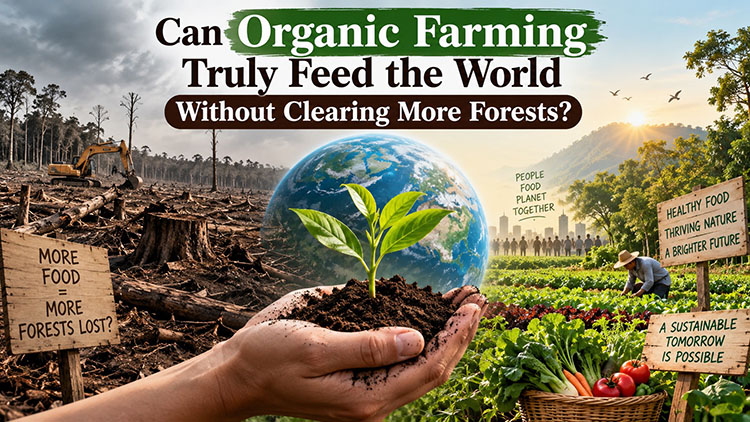
Bhubaneswar: For decades, the debate over how to feed the world without destroying it has been framed as a binary choice. On one side stand the proponents of industrial agriculture, who argue that high yield, intensive farming is the only way to produce enough calories while sparing land for nature. On the other are the advocates of organic farming, who point to its environmental benefits and question the long term sustainability of chemical dependent monocultures. At the heart of this argument is a single, critical question: can organic farming be scaled up enough to feed the global population without needing to plow over more forests and wildlands?
The short answer, according to recent research, is that it is theoretically possible, but not without significant systemic changes. The core challenge is a well documented yield gap. A comprehensive analysis published in Nature Communications in 2017 found that switching to 100 percent organic production would lead to an increase in global land use of between 16 and 33 percent, assuming the same dietary patterns and levels of food waste . This is a sobering statistic that seems to validate the concerns of those who argue for conventional intensification. Other studies have confirmed this average yield gap, placing it between 19 and 25 percent lower for organic systems across various crops compared to conventional methods .
However, this headline figure conceals a more hopeful reality. The yield gap is not a fixed law of nature; it varies dramatically by crop, region, and farming practice. In the Global South, where many smallholder farmers often cannot afford high doses of synthetic fertilizers and pesticides, organic and agroecological methods have been shown to be incredibly effective. A recent meta analysis of 392 experiments across Africa, for example, found that agroecological practices such as crop rotation, intercropping, and the use of organic fertilizers boosted yields by an average of 39 percent compared to the low input monocultures that are currently common in the region . This suggests that in these contexts, organic methods are not a step down in productivity but a significant step up.
This is where the real opportunity lies. The researchers behind the Nature Communications study didn’t just model a simple swap of conventional for organic. They showed that if you combine a shift to organic farming with three other major changes, the picture changes entirely. Their modeling indicated that if we reduce the consumption of animal products by about one third, change the way we feed livestock to rely less on human edible grains, and cut global food waste by 50 percent, then even a 60 percent conversion to organic farming could feed the projected 2050 population without needing extra cropland and with significantly reduced environmental impacts .
These three complementary changes are crucial. Currently, a vast amount of the world’s agricultural land is used to grow feed for livestock, not food for people. By shifting animals, particularly ruminants like cattle, to pasture based diets and reducing overall meat demand, a massive amount of land is freed up. This could easily compensate for the yield losses associated with organic farming . Furthermore, innovations in farming systems themselves are beginning to narrow the yield gap. In trials in Indonesia, a method called Complex Rice Systems, which integrates azolla, ducks, and other symbiotic elements into rice paddies, has proven capable of matching and even exceeding conventional yields in some weather conditions, offering a practical example of how ecological principles can boost productivity .
The debate often comes down to a concept known as “land sparing” versus “land sharing.” Land sparing advocates argue for farming as intensively as possible on a small amount of land to leave the rest untouched, while land sharing advocates believe that wildlife friendly farming across a larger area is the better approach . The answer for organic farming seems to be that it can be a viable land sharing strategy if it is part of a wider societal shift. It relies on managing ecosystems for both food production and biodiversity, a practice that has been shown to increase soil carbon, improve water retention, and support pollinators .
Ultimately, the question of whether organic farming can feed the world is not just an agricultural one; it is a question about the kind of food system we want. The science suggests that organic farming cannot simply replace conventional farming in a like for like manner. But when integrated into a broader plan that addresses dietary habits and waste, it can be a cornerstone of a sustainable, resilient future. This would require a conscious choice to step off the “express train” of ever increasing intensification and redefine what it means to be productive. The potential is there; the question is whether we have the collective will to make the changes needed to realize it.
