

Ipsa Tripathy
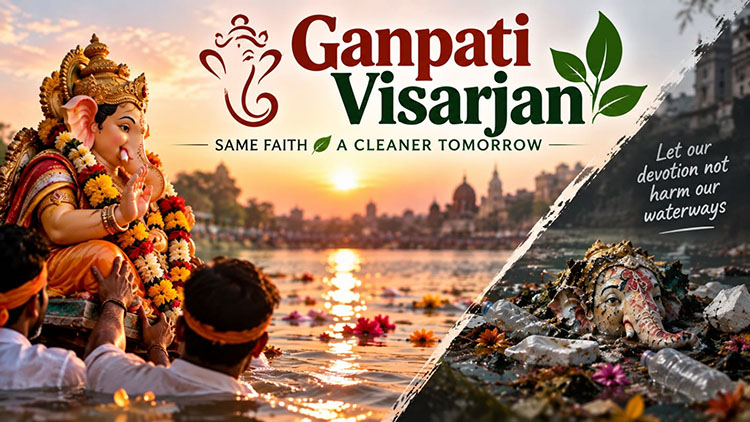
Bhubaneswar: Ganpati Visarjan is one of the most emotional moments of Ganesh Chaturthi. After days of worship, music and celebration, devotees carry Lord Ganesha’s idol towards a river, lake, pond or sea and offer it to the water. The immersion represents a sacred return of the deity to the elements and marks the completion of the festival. For devotees, it is an act of faith, not an act of pollution. The environmental problem arises from the materials increasingly used to make, paint and decorate idols.Traditionally, Ganesha idols were made from natural clay and decorated with materials such as turmeric and sandalwood. Over time, plaster of Paris, synthetic paints, plastic and thermocol became widely used because they are inexpensive, lightweight and convenient for making larger and more elaborate idols. The Central Pollution Control Board has identified these materials as important sources of concern during idol immersion. Its guidelines specifically encourage natural clay, biodegradable materials and naturally occurring colours while restricting materials that can contaminate water bodies.
Plaster of Paris is one of the major environmental concerns. Unlike natural clay, it does not readily dissolve in water. Idol fragments can remain in water bodies and contribute to physical pollution. The problem becomes more complicated when the idol contains paints and decorative materials. CPCB documents note that some synthetic colours used on idols may contain metals such as lead, cadmium, mercury and arsenic. When such materials enter water, they can contribute to deterioration of water quality.
The environmental impact is not limited to the idol itself. Flowers, garlands, cloth, plastic packaging, thermocol decorations and other puja materials are sometimes thrown into the water along with the idol. Organic material such as flowers and leaves decomposes and can temporarily alter water quality, while plastic and other non biodegradable materials remain in the environment much longer. Scientific studies of Indian lakes have documented changes in water quality and increased concentrations of certain metals associated with idol immersion, although the overall pollution of a particular water body can also come from sewage, industrial discharge and other sources.
There is also a biological dimension. When pollutants enter a lake, river or pond, they do not necessarily remain suspended in the water. Some substances can settle into sediments, while certain metals can accumulate in aquatic organisms. Research conducted in Nagpur, for example, detected elevated concentrations of several metals in water and fish following periods of idol immersion. This does not mean that every immersion produces the same level of contamination, but it demonstrates why the materials entering water bodies matter.
The important point is that protecting water does not require abandoning faith. In fact, devotees can preserve the spiritual meaning of Visarjan while changing the materials and methods used during the celebration.The simplest step is choosing an idol made from natural, unbaked clay rather than plaster of Paris. CPCB’s revised guidelines specifically recommend eco friendly idols made from natural clay and encourage biodegradable decoration and natural colours.
A clay idol can be designed for home immersion in a clean container of water, where the dissolved clay can subsequently be used for plants or returned to the soil, provided paints and other non biodegradable materials have not been mixed into it.Central Pollution Control BoardFor community celebrations, organisers can use designated artificial immersion ponds or temporary lined tanks rather than directly immersing idols in natural rivers and lakes. CPCB’s guidelines specifically recommend such temporary arrangements where appropriate. This allows the ritual to continue while preventing idol material from entering sensitive water bodies.
Devotees can also make a simple but important change: separate the puja waste from the idol. Flowers, leaves, food offerings, plastic covers and decorative materials should not be thrown into rivers or ponds. Biodegradable flowers can be collected separately for composting, while plastic, thermocol and other materials should enter appropriate waste collection systems.The size of the idol also matters. A smaller natural clay idol requires fewer resources to produce, transport and immerse. CPCB’s guidelines include restrictions concerning idol size as part of environmentally responsible immersion practices.
Communities can go one step further by supporting local artisans who make traditional clay idols and use natural colours. This does not only reduce pollution. It also keeps traditional craftsmanship alive and gives environmentally responsible choices an economic foundation.There is no contradiction between devotion and environmental responsibility. A river, lake or pond is not merely a place where an immersion takes place. It is a living ecosystem supporting fish, plants, microorganisms and, in many places, human communities. Respecting that ecosystem can be understood as an extension of the values of reverence and gratitude that are already central to religious practice.Ganpati Visarjan does not have to become a choice between faith and the environment. The prayer, the celebration, the gathering of families and the farewell to Ganesha can remain unchanged in spirit. What can change are the materials we use and the way we return the idol to nature.The most meaningful Visarjan may therefore be one where devotion leaves behind memories, not plastic, synthetic paint and polluted water.
