

Ipsa Tripathy
Bhubaneswar: Antibiotics are among the most important medicines in modern medicine. They allow doctors to treat bacterial infections and make many medical procedures, including surgery and cancer treatment, safer. But their effectiveness is being threatened by antimicrobial resistance, a process in which microorganisms become resistant to medicines that once worked against them.
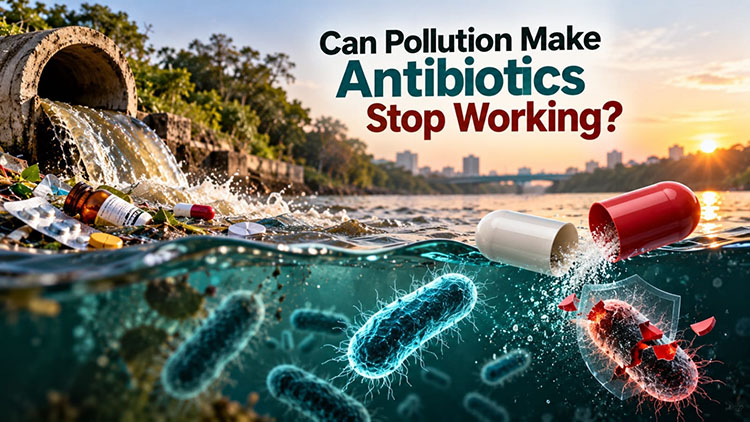
The problem is usually discussed in terms of unnecessary or inappropriate antibiotic use. There is another part of the story that is less visible: the environment. Pollution from wastewater, hospitals, farms, pharmaceutical manufacturing and poorly managed waste can carry antibiotics, resistant bacteria and antibiotic resistance genes into rivers, soils and other environments. These places can then become part of the wider cycle through which resistance develops and spreads.
How does pollution contribute to resistance?
When antibiotics are taken by people or animals, some of the medicines and their breakdown products can leave the body through urine and faeces. These residues can enter wastewater systems. Wastewater can also contain bacteria and genetic material carrying antibiotic resistance. If treatment is incomplete, these materials may reach the environment. Sewage, agricultural runoff and waste from healthcare facilities are therefore important pathways connecting human activity with environmental resistance.
The same concern exists around pharmaceutical manufacturing. The World Health Organization reported that high concentrations of antibiotics have been documented in water bodies downstream of some antibiotic manufacturing facilities. WHO has identified controlling such pollution as part of protecting the effectiveness of antibiotics.
The science is more complicated than saying that polluted water simply creates resistant bacteria. Resistance can arise naturally through genetic changes, and bacteria can acquire resistance genes from other bacteria. Environmental pollution can create conditions that favour the survival and spread of bacteria carrying those resistance traits. Researchers describe the environment as both a reservoir and a pathway for antibiotic resistance.
The hidden role of resistance genes
One of the most important discoveries in this field is that resistance is not limited to a particular bacterial species. Bacteria can carry antibiotic resistance genes, pieces of genetic information that can provide resistance to particular antibiotics. Some of these genes can move between bacteria. This means that environmental bacteria can potentially act as reservoirs of resistance genes that may eventually reach bacteria capable of causing human disease.
Wastewater is particularly important because it brings together microorganisms from different sources. A 2026 study highlighted by Nature India found extensive antimicrobial resistance in wastewater collected from several major Indian cities, including resistance genes present in previously uncharacterised microorganisms. This does not mean that every resistant bacterium in wastewater will infect a person. There are many biological and environmental barriers between environmental bacteria and human infection. Scientists are still studying how often resistance genes successfully move through these barriers.
Why this matters for human health
The consequences become serious when disease-causing bacteria acquire resistance to antibiotics. According to the World Health Organization, approximately one in six laboratory-confirmed bacterial infections worldwide in 2023 was resistant to antibiotic treatment. Between 2018 and 2023, resistance increased in more than 40% of the pathogen-antibiotic combinations monitored by WHO. When antibiotics become less effective, infections can become more difficult to treat. This can increase illness, complications, hospital stays and healthcare costs. Resistance can also make procedures that depend on effective infection treatment more difficult to perform safely.
Pollution control is part of the solution
Antibiotic resistance cannot be solved only inside hospitals. Better wastewater management can reduce the release of resistant bacteria, resistance genes and pharmaceutical residues into the environment. Proper management of waste from healthcare facilities, farms and pharmaceutical manufacturing is also important.
The World Health Organization now specifically recommends action to reduce antibiotic pollution from manufacturing. UNEP has likewise identified pollution from pharmaceuticals, agriculture, healthcare, sewage and municipal waste as important environmental dimensions of antimicrobial resistance.
For individuals, responsible antibiotic use remains important. Antibiotics should be used only when medically appropriate and according to professional medical advice. Unused medicines should also be disposed of through appropriate medicine take-back or disposal systems where available rather than being released into household wastewater.
The larger lesson is straightforward: an antibiotic does not become useless simply because a river is polluted. But environmental pollution can contribute to the biological conditions that allow antibiotic resistance to develop, persist and spread.
Antibiotic resistance is therefore not only a medical problem. It is also a water, sanitation, agriculture, waste-management and environmental problem. Protecting the effectiveness of antibiotics requires attention to all of these connected systems
