

Ipsa Tripathy
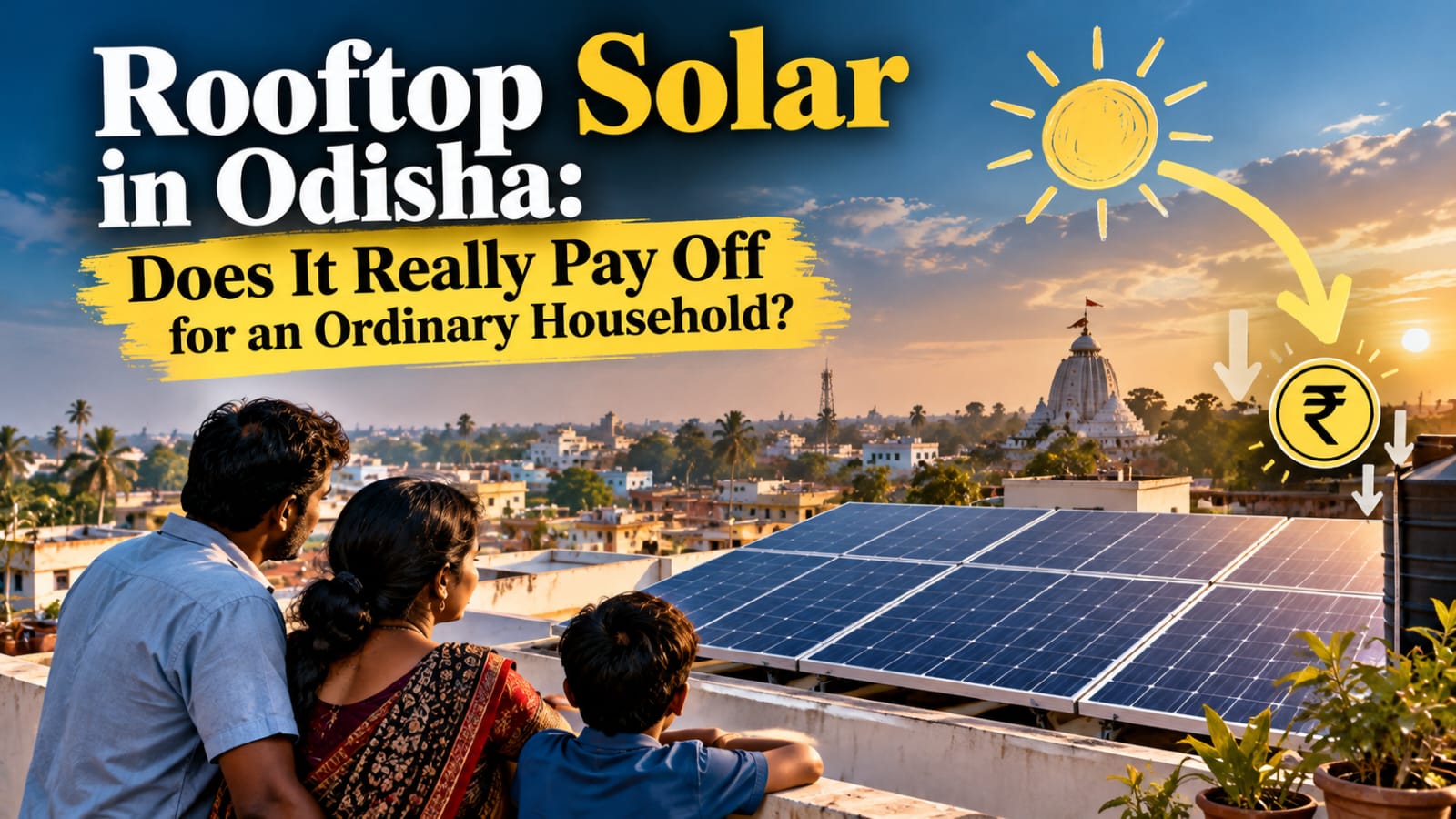
Bhubaneswar: Drive through Berhampur, Balasore or the newer residential colonies of Bhubaneswar, and you will notice something that was far less common a few years ago: dark blue solar panels on rooftops that once held little more than water tanks and drying clothes. Rooftop solar is no longer just an option for wealthier households. With government subsidies bringing down installation costs, more families are considering whether their roofs can help reduce their electricity bills.
Odisha has made considerable progress under the PM Surya Ghar: Muft Bijli Yojana. By August 2026, the state had reportedly installed around 1.74 lakh rooftop solar systems and received more than 3.12 lakh applications. The numbers suggest growing interest, but the question most households want answered is much simpler. Forget the environmental benefits for a moment. Does installing solar actually save money?
The answer depends on how much electricity a family uses, what it pays for a system and how much of the power generated is consumed at home. For some households, the financial case is compelling. For others, the savings are more modest.
The biggest factor is the subsidy. Under the central PM Surya Ghar scheme, eligible households can receive financial assistance of ₹30,000 per kilowatt for the first 2 kW, with support reaching ₹78,000 for systems of 3 kW or more. Odisha has added state assistance through the Odisha Akshaya Shakti Bikash Yojana, offering additional support of ₹25,000 for a 1 kW system, ₹50,000 for 2 kW and up to ₹60,000 for systems of 3 kW and above. Together, the central and state contributions can reach ₹1.38 lakh for an eligible 3 kW installation. The state has also allocated ₹495 crore in its 2026–27 budget for additional support under the programme.
These subsidies change the calculation considerably. A rooftop system that might otherwise take many years to recover its cost can become affordable much sooner. But the advertised subsidy is not the same as an automatic discount for everyone. Eligibility, the type of installation and the applicable scheme conditions all matter.
A 1 kW rooftop solar system in Odisha may cost around ₹65,000 to ₹75,000 before subsidies, depending on the equipment, installer and site requirements. Under favourable conditions, it can generate roughly 100 units of electricity a month. A 3 kW system may produce around 300 units in a good month, although actual generation changes with the season, weather, shading, panel orientation and maintenance. Odisha’s generally sunny climate is an advantage, but no system produces the same amount every month.
The financial benefit depends on the electricity a household would otherwise buy from the grid. Odisha’s domestic electricity tariffs use consumption slabs, meaning the energy charge per unit generally increases as consumption rises. A household using more electricity may therefore save more money by generating its own power, particularly when solar generation replaces units that would otherwise be charged at higher rates. Retail tariffs and other bill components can change, so households should use their current tariff category and electricity bill when estimating savings.
Consider three households with very different needs. The first is a small family with low electricity consumption. The second is a middle-class household running a refrigerator, fans, television and an air conditioner during the hotter months. The third is a family with higher consumption and a larger monthly bill. Each faces a different financial calculation, even if all three live under the same sunshine.
For a low-income household eligible for a subsidised 1 kW installation through a utility-led aggregation model, the upfront cost may be particularly small. Under the arrangement described for some participating households, the consumer contribution can be around ₹5,000, with the remaining eligible cost supported through the scheme. Certain beneficiaries under housing programmes may qualify for additional assistance, reducing their contribution further. For families who qualify, this can make rooftop solar accessible without having to pay the full installation cost first. The exact contribution and savings must be confirmed with the participating electricity distribution company.
Now consider a household in Cuttack using around 350 units a month. A 3 kW system could generate a substantial share of its electricity needs in suitable conditions. If the installation costs ₹1.8 lakh to ₹2 lakh before subsidies, and the household receives the full ₹1.38 lakh in eligible assistance, its effective cost could fall to roughly ₹42,000 to ₹62,000. The actual amount depends on the final installation price and the subsidy approved.
If the system generates enough electricity to replace a large share of the household’s grid consumption, the bill could fall considerably. But it would be misleading to assume that every unit generated automatically eliminates one unit from the bill. Solar production is highest during daylight, while many households use more electricity in the evening. The value of the system therefore depends on when appliances are used, the applicable billing arrangement and the amount of electricity exported to the grid. Savings of around ₹1,500 a month may be possible for some households, but they are not guaranteed. A payback period of roughly three years should be treated as an illustrative estimate, not a promise.
For a family using only 80 units a month, the case is different. Its electricity bill may already be relatively low, leaving less room for savings. Installing a large system could mean generating more power than the household can use during the day. A smaller system, where permitted and financially sensible, may be a better fit. The attraction of a low-cost installation is real, but the household should still compare the contribution it must pay with the savings it can reasonably expect.
There are practical issues to consider before signing a contract. A rooftop system needs enough unshaded space and a structure that can safely support the panels and mounting equipment. Tenants and apartment residents may not have the necessary roof rights. Families should also remember that subsidies do not always arrive at the moment of installation. Under some installation routes, the household pays the vendor first and receives eligible assistance later, which can create a cash-flow problem.
Odisha’s exposure to cyclones makes installation quality especially important. Panels need secure mounting and appropriate wind resistance, and the work should be carried out by a qualified installer. Households should check the official empanelled vendor list and understand the warranty, maintenance arrangements and terms of the installation before paying.
There is another common misunderstanding: rooftop solar does not automatically provide electricity during a power cut. A standard grid-connected system usually shuts down when the grid fails, for safety reasons. A battery or a compatible backup arrangement is needed if a household wants electricity during outages, and that adds to the cost.
So, does rooftop solar pay off in Odisha? For many households with moderate or high electricity consumption, it can be a sound long-term investment, particularly when the combined subsidies significantly reduce the initial cost. Families with low consumption may still benefit, but should choose a system suited to their needs rather than assuming that a bigger installation is always better. Solar panels are designed to operate for decades, although generation gradually declines and inverters or other components may need replacement during the system’s lifetime.
The challenge now is making the benefits accessible beyond homeowners who can afford the initial expense and control their own rooftops. Renters, apartment residents and households with limited savings may find it harder to participate, even when the long-term economics look attractive. Flexible financing, transparent installation costs and clear information from electricity distribution companies could help close that gap.
Rooftop solar is not a way to eliminate every electricity bill, nor is it equally economical for every family. But for households that choose the right system and understand how the subsidy and billing arrangements work, it can reduce dependence on grid electricity and offer savings over time. In Odisha, the question is no longer whether rooftop solar can work. It is whether the programme can make it practical for ordinary households across income groups, not only those with a suitable roof and enough money to get started.
