

Ipsa Tripathy
Bhubaneswar: For most people in Odisha, the arrival of the monsoon brings relief. The scorching summer heat fades. Rivers begin to flow again. Reservoirs fill up. Farmers prepare their fields and wait for the season that sustains agriculture across the state. Rain is often seen as nature’s gift.
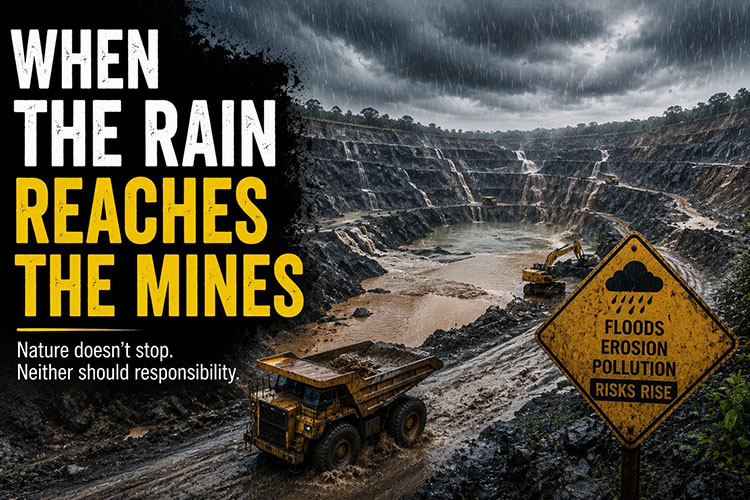
But in Odisha’s mining districts, the monsoon tells a more complicated story. As rainwater rushes across exposed earth, open pits, overburden dumps, and mineral stockyards, it raises an important environmental question: What happens when the rains reach the mines? The answer is not always visible. Yet its effects can influence rivers, farmland, forests, and communities long after the clouds have disappeared.
Odisha’s Mineral Wealth
Odisha is one of India’s richest mineral-producing states. Districts such as Keonjhar, Sundargarh, Angul, Jajpur, Koraput, and Mayurbhanj have played a major role in supplying iron ore, coal, bauxite, chromite, and other minerals that support industries across the country.
Mining has undoubtedly contributed to economic growth. It has generated employment, supported industrial development, and strengthened public revenues. Roads, railways, steel plants, and numerous infrastructure projects are closely linked to Odisha’s mineral economy.
Yet every form of development carries responsibilities. The monsoon often becomes the season when the environmental consequences of mining are most visible.
When Rain Meets Disturbed Land
In a natural forest, rainwater does not immediately flow away. Trees, vegetation, roots, and soil help absorb and slow down water movement. Much of the rainfall gradually seeps into the ground, recharging groundwater and supporting ecosystems. Mining changes that landscape. Large areas of vegetation may be removed. Soil layers may be disturbed. Exposed surfaces become more vulnerable to erosion.
When heavy monsoon rainfall occurs, water can move rapidly across these altered landscapes. The result is often increased runoff carrying soil, sediment, and other materials into nearby streams and water bodies. For communities living downstream, this can become a serious concern.
Rivers Carry More Than Water
One of the most critical environmental issues during the monsoon is sedimentation. Heavy rainfall can wash loose soil and mineral-rich particles into rivers and streams. Over time, excessive sediment can affect water quality, alter river habitats, and impact aquatic ecosystems. Fish breeding grounds may be disturbed. Small streams can become clogged. Wetlands may experience changes in water flow patterns.
For communities that depend on these water sources for agriculture, fishing, or domestic use, the consequences can be significant. The challenge becomes even greater when mining regions are located near sensitive river systems. In Odisha, where rivers serve as lifelines for both people and biodiversity, protecting water quality during the monsoon is especially important.
The Hidden Risk to Agriculture
The relationship between mining and agriculture is rarely discussed. Yet many mining areas are surrounded by farming communities. During periods of intense rainfall, runoff from disturbed land can sometimes affect nearby agricultural landscapes. Excess sediment may accumulate in fields, drainage systems, or irrigation channels.
For farmers, water quality is just as important as water quantity. A healthy monsoon should nourish agriculture, not create additional uncertainty. This is why environmental safeguards around mining operations become particularly important during the rainy season.
Wildlife Faces the Consequences Too
The impact of monsoon runoff extends beyond human communities. Mining districts often overlap with ecologically sensitive regions that support forests, wildlife habitats, and biodiversity. Heavy rainfall can alter local ecosystems through increased erosion, habitat disturbance, and changes in water availability. Small streams that sustain wildlife during dry months may be affected by sediment loads. Wetland habitats can experience ecological stress. Species already coping with habitat fragmentation may face additional pressures.
For Odisha, which is home to elephants, leopards, deer, numerous bird species, and diverse forest ecosystems, environmental management during the monsoon becomes a conservation issue as much as an industrial one.
The Climate Change Factor
The challenge is becoming more complex as rainfall patterns evolve. Climate scientists have observed an increase in extreme rainfall events across many parts of India. Instead of steady rainfall spread across weeks, some regions now experience short periods of very intense precipitation.
For mining landscapes, this can amplify environmental risks. A sudden cloudburst can generate far greater runoff than traditional rainfall patterns, placing additional pressure on drainage systems, sediment control measures, and environmental safeguards. In other words, climate change is increasing the need for stronger environmental planning.
Development and Responsibility
The discussion around mining often becomes polarized. One side emphasizes economic growth. The other focuses on environmental protection. The reality is that Odisha needs both. Mining remains important for development. At the same time, environmental safeguards cannot be treated as optional.
Responsible mining requires preparation for every season, especially the monsoon. Proper drainage systems, sediment control structures, slope stabilization, afforestation, water monitoring, and scientific mine closure planning all play important roles in reducing environmental impacts.
The goal should not be to stop development. The goal should be to ensure that development does not undermine the natural systems that communities depend upon.
Beyond the Rain
When the first monsoon showers arrive, they bring hope to millions of people across Odisha. But they also reveal the true condition of the landscapes we have altered. The rain does not distinguish between forests, farms, rivers, and mines. It flows through all of them.
And in doing so, it reminds us that environmental systems are interconnected. What happens on a mining site can ultimately affect a stream. What affects a stream can affect a farm. What affects a farm can affect a community. That is why the monsoon is more than a season of rain.
It is a test. A test of whether economic development and environmental responsibility can move forward together. For Odisha, the answer to that question may shape not only the future of its mining sector, but also the future of its rivers, forests, agriculture, and people.
