

Ipsa Tripathy
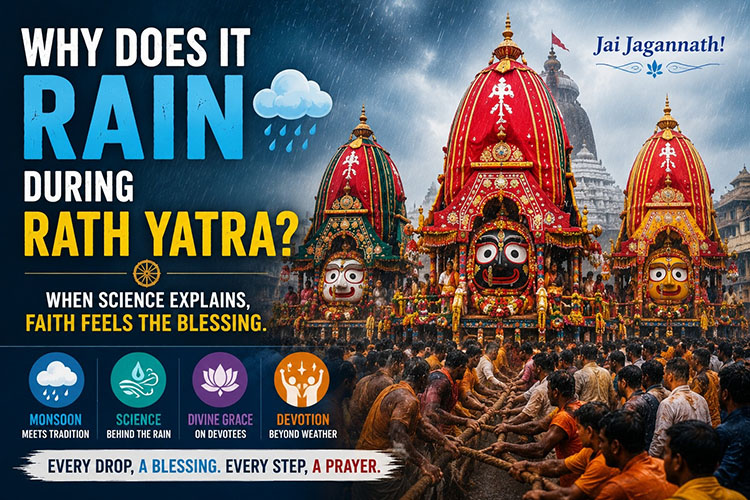
Bhubaneswar: Every year, as the grand chariots of Lord Jagannath, Lord Balabhadra, and Devi Subhadra begin their majestic journey from the Jagannath Temple to the Gundicha Temple in Puri, lakhs of devotees gather along the Bada Danda with folded hands and tearful eyes. Amid the chants of “Jai Jagannath” and the rhythmic pulling of the chariots, another familiar guest often arrives, the rain. Sometimes it begins as a gentle drizzle. At other times, dark clouds gather unexpectedly and showers sweep across the city. The devotees, instead of seeking shelter, often continue walking, drenched in rain yet smiling with devotion.
For generations, Odias have believed that the rain during Rath Yatra is a divine blessing. Many lovingly say that Mahaprabhu himself showers his grace upon his devotees, washing away their worries and making the sacred journey even more auspicious. But is there also a scientific explanation behind this recurring phenomenon? Surprisingly, the answer is yes. And rather than contradicting faith, science beautifully explains the natural rhythm in which this centuries-old festival unfolds.
The Arrival of the Monsoon
Rath Yatra is celebrated every year on the Dwitiya Tithi of the bright fortnight of Ashadha, which usually falls in late June or early July. This period is not randomly chosen. It coincides almost perfectly with one of India’s biggest seasonal transitions, the arrival of the Southwest Monsoon. After months of intense summer heat, the Indian landmass becomes extremely hot. At the same time, the Indian Ocean remains comparatively cooler. This temperature difference creates a large low-pressure system over the Indian subcontinent, drawing moisture-laden winds from the Arabian Sea and the Bay of Bengal.
As these winds travel inland, they carry enormous quantities of water vapour. When the warm, moisture-rich air rises and cools, it condenses into clouds, leading to rainfall. Odisha, located along the Bay of Bengal, is among the first eastern states to experience the full strength of the monsoon. By the time Rath Yatra arrives, the southwest monsoon has usually established itself across the state. From a meteorological perspective, rainfall during this period is therefore not unusual. It is part of the natural seasonal cycle that has repeated itself for centuries.
Why Does It Often Rain During the Chariot Festival?
People often remark that it seems to rain specifically on Rath Yatra day. While there is no scientific evidence that rainfall occurs every Rath Yatra, the timing of the festival significantly increases the probability of showers. The atmosphere during the monsoon is highly dynamic. Moisture levels remain high, cloud formation is frequent, and local weather conditions can change rapidly.
Puri’s geographical location adds another factor. Being a coastal town, it experiences strong interactions between land and sea breezes. During the day, heated land causes warm air to rise while cooler, moisture-rich air moves inland from the Bay of Bengal. These local atmospheric circulations often encourage cloud formation and afternoon or evening rainfall. Meteorologists describe such events as typical monsoon weather rather than extraordinary occurrences. Yet for devotees, every drop carries a deeper meaning.
When Science Ends, Faith Begins
Science explains how rain forms. Faith explains what it means. For millions of devotees, the rain that falls during Rath Yatra is not simply condensed water vapour. It is Mahaprabhu’s blessing. There is a beautiful emotional belief deeply rooted in Odisha’s culture. After spending fifteen days in Anasara, away from public view following the Snana Purnima rituals, Lord Jagannath, along with Lord Balabhadra and Devi Subhadra, finally comes out to meet the people.
Unlike many deities who remain inside temple sanctums, Lord Jagannath steps outside. He does not wait for devotees to enter the temple. He comes to them. He travels with them. He allows everyone, irrespective of caste, religion, wealth or social status, to pull his chariot. When rain begins to fall during this sacred journey, devotees rarely see it as an inconvenience.
Instead, they often say: “Mahaprabhu has blessed us.” Children laugh. Elderly devotees continue chanting. Thousands walk barefoot on rain-soaked roads without complaint. The rain becomes part of the celebration itself. It is almost as if nature joins the procession.
A Festival That Celebrates Nature
Rath Yatra arrives at a remarkable moment in India’s ecological calendar. The scorching summer is giving way to relief. Dry fields begin receiving their first substantial rainfall. Farmers prepare their land for cultivation. Trees regain their freshness. Rivers slowly swell. The earth itself seems to breathe again.
In many ways, the festival and the monsoon complement one another. Jagannath’s journey symbolises movement, renewal and togetherness. The monsoon represents rejuvenation, fertility and life. Their coincidence is not merely seasonal. It reflects humanity’s age-old relationship with nature. Long before modern meteorology existed, communities organised festivals around seasonal changes because their lives depended on rainfall, agriculture and healthy ecosystems. Rath Yatra is one such timeless reminder.
Devotion That Knows No Weather
Perhaps one of the most extraordinary sights during Rath Yatra is not the rain itself. It is the devotees. Whether the sun shines brightly or heavy showers fall, the ropes of the three magnificent chariots remain firmly held by thousands of hands. The chants grow louder. The enthusiasm only increases.
Rain becomes almost invisible. For many pilgrims, walking through rain while witnessing Lord Jagannath’s journey becomes a memory they cherish for a lifetime. The wet clothes, muddy roads and tired feet no longer matter. Only Mahaprabhu matters. Perhaps that is why rain feels different during Rath Yatra. It does not interrupt devotion. It becomes part of it.
A Lesson Hidden in the Rain
There is another message hidden within this annual coincidence of faith and nature. The same monsoon that blesses Rath Yatra also sustains Odisha’s rivers, forests, wetlands and farmlands. Without healthy forests, changing climate patterns and balanced ecosystems, the monsoon itself becomes increasingly unpredictable. Scientists have already observed shifts in rainfall intensity, delayed monsoons and more frequent extreme weather events across India.
Protecting nature therefore becomes more than an environmental responsibility. It becomes a cultural one. The rain that devotees celebrate each Rath Yatra depends on ecological systems that humanity must protect. Perhaps preserving forests, rivers and wetlands is also a way of preserving traditions that have endured for centuries.
Where Science and Faith Walk Together
Modern science explains atmospheric pressure, moisture transport and cloud formation. Devotion sees something beyond equations. Neither needs to oppose the other. Science helps us understand the mechanism. Faith gives that experience meaning. As Lord Jagannath, Lord Balabhadra and Devi Subhadra travel through the Grand Road of Puri each year, the rain reminds us of both.
It reminds us of the remarkable science that governs our planet’s climate. And it reminds us of the timeless faith that transforms ordinary rainfall into divine grace. Perhaps that is why, when the first drops fall on Rath Yatra, very few devotees look for shelter. Instead, they lift their faces towards the sky. Because in Odisha, the rain is not merely weather.
It is believed to be the joyous welcome of the heavens themselves, as if the clouds, the wind and the monsoon are celebrating alongside Mahaprabhu, rejoicing with him as he steps out to meet every devotee, blessing them not only with his presence but also with the life-giving rain that has sustained this land for generations.
