

Ipsa Tripathy
Bhubaneswar: For many people, the Himalayas are a symbol of peace. Snow-covered peaks, flowing rivers and picturesque valleys have long represented nature at its most magnificent. Every year, millions of pilgrims, tourists and trekkers travel to the mountains seeking beauty, adventure and spiritual solace. But in recent years, another image has begun to define the Himalayan landscape.
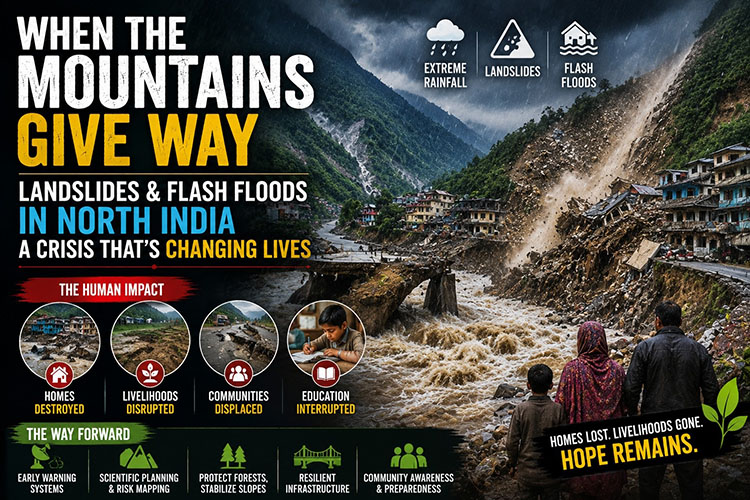
Collapsed roads. Entire hillsides sliding into valleys. Villages buried under debris. Raging rivers sweeping away homes within minutes. The disasters unfolding across northern India are no longer isolated tragedies. States such as Himachal Pradesh, Uttarakhand, Jammu & Kashmir and Sikkim have witnessed an increasing number of landslides and flash floods, often triggered by intense rainfall. While extreme weather has always been part of mountain ecosystems, scientists warn that climate change and human activities are making these disasters more frequent and more destructive.
Behind every collapsed bridge and damaged highway lies a story that rarely receives enough attention, the lives of the people who call these mountains home.
When Rain Falls Too Fast
Unlike ordinary floods that develop gradually, flash floods occur with little warning. They are caused by extremely intense rainfall over a short period, cloudbursts, sudden releases of water from glacial lakes or rapid runoff on steep mountain slopes. Mountain terrain makes these floods particularly dangerous.
Water gathers speed as it rushes downhill, carrying rocks, mud, uprooted trees and debris along its path. Entire villages can be affected within minutes. Roads disappear. Bridges collapse. Electricity and communication networks are cut off, leaving communities isolated for days. In many recent disasters across Himachal Pradesh and Uttarakhand, families had only a few minutes to escape before floodwaters engulfed their homes.
Why Are Landslides Becoming More Common?
A landslide occurs when soil, rock or debris moves down a slope under the force of gravity. Heavy rainfall is one of the most common natural triggers. When rainwater seeps into mountain slopes, it increases the weight of the soil while reducing the friction that normally holds it together. Eventually, the slope becomes unstable and collapses. Climate change is adding another layer of complexity.
Warmer air can hold more moisture than cooler air. As a result, when weather systems release rainfall, the intensity is often greater than in the past. Scientists have observed an increase in extreme rainfall events across several parts of the Himalayan region, even if total seasonal rainfall does not always increase. More rain falling within a shorter period places enormous stress on already fragile mountain slopes.
Development on Fragile Mountains
Climate change is only part of the story. Human activities have also altered the stability of mountain landscapes. Road construction often involves cutting steep slopes, reducing their natural support. Hydropower projects, tunnelling, quarrying and expanding settlements further disturb geological formations. Large-scale deforestation removes tree roots that naturally bind soil together and reduce erosion.
Scientists do not argue that development should stop. Mountain communities need roads, hospitals, schools and electricity. The challenge is ensuring that development respects the geological limitations of the Himalayas. Unlike the plains, mountain ecosystems respond differently to human intervention. Ignoring these differences can increase disaster risk.
Lives Changed Overnight
Statistics describe the scale of disasters. People reveal their true impact. For mountain families, the loss is rarely limited to property. Fields that supported generations disappear beneath mud. Fruit orchards are washed away. Livestock, often the primary source of income, perish in floods. Schools remain closed for weeks because roads no longer exist.
Children struggle to continue their education. Tourism, which sustains thousands of families in states like Himachal Pradesh and Uttarakhand, suffers immediately after disasters. Hotels remain empty, trekking routes close and local businesses lose their customers. Even after floodwaters recede, rebuilding livelihoods can take years. Some villages become so vulnerable that residents are forced to relocate permanently, leaving behind ancestral homes that can never be replaced.
Rivers Are Changing Too
The rivers flowing through the Himalayas are naturally dynamic. However, extreme rainfall, glacial melt and excessive sediment from landslides are altering their behaviour. Floodwaters now carry larger quantities of rocks and debris, increasing their destructive power. Sediment fills river channels, reducing their capacity to safely carry future floods.
As climate change continues affecting glaciers and rainfall patterns, scientists expect mountain rivers to become even more unpredictable. The challenge is no longer preparing only for seasonal floods. It is preparing for increasingly extreme events.
What Can Science Do?
Disasters cannot always be prevented. Their impacts, however, can often be reduced. One of the most important tools is early warning systems. Weather radars, Doppler radar networks, satellite observations and advanced rainfall forecasting now allow meteorological agencies to identify areas facing high flood risk hours before disaster strikes. Geological monitoring is equally important.
Scientists use satellite imagery, drones, GPS instruments and ground sensors to detect slow movements in unstable slopes before major landslides occur. Hazard mapping helps identify locations where construction should be avoided altogether. Engineering solutions also matter.
Proper drainage systems reduce water accumulation on slopes. Retaining walls, slope stabilisation techniques and bioengineering methods using native vegetation can significantly lower landslide risk when applied appropriately. Nature itself offers some of the best protection. Healthy forests stabilise soil, absorb rainfall and reduce surface runoff. Protecting mountain vegetation is therefore not only a biodiversity issue but also a disaster management strategy.
The Role of Government
The Government of India and state governments have strengthened disaster preparedness through institutions such as the National Disaster Management Authority (NDMA), the India Meteorological Department (IMD) and the Geological Survey of India (GSI). Forecasting systems have improved considerably in recent years, while disaster response has become faster through the coordinated efforts of the National Disaster Response Force (NDRF), armed forces and state agencies.
However, experts continue to emphasise that prevention must receive equal attention. Infrastructure projects in ecologically sensitive mountain regions should be guided by detailed geological assessments rather than engineering feasibility alone. Environmental Impact Assessments need to carefully evaluate slope stability, drainage patterns and cumulative impacts before construction begins. Development must adapt to the mountains, not expect the mountains to adapt to development.
A Lesson From the Himalayas
The recent disasters in northern India are reminders that mountains are living landscapes. They rise, erode and change continuously over time. When intense rainfall meets fragile geology and unplanned development, disasters become more likely. For the families living in these regions, climate change is no longer an abstract scientific concept. It is the road that disappeared overnight.
It is the field buried beneath debris. It is the home that can never be rebuilt in the same place. The Himalayas have always commanded respect. Perhaps the greatest lesson they offer today is that resilience begins with understanding nature rather than attempting to overpower it. As India continues to develop its mountain regions, the challenge is not choosing between progress and conservation. It is ensuring that development works with the landscape, not against it. Because when the mountains give way, they do not distinguish between roads, hotels, homes or hopes. They carry everything downhill together.
