

Ipsa Tripathy
Bhubaneswar: Every morning, millions of people check the weather before stepping outside. Farmers decide when to sow crops, fishermen determine whether it is safe to sail, airlines plan flight routes, and families decide whether to carry an umbrella, all based on a simple weather forecast. But have you ever wondered how meteorologists can predict whether it will rain tomorrow or if a cyclone will make landfall days in advance?
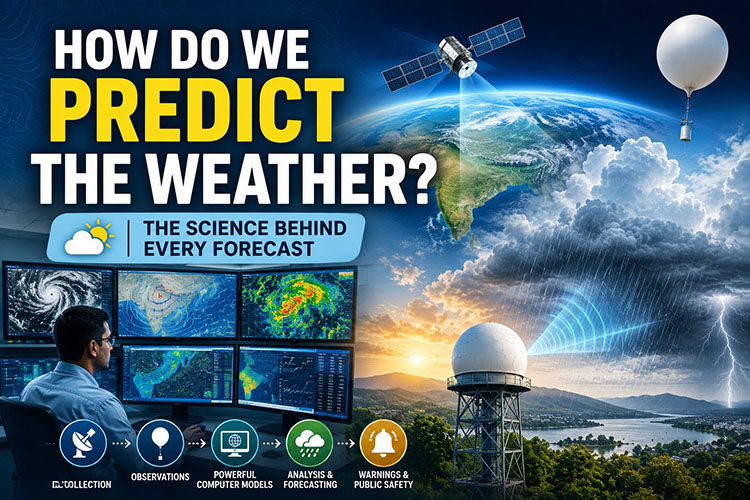
The answer lies in one of the most remarkable achievements of modern science, a combination of satellites orbiting Earth, weather balloons floating high into the atmosphere, powerful computers performing trillions of calculations every second, and scientists working around the clock. Weather prediction is far more than educated guessing. It is a sophisticated process built on physics, mathematics and decades of technological innovation.
It All Begins with Observation
Imagine trying to solve a puzzle without knowing what the pieces look like. Predicting the weather would be impossible without first understanding what the atmosphere is doing at this very moment. Every day, millions of observations are collected from around the world. Weather stations measure temperature, humidity, air pressure, rainfall and wind speed at the Earth’s surface. Ships and ocean buoys record conditions across vast stretches of the oceans, while aircraft provide valuable atmospheric measurements during flights.
One of the most important tools is the weather balloon. Released twice a day in many countries, these balloons rise more than 30 kilometres into the atmosphere carrying instruments called radiosondes. As they ascend, they continuously measure temperature, pressure, humidity and wind at different heights before transmitting the information back to Earth. Together, these observations provide scientists with a detailed snapshot of the atmosphere.
Satellites Watch the Entire Planet
Weather does not respect national borders. Storms forming over oceans can eventually affect countries thousands of kilometres away. This is why satellites have become indispensable. Orbiting hundreds to thousands of kilometres above Earth, weather satellites continuously observe cloud movements, sea surface temperatures, atmospheric moisture and even the development of tropical cyclones.
Unlike ground stations, satellites can monitor remote oceans, deserts and polar regions where direct observations are difficult. The familiar satellite images shown during television weather reports are only a small part of the information these spacecraft collect. Modern satellites can even estimate rainfall intensity, detect lightning activity and monitor dust storms, wildfires and volcanic ash clouds.
Feeding the Data into Supercomputers
Collecting weather data is only the first step. Every observation from satellites, weather stations, aircraft, ships and balloons is transmitted to meteorological centres around the world. These centres operate some of the most powerful supercomputers ever built. The atmosphere is governed by the laws of physics. Air moves because of differences in temperature and pressure. Water evaporates, condenses into clouds and falls as rain. The Earth’s rotation influences wind direction, while mountains, forests and oceans modify local weather.
Scientists describe these processes using mathematical equations. The supercomputer divides the atmosphere into millions of tiny three-dimensional blocks. For each block, it calculates how temperature, pressure, humidity and wind will change over the coming minutes, hours and days. The result is a numerical weather prediction, a detailed simulation of Earth’s future atmosphere.
Why Forecasts Sometimes Change
Have you ever noticed that yesterday’s prediction for the weekend differs from today’s? This happens because the atmosphere is an extremely complex and dynamic system. Even a tiny error in the initial measurements can grow over time, making long-range predictions increasingly uncertain. This phenomenon is popularly known as the “butterfly effect,” where small atmospheric changes can eventually influence large weather systems.
To account for this uncertainty, meteorologists often run the same forecast model multiple times with slightly different starting conditions. If most simulations produce similar results, confidence in the forecast increases. If they differ significantly, forecasters know that the weather remains uncertain. This approach is known as ensemble forecasting and has greatly improved modern weather prediction.
Humans Still Play an Important Role
Although computers perform most of the calculations, weather forecasting is not entirely automated. Experienced meteorologists carefully examine computer-generated forecasts before issuing public advisories. They compare results from different weather models, study satellite imagery, radar observations and local weather conditions, and use their expertise to identify situations where computer models may struggle.
For example, predicting thunderstorms over a single city or the exact path of a cyclone often requires human judgement alongside computer guidance. Weather forecasting remains a partnership between technology and experience.
Radar Helps Track Rain in Real Time
If satellites observe weather from space, weather radar watches it much closer to home. Radar systems send pulses of radio waves into the atmosphere. When these waves strike raindrops, hail or snow, part of the signal returns to the radar. By analysing these returning signals, meteorologists can determine where rain is falling, how intense it is and in which direction storms are moving. This allows authorities to issue timely warnings for heavy rainfall, thunderstorms and flash floods, often hours before the worst weather arrives.
Why Some Forecasts Are More Accurate Than Others
Weather forecasts are generally most reliable for the next one to three days. Predictions remain useful for up to a week, but uncertainty increases with time because the atmosphere is constantly changing. Forecasting tomorrow’s weather is much easier than predicting conditions two weeks from now.
In contrast, climate predictions are different. Climate scientists do not predict the exact weather on a specific day years into the future. Instead, they study long-term patterns such as rising temperatures, changing rainfall and increasing frequencies of extreme weather events. Weather describes what happens today; climate describes what happens over decades.
Artificial Intelligence Is Changing Forecasting
A new generation of forecasting tools is emerging through artificial intelligence (AI). AI systems can analyse enormous volumes of historical weather data and recognise complex patterns much faster than traditional methods. When combined with satellite observations and physics-based models, AI is helping improve rainfall predictions, cyclone tracking and severe weather warnings.
However, AI does not replace conventional forecasting. Instead, it complements existing models, allowing meteorologists to deliver faster and often more accurate forecasts. The future of weather prediction will likely combine the strengths of physics, advanced computing and machine learning.
Reading the Sky, Protecting Lives
Weather forecasting is one of humanity’s greatest scientific achievements. Every forecast represents the combined efforts of satellites orbiting the planet, weather balloons rising into the stratosphere, radar systems scanning the skies, thousands of observation stations and supercomputers solving millions of mathematical equations every second.
These forecasts do far more than tell us whether to carry an umbrella. They help farmers protect crops, pilots avoid dangerous storms, ships navigate safely, emergency responders prepare for disasters and governments save countless lives through timely warnings. The next time you check the weather on your phone, remember that behind those few simple icons lies one of the most complex scientific systems ever created, working continuously to understand the ever-changing atmosphere above us.
