

Ipsa Tripathy
Bhubaneswar: For many people, the monsoon is a season of renewal. It brings green fields, fills rivers and replenishes reservoirs. But in Assam, the monsoon has once again become a season of fear. Across large parts of the state, swollen rivers have entered villages, submerged roads, destroyed homes and forced thousands of families to leave behind everything they owned. What began as heavy rainfall has developed into yet another humanitarian crisis, reminding the country that Assam continues to live with one of the most persistent flood challenges in India.
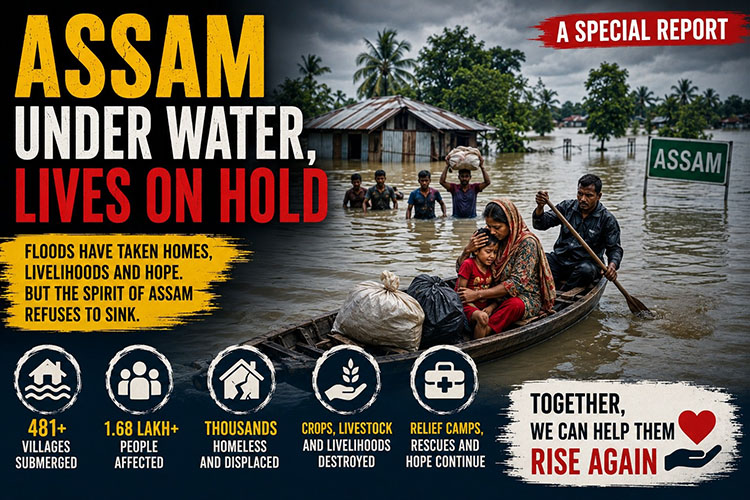
This year’s floods have already claimed dozens of lives, affected more than 1.68 lakh people, submerged 481 villages across multiple districts and left communities struggling to rebuild even before the waters have fully receded.
A Home Can Be Rebuilt. A Season Cannot.
Walking through flood-hit villages, one quickly realises that the greatest loss is not always visible. Walls may collapse and roads may disappear beneath muddy water, but the deeper damage lies in the uncertainty people now face.
For farmers, an entire season’s investment has vanished beneath floodwaters. Rice fields that promised a good harvest now resemble shallow lakes. Livestock have either perished or been moved to overcrowded relief shelters. Fishing communities have seen their boats damaged or rendered unusable by powerful currents. For daily wage labourers, every flooded road means another day without income. Floods steal more than property. They steal opportunity.
Entire Communities Waiting for Relief
Relief camps across Assam are sheltering thousands who had little time to gather their belongings before evacuating. Children sleep on temporary bedding inside schools and community halls. Elderly people worry about medicines that were left behind. Mothers struggle to maintain normal routines while ensuring food and drinking water remain available for their families.
Although rescue teams, volunteers and disaster response forces have worked tirelessly to evacuate vulnerable residents, the emotional burden of displacement cannot easily be measured. Many families do not know when or whether they will return home. Government agencies continue distributing food, drinking water and essential supplies while preparing for rehabilitation in the affected districts.
Why Assam Floods Every Year
Flooding is not new to Assam. The state lies within the vast Brahmaputra River basin, one of the largest and most dynamic river systems in the world. Every monsoon, heavy rainfall over Assam, Arunachal Pradesh and neighbouring Himalayan catchments causes enormous volumes of water to flow downstream. Numerous tributaries including the Subansiri, Dikhou, Dhansiri and Kopili join the Brahmaputra, further increasing water levels.
This year, experts point to unusually heavy rainfall across upstream catchments as the primary reason behind the rapid rise in river levels, rather than sudden releases from dams. At the same time, erosion, sediment deposition and changing river channels reduce the capacity of rivers to safely carry floodwaters. When intense rainfall continues for several days, even embankments and drainage systems struggle to cope.
Flood statistics rarely tell the full story. Every flooded home represents years of savings. Every damaged school interrupts children’s education. Every washed-away road isolates entire communities from hospitals, markets and emergency services. For families living in low-lying areas, flood recovery often begins with cleaning thick layers of mud from homes, repairing damaged wells and replacing household essentials that cannot be recovered. Many lose important documents, farming equipment and stored food grains. The economic burden continues long after television cameras leave.
The floods are not affecting only people. Assam’s internationally important wetlands and wildlife habitats are under immense pressure during severe flooding. Wild animals are often forced to leave protected forests in search of higher ground, increasing the risk of road accidents and human-wildlife conflict. Floodwaters also alter fish habitats, transport enormous quantities of sediment and reshape riverbanks. Although seasonal flooding has long been part of the Brahmaputra’s natural cycle, increasingly intense flood events create additional challenges for both biodiversity and conservation management.
Climate Change Is Making Flood Management More Difficult
Scientists are careful not to attribute any single flood entirely to climate change. However, there is growing evidence that a warming atmosphere can hold more moisture, increasing the likelihood of intense rainfall events. When such rainfall occurs over already saturated river basins, the risk of severe flooding rises substantially.
For Assam, where rivers already carry enormous volumes of water each monsoon, this means disaster management must increasingly account for more frequent weather extremes. Early warning systems, improved forecasting and better river basin management are becoming essential rather than optional.
Recovery Will Take Longer Than the Flood
Although water levels have begun to recede in some districts, recovery is only beginning. Damaged roads must be repaired. Schools need cleaning before classes resume. Farmers must assess crop losses and decide whether replanting is possible. Families will spend months rebuilding homes, replacing household belongings and restoring livelihoods. The state government has begun rehabilitation planning and is strengthening digital flood damage assessments to improve relief distribution and recovery planning. Yet for many families, recovery is measured not in weeks but in seasons.
Assam has demonstrated remarkable resilience through repeated floods. Communities continue helping neighbours, volunteers distribute essential supplies and disaster response teams work under extremely challenging conditions. But resilience alone cannot become the long-term strategy.
Experts increasingly emphasise integrated river basin management, improved floodplain planning, restoration of wetlands that naturally absorb excess water, stronger embankments where appropriate, better forecasting systems and climate-resilient infrastructure. Floods cannot always be prevented. Their impacts, however, can be reduced through scientific planning and sustained investment.
A State Waiting for Dry Ground
Today, thousands of families across Assam are waiting for something many people take for granted a chance to return home. For them, the flood is not simply a natural disaster. It is a disruption of everyday life. It is the child whose books were swept away. It is the farmer staring at fields that no longer promise a harvest. It is the elderly couple wondering whether their home is still standing. As floodwaters slowly retreat, the headlines will eventually fade. But for the people of Assam, rebuilding lives will continue long after the rivers return to their banks. Their struggle is a reminder that behind every flood statistic is a family hoping that the next monsoon will bring rain not ruin.
