

The Emerging Science Behind a New Approach
Ipsa Tripathy
Bhubaneswar: Weather forecasting has always faced a fundamental scientific problem: the atmosphere is chaotic. The equations that describe atmospheric motion are deterministic, but tiny differences in the initial state can grow rapidly with time. This means that even a very small error in measurements of temperature, pressure, humidity or wind can eventually lead to a substantially different forecast. This sensitivity, famously demonstrated through Edward Lorenz’s work on atmospheric chaos, places a natural limit on how far ahead precise weather can be predicted.
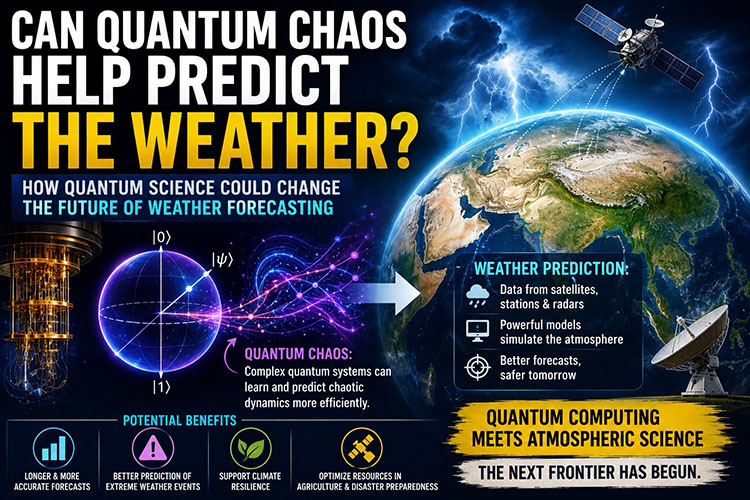
Now, researchers are asking whether quantum computing and quantum machine learning can provide new ways of dealing with this problem. The connection between quantum chaos and weather prediction is still an emerging field. It does not mean that quantum computers can currently replace the supercomputers used by meteorological agencies. Instead, researchers are investigating whether quantum systems can learn and reproduce the complex dynamics of chaotic systems more efficiently.
Why Weather Is a Chaotic Problem
Modern numerical weather prediction uses mathematical equations describing atmospheric physics. These equations are solved repeatedly on powerful computers using observations collected from satellites, weather stations, aircraft, ocean instruments and radar systems. The difficulty is that the atmosphere contains enormous numbers of interacting variables and operates across many spatial and temporal scales.
A small uncertainty in the initial atmospheric state can grow as the forecast progresses. This is why weather forecasts become less certain further into the future. Scientists therefore do not simply ask, “What will the weather be?” They also need to estimate the uncertainty surrounding the prediction. This is where the study of chaotic dynamical systems becomes particularly important.
Where Quantum Science Enters
Quantum computing uses physical systems governed by quantum mechanics to process information. Quantum systems can exhibit phenomena such as superposition and entanglement, producing complex dynamical behaviour that researchers can exploit computationally. One approach attracting attention is quantum reservoir computing (QRC).
Reservoir computing is a machine-learning method designed particularly for temporal and dynamical problems. Instead of repeatedly adjusting a large neural network, a complex dynamical system, the reservoir is used to transform incoming information into a high-dimensional representation. A relatively simple readout layer is then trained to make predictions.
Researchers are now investigating whether quantum systems can act as these reservoirs. The idea is particularly relevant to chaotic systems because the reservoir itself provides rich nonlinear dynamics that can be used to learn patterns in time-dependent data.
From Chaotic Models to Weather
Scientists do not begin by putting an entire atmosphere into a quantum computer. They first test quantum methods on simplified mathematical models of chaos. The Lorenz-63 system, derived from Lorenz’s early atmospheric work, is one such benchmark. Another is Lorenz-96, a higher-dimensional model widely used as a simplified representation of atmospheric dynamics and as a testbed for forecasting and data assimilation.
Recent research has demonstrated quantum methods for predicting chaotic dynamics and extreme events. A 2024 Physical Review Research study developed a recurrence-free quantum reservoir computing approach and tested it on low- and higher-dimensional chaotic systems as well as a model involving extreme turbulent events. The researchers reported longer predictability for an extreme-event forecasting task compared with their classical reservoir benchmark. These are controlled scientific experiments, not operational weather forecasts. Their importance lies in demonstrating that quantum systems can be investigated as computational tools for nonlinear and chaotic dynamics.
A Direct Step Towards Weather Prediction
The field moved closer to practical weather applications in 2026. A study published in Scientific Reports investigated a hybrid quantum-classical approach to four-dimensional variational data assimilation (4D-Var) using Lorenz-63 and Lorenz-96 models. Data assimilation is a central component of numerical weather prediction because it combines observations with a model to estimate the atmosphere’s current state. The study compared its hybrid quantum-classical approach with classical optimisation and several machine-learning methods. The experiments were performed using quantum simulation rather than a large-scale operational quantum computer.
Another 2026 study, published in Physical Review Letters, reported an experimental quantum reservoir based on correlated quantum spins. The researchers used a nine-spin quantum reservoir for temporal prediction and reported higher accuracy than classical reservoirs with thousands of nodes on their tested long-term weather-forecasting task. This is an important experimental result, but it should be interpreted carefully. It does not demonstrate that quantum computers now outperform the sophisticated numerical weather-prediction systems used by meteorological centres.
The Major Scientific Challenge
There is a fundamental difficulty in applying quantum computing to weather: weather prediction is a big-data problem. A real forecasting system must process enormous quantities of observations and produce information about a very large number of atmospheric variables. Quantum computers, meanwhile, do not automatically provide a faster solution simply because they use qubits.
Researchers must account for the cost of loading classical data into quantum systems, extracting useful information from quantum states, hardware noise and the limited capabilities of current quantum processors. A 2023 review in the Bulletin of the American Meteorological Society concluded that quantum computers are unlikely to completely replace classical computers for numerical weather prediction. Instead, the authors suggested that quantum processors could potentially perform specialised tasks within larger classical weather and climate models if suitable algorithms and hardware advantages can eventually be demonstrated.
Could Quantum Chaos Improve Extreme-Weather Prediction?
One particularly interesting possibility concerns extreme events. Chaotic systems can generate rare, large-amplitude events that are difficult to predict. Such behaviour is relevant to many physical systems, although a laboratory chaotic model should not be treated as a direct model of a cyclone, flood or heatwave.
Quantum reservoir computing is being investigated because quantum dynamics can provide nonlinear transformations in relatively compact systems. Research published in 2024 demonstrated quantum reservoir methods for predicting chaotic dynamics and extreme events in controlled models. Whether these advantages can translate to realistic atmospheric forecasting remains an open scientific question.
The Future Is More Likely to Be Hybrid
The most realistic near-term possibility is therefore not a completely quantum weather forecast. It is a hybrid system. Classical supercomputers would continue performing the large-scale numerical simulations and handling enormous observational datasets, while quantum processors could potentially be used for specialised optimisation, machine learning, data assimilation or nonlinear-dynamics tasks. This approach is consistent with the broader direction of quantum computing research: finding specific problems where quantum hardware can provide a measurable advantage rather than assuming that every computational task will become faster.
A New Frontier in Weather Science
The relationship between quantum chaos and weather prediction is still young, but it rests on a genuine scientific connection. The atmosphere is chaotic. Quantum systems can exhibit complex dynamics. Quantum machine-learning methods can be trained on temporal data. Researchers have already tested these ideas on chaotic mathematical models, data-assimilation problems and, more recently, experimental weather-forecasting tasks.
But the central question remains unanswered: Can quantum computing provide a practical advantage for real-world weather prediction? Science does not yet have that answer. What exists today is something more valuable at this stage: experimental evidence that quantum systems can be used to study and predict certain complex dynamical processes, together with a growing body of research exploring how those methods might eventually contribute to meteorology.
The next breakthrough may therefore not come from replacing today’s weather models, but from combining classical atmospheric science with a fundamentally different way of processing information. For a field where small uncertainties can grow into major forecasting errors, that possibility is worth investigating.
