

Ipsa Tripathy
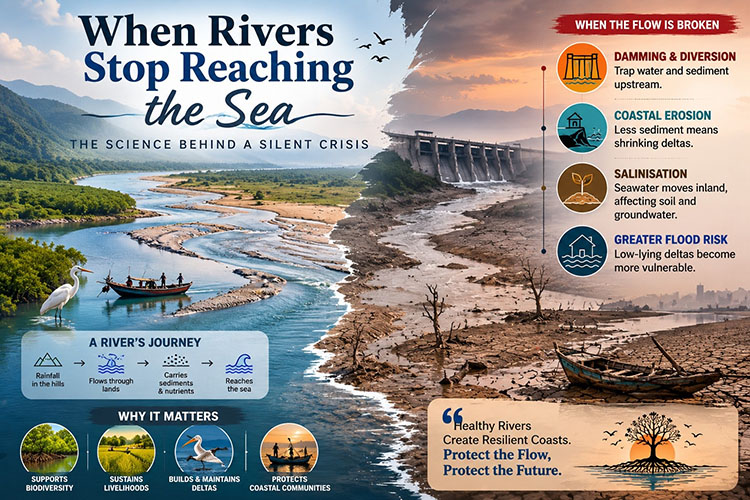
Bhubaneswar: A river does not end when it disappears into the sea. At its mouth, it performs another important function: it delivers freshwater, nutrients and sediment from the land to the coastal environment. For thousands of years, this continuous movement has helped build and maintain river deltas, wetlands and coastal ecosystems. But when river flow is substantially reduced before reaching the coast, or when much of its sediment is trapped upstream, the consequences can extend far beyond the river channel. This is becoming an important scientific and environmental concern in many parts of the world.
A River Carries More Than Water
Rivers transport material from their drainage basins towards the ocean. Along with dissolved substances, they carry enormous quantities of suspended sediment particles of clay, silt and sand produced through weathering and erosion. When a river reaches the coast, its flow slows and some of this sediment is deposited. Over long periods, these deposits contribute to the formation and maintenance of deltas.
A delta is therefore not simply land at the mouth of a river. It is a dynamic system in which river discharge, sediment supply, waves, tides, sea-level changes and coastal processes continuously interact. Regular sediment delivery is particularly important because it helps deltas maintain their elevation relative to rising sea levels. Reduced sediment supply can increase the vulnerability of delta regions to erosion, flooding and salinisation.
What Happens When Dams Interrupt the Flow?
Dams and reservoirs have transformed the natural flow of many major rivers. They store water for purposes such as irrigation, drinking-water supply and hydropower. At the same time, reservoirs can trap substantial amounts of sediment that would otherwise continue downstream. Research across major Asian rivers has found a relationship between the development of large dams and declining sediment delivery to the ocean. Sediment trapped behind reservoirs can therefore reduce the material available to downstream floodplains, estuaries and deltas.
This does not mean that every dam automatically causes a delta to shrink. Delta behaviour depends on several factors, including sediment supply from tributaries, coastal waves and tides, subsidence, sea-level change and human activities. But a sustained reduction in sediment supply can weaken the natural ability of a delta to maintain itself.
The Mahanadi provides a useful example of the relationship between river flow, sediment and the coast. The river flows through Chhattisgarh and Odisha before entering the Bay of Bengal. It is one of India’s major peninsular rivers in terms of water and sediment discharge. A long-term study of the Mahanadi basin examined data from 1980 to 2010 and found that sediment delivery to the ocean declined at approximately 0.515 million tonnes per year during that period. The researchers did not find a comparable significant decline in basin water discharge and attributed the reduction in sediment discharge mainly to human activities, particularly the increase in the number of dams.
Earlier research estimated that the Mahanadi transported approximately 15.74 million tonnes of sediment annually to the Bay of Bengal, with more than 95% of the annual sediment discharge occurring during the monsoon season. These findings demonstrate why the river’s role cannot be measured only by how much water reaches the sea.
The sediment matters too.
Why Sediment Is Important to the Coast
A delta is constantly being reshaped. Waves and coastal currents remove sediment, while the river supplies new material. When these processes remain relatively balanced, the delta can maintain its form. When sediment supply declines, coastal processes can gain greater influence. A global assessment of 54 deltas found that 42 had experienced reductions in fluvial sediment supply compared with earlier periods. Twenty-nine of the 54 deltas showed overall erosion during the study period. The researchers found a clear relationship between reduced sediment supply and delta shoreline behaviour, although the response varied considerably between individual deltas.
This variation is important. It means that declining river sediment does not produce the same outcome everywhere. Some deltas can compensate through other sediment sources or changes in their channels and wetlands. Others become increasingly vulnerable.
Less Sediment Can Mean More Coastal Vulnerability
When a delta receives insufficient sediment to maintain its elevation, several pressures can become more significant. Coastal erosion can remove land from the shoreline. Sea-level rise can increase the relative elevation difference between the sea and the delta surface. Salinisation can occur when seawater penetrates further into coastal soils, rivers and groundwater. Flooding can become more damaging when low-lying delta landscapes lose elevation relative to surrounding water levels.
These processes do not necessarily occur because a river has completely stopped reaching the sea. Even partial changes in water and sediment delivery can alter the balance of a delta over long periods. Scientists studying global deltas have therefore increasingly focused on the concept of resilience the ability of a delta to absorb environmental pressures while maintaining its essential structure and functions.
The Ecological Consequences
River mouths and deltas support complex ecosystems. Freshwater entering the sea influences salinity, nutrient availability and coastal productivity. Sediment transported by rivers also contributes material to floodplains, mudflats and coastal wetlands. Changes in river discharge can therefore affect estuarine and coastal habitats. For communities, the consequences can also be significant. Deltas are often densely populated and support agriculture, fisheries, transport and settlements. Their exposure to flooding and coastal erosion means that changes in river behaviour can eventually become social and economic concerns.
Climate Change Adds Another Pressure
Human alteration of rivers is only one part of the problem. Climate change is affecting the conditions under which deltas exist. Rising sea levels, changes in rainfall and extreme events can alter river discharge and coastal processes. A scientific review published in Nature Reviews Earth & Environment found that river deltas can undergo rapid changes when climate and land-use pressures interact. Some delta systems may experience shifts in channel behaviour, estuarine conditions and coastal wetlands when critical thresholds are approached. This makes river management increasingly complex. A decision taken hundreds of kilometres upstream can influence environmental conditions at the coast.
Keeping the Connection Alive
The solution is not to stop using rivers for human needs. Water is essential for agriculture, cities, industry and energy. The challenge is to manage river systems while recognising that their natural functions extend all the way to the sea. Better monitoring of environmental flows and sediment transport can help scientists understand how individual rivers are changing. Reservoir and basin management can be designed with downstream ecological requirements in mind, while restoration of wetlands and floodplains can strengthen natural resilience where appropriate.
For Odisha, understanding the Mahanadi as a complete river system from its upper catchment to the Bay of Bengal is particularly important. A river is not simply a source of water to be divided among competing uses. It is a connected system. When its water and sediment reach the sea, they continue shaping landscapes, ecosystems and human livelihoods. When that connection is significantly disrupted, the effects may take years or decades to become visible. By then, restoring the original balance can be considerably more difficult.
