

Ipsa Tripathy
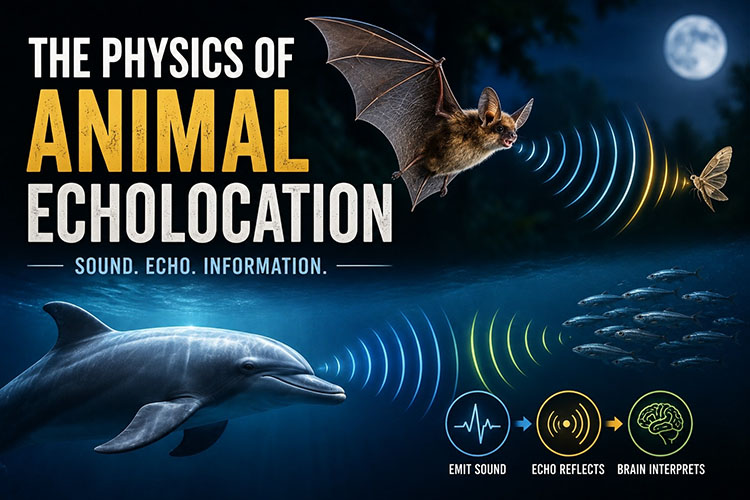
Bhubaneswar: In complete darkness, vision becomes of limited use. Yet many animals can still move through complex environments, locate prey and avoid obstacles with remarkable accuracy. They achieve this using echolocation, a biological sensing system based on sound.
Echolocation is best known in bats and toothed whales, including dolphins. More than 1,100 bat species and more than 70 species of toothed whales are known to use echolocation. Some other animals, including certain birds and small mammals, also use simpler forms of echolocation. At its simplest, echolocation involves three steps:
Sound production → echo reflection → interpretation of the returning sound
The physics behind this process is closely related to the principles used in human-made sonar systems.
Sound as a Biological Sensor
Sound is a mechanical wave. It travels through a medium by producing changes in pressure and particle motion. When a sound wave encounters an object, part of its energy can be reflected back toward its source. An echolocating animal deliberately produces a sound and listens for these reflections. The returning echo contains information about the object that produced it.
The animal’s nervous system processes characteristics such as the time delay, frequency, intensity and direction of the echo. Together, these signals provide information about the surrounding environment. This is fundamentally different from passive hearing. The animal is not merely listening to sounds already present in the environment. It is actively generating a signal and analysing the response.
How Distance Is Measured
One of the most important pieces of information in an echo is the time between producing the sound and receiving its reflection. Sound travels at a finite speed. If an echo returns quickly, the reflecting object is relatively close. If it takes longer, the object is farther away.
The basic relationship is:
Distance = (speed of sound × echo delay) / 2
The division by two is necessary because the sound travels from the animal to the object and then back again. Bats can use extremely small differences in echo timing to estimate the distance of objects. Their auditory systems contain neurons that respond selectively to particular delays between emitted sounds and returning echoes, helping represent target range.
Many echolocating animals produce sounds above the upper limit of normal human hearing, approximately 20 kilohertz (kHz). These sounds are called ultrasound. The use of high frequencies has an important physical advantage: shorter wavelengths can interact effectively with relatively small objects. This is particularly useful for bats hunting insects. Many insectivorous bats produce calls with dominant frequencies between approximately 20 and 60 kHz, although echolocation frequencies vary considerably among species. Some bat calls extend above 100 kHz. Higher frequencies, however, have a disadvantage. Sound is absorbed by air more strongly at higher frequencies, reducing its effective range. Bats therefore operate within a balance between resolution and transmission distance.
Direction Matters Too
Knowing how far away an object is is not enough. An animal also needs to know where the object is located. Bats produce highly directional sound beams, concentrating more acoustic energy in particular directions. Their ears receive the returning echoes, and differences in the sounds reaching the two ears provide information about the horizontal position of an object. The external structure of a bat’s ears also modifies incoming sounds. This provides spectral information that can help the animal determine the elevation of a target. The result is a form of three-dimensional acoustic perception.
Some bats use another important physical phenomenon: the Doppler effect. When a sound source and a reflecting object move relative to one another, the frequency of the returning sound changes. This frequency shift provides information about relative motion. Certain bats that use constant-frequency signals can detect these Doppler shifts very precisely. Some compensate for the frequency shift caused by their own flight so that returning echoes remain within the frequency range where their hearing is most sensitive. This allows them to extract information from moving targets, including the characteristic acoustic changes produced by the movement of insect wings.
Bats and Dolphins Use Different Acoustic Environments
The basic principle is similar in bats and toothed whales, but the physical environments are very different. Sound travels approximately 4.4 times faster in water than in air. Water also has different acoustic properties, including different attenuation and scattering characteristics. These differences influence the frequencies, signal structures and strategies used by aquatic echolocators.
Toothed whales, including dolphins, produce powerful high-frequency clicks. Unlike bats, which receive echoes through their ears, toothed whales receive sound through structures associated with the lower jaw and transmit sound through specialised tissues in the head. biosonar allows them to detect and track objects in underwater environments where visibility can be severely limited.
The Echo Is Not a Simple Copy of the Original Sound
When sound strikes an object, the returning echo depends on several factors.
These include:
- The size and shape of the object
- Its material and acoustic properties
- The angle at which the sound strikes it
- The frequency of the emitted sound
- The distance between the animal and the object
- Properties of the surrounding medium
Consequently, an echo contains much more information than simply “something is there.” Different parts of an object can reflect sound differently. A complex target can therefore produce variations in the returning signal that help an animal distinguish one object from another.
Echolocation Is an Active and Flexible Process
Animals do not always produce identical calls. Bats can change the frequency, duration, intensity and timing of their calls depending on what they are doing. During an insect chase, for example, they increase the rate of their calls as they approach the target. Both bats and toothed whales can modify their signals as they move closer to prey. This makes echolocation an active feedback system:
Call → echo → neural processing → movement or new call → new echo
The animal continuously updates its information as it moves through its environment.
Echolocation is highly effective, but it is not unlimited. Sound weakens as it travels. High-frequency sound can be absorbed particularly strongly in air. Background noise can interfere with returning echoes, while vegetation, surfaces and other objects can produce acoustic clutter that makes target detection more difficult. Animals have evolved behavioural and sensory adaptations to deal with these limitations. They can alter their signal characteristics, adjust their direction of emission and change the timing of calls according to the environment.
From Animal Biology to Human Technology
The principles discovered through studying animal echolocation have influenced the development and understanding of artificial sonar and other sensing technologies. Both biological and engineered sonar systems depend on the same fundamental physical ideas: sound propagation, reflection, time delay, frequency, intensity and Doppler shift. Research on animal echolocation has also helped scientists understand how biological nervous systems process complex acoustic information.
Echolocation therefore represents an elegant combination of physics and biology. An animal generates sound, waits for a tiny fraction of that sound to return, and extracts information about the world from the returning signal. For bats flying through darkness and dolphins moving through turbid water, sound effectively becomes a means of seeing. The underlying principle is simple, but the biological system built around it is extraordinarily sophisticated: the physics of a reflected sound wave becomes information about distance, direction, movement and the structure of the surrounding world.
