

Ipsa Tripathy
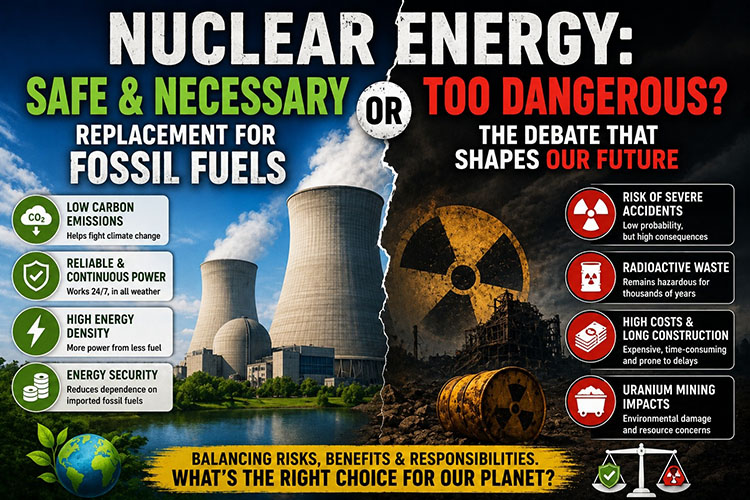
Bhubaneswar: As countries attempt to reduce their dependence on coal, oil and natural gas, nuclear energy has returned to the centre of the energy debate. Nuclear power produces electricity without burning fossil fuels, operates continuously and can generate large amounts of electricity from a relatively small quantity of fuel. At the same time, nuclear accidents, radioactive waste and the potential consequences of failures raise legitimate concerns about its safety.
The question is therefore not simply whether nuclear energy is dangerous or safe. The more useful question is whether its benefits in reducing fossil-fuel dependence outweigh the risks associated with nuclear technology. Nuclear power plants generate electricity through nuclear fission. In a conventional reactor, atoms of uranium are split, releasing energy in the form of heat. That heat produces steam, which drives turbines connected to electricity generators. Unlike coal- and gas-fired plants, the reactor does not need to burn carbon-containing fuel to produce heat.
This gives nuclear energy an important advantage in the climate debate. The operation of a nuclear power plant produces very low direct carbon dioxide emissions. When the entire life cycle is considered, including uranium mining, construction, operation and decommissioning, nuclear power remains among the low-carbon electricity technologies. The Intergovernmental Panel on Climate Change has reported life-cycle greenhouse-gas emissions from nuclear power that are comparable to those of renewable technologies and substantially lower than those of fossil-fuel electricity.
This matters because replacing fossil fuels is not only about reducing carbon dioxide. Burning coal, oil and gas also releases air pollutants such as particulate matter, sulphur dioxide and nitrogen oxides. These pollutants contribute to respiratory and cardiovascular disease and premature deaths. Nuclear electricity avoids the combustion-related air pollution associated with fossil-fuel power generation.
Another advantage is reliability. Solar and wind power depend on sunlight and weather conditions, while nuclear reactors can operate for long periods at high capacity. Nuclear plants can therefore provide firm electricity generation that complements variable renewable sources. This becomes particularly important as electricity systems increasingly depend on wind and solar power. However, describing nuclear energy as a perfect replacement for fossil fuels would be scientifically inaccurate.
The greatest concern comes from the possibility of a severe nuclear accident. Three events are particularly important in the history of commercial nuclear power: Three Mile Island in the United States in 1979, Chernobyl in the Soviet Union in 1986, and Fukushima Daiichi in Japan in 2011.
These accidents were very different from one another. Chernobyl involved a reactor design with serious safety characteristics and operational failures. Fukushima was triggered by an exceptionally powerful earthquake and tsunami that caused loss of electrical power and cooling capacity. Three Mile Island involved equipment failures, design issues and operator-related factors, but resulted in no detectable increase in cancer mortality among the surrounding population according to major health assessments.
The consequences of severe accidents can nevertheless be substantial. The Chernobyl accident caused acute radiation deaths among workers and emergency responders, and radioactive contamination affected large areas. At Fukushima, the accident resulted in significant radioactive releases and the evacuation of surrounding communities. The long-term health effects of radiation exposure remain an important area of scientific assessment, while the psychological and social consequences of evacuation were also considerable.
These events demonstrate an important characteristic of nuclear power: the probability of a catastrophic accident can be low, but the consequences can be unusually serious.
Modern reactor designs incorporate multiple safety systems intended to prevent accidents from progressing and to maintain cooling even under abnormal conditions. Passive safety systems in some newer designs can use natural physical processes such as gravity and convection rather than relying entirely on pumps or external power. These technologies have developed partly in response to lessons learned from earlier accidents.
The other major issue is radioactive waste.
Nuclear reactors produce radioactive materials that must be isolated from humans and the environment for appropriate periods. Spent nuclear fuel is highly radioactive and generates heat initially, so it is first stored under controlled conditions, commonly in water-filled spent-fuel pools and later, where appropriate, in dry storage systems.
Long-term geological disposal is considered by international scientific and technical organisations to be a viable approach for permanently isolating high-level radioactive waste. The basic principle is to place waste deep underground in stable geological formations using multiple engineered and natural barriers.
The existence of radioactive waste is therefore a genuine environmental responsibility, but it is important to distinguish the existence of a long-term waste-management challenge from the claim that there is no technical solution to it. Several countries have developed or are developing geological repositories, although political, regulatory and social acceptance issues have often made progress slow.
There is also the question of uranium.
Nuclear energy does not eliminate environmental impacts associated with resource extraction. Uranium mining can disturb land and generate waste, and the nuclear fuel cycle requires energy and infrastructure. The environmental performance of nuclear power therefore depends partly on how uranium is extracted and processed and how the entire fuel cycle is managed.
Cost is another serious consideration. Building a nuclear power plant requires large upfront investment, extensive safety systems and lengthy regulatory processes. Some projects have experienced major delays and cost overruns. These financial risks can make new nuclear construction less attractive than alternatives that can be deployed more quickly.
At the same time, nuclear reactors can operate for many decades once constructed. Existing reactors can therefore provide low-carbon electricity over long operating lifetimes. The economic comparison depends on construction costs, financing, electricity demand, plant lifetime, fuel prices and the costs of alternative energy systems.
So, is nuclear energy too dangerous?
The scientific evidence does not support either extreme position. Nuclear power is not risk-free, but neither are fossil fuels or renewable energy technologies. Coal mining causes occupational hazards and air pollution; oil and gas production can cause environmental contamination and methane emissions; large hydropower projects can alter ecosystems and displace communities; and renewable technologies also require mining, land and infrastructure.
The relevant comparison is therefore risk versus risk, rather than nuclear energy versus an imaginary risk-free alternative. If the objective is to reduce fossil-fuel consumption and greenhouse-gas emissions, nuclear energy can provide a substantial amount of low-carbon electricity while reducing dependence on coal and natural gas. Its continuous generation can also complement variable renewable sources.
But nuclear power should not be presented as the only solution. Energy efficiency, renewable electricity, storage, transmission networks, demand management and other low-carbon technologies all have important roles. Different countries will also have different energy requirements, financial capacities, geological conditions and regulatory capabilities.
The strongest argument is therefore for a technology-neutral low-carbon energy strategy in which nuclear power is considered where it can meet rigorous safety, environmental and economic standards. Nuclear energy carries risks that must be managed over generations. Fossil fuels carry risks that are already affecting air quality, ecosystems and the climate. The real question is not whether nuclear power is perfectly safe, it is not. It is whether its risks can be controlled sufficiently to justify its benefits as part of the transition away from fossil fuels.
The evidence suggests that nuclear energy can be a safe and valuable component of a low-carbon electricity system, but it is neither risk-free nor a universal replacement for fossil fuels. Its role should be determined by science, rigorous regulation, economics and the specific needs of each energy system.
