

Ipsa Tripathy
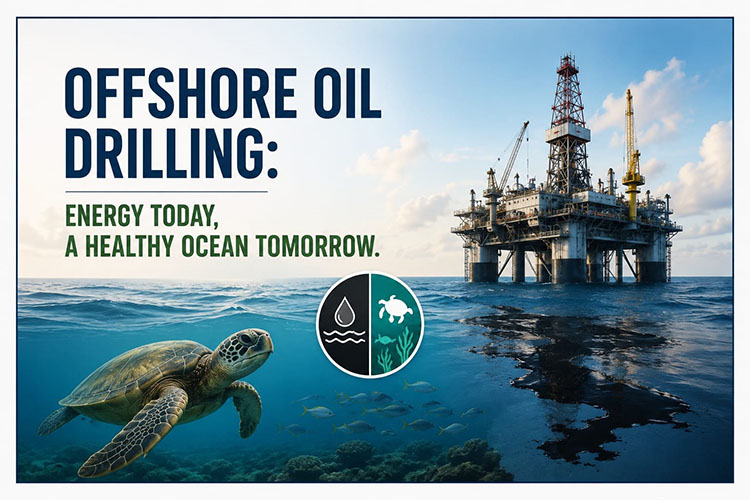
Bhubaneswar: Offshore oil drilling has become an important part of the global energy system. Oil and gas companies extract petroleum from beneath the seabed using platforms, floating production systems and subsea equipment. These operations provide energy and support economic activity, but they also place industrial infrastructure in marine environments that support highly diverse ecosystems.
The environmental question is not simply whether offshore drilling is harmful. Its effects vary with the location, technology used, duration of the operation and the type of ecosystem involved. Understanding these effects is important when considering how offshore oil production should be managed in the future.
What Happens During Offshore Drilling?
Offshore oil extraction involves several stages, including seismic surveys, drilling, production, transportation and eventually decommissioning. Before drilling begins, companies commonly use seismic surveys to investigate geological structures beneath the seabed. Powerful acoustic signals are generated and their reflections are recorded to identify possible oil and gas deposits.
These sounds travel through the ocean and can be considerably louder than naturally occurring underwater sounds. Marine mammals such as whales and dolphins depend heavily on sound for communication, navigation and finding food. Exposure to intense anthropogenic noise can therefore interfere with their behaviour.
The effects vary according to species, distance from the source, duration of exposure and characteristics of the sound. Scientific research has documented behavioural responses of marine mammals to industrial noise, although the consequences differ among species and situations.
The Problem of Underwater Noise
Noise does not stop once drilling begins. Offshore platforms, drilling equipment, vessel traffic and construction activities can continuously add sound to the marine environment. For animals that rely on acoustic communication, this can create acoustic masking. Essentially, human-generated noise can make it more difficult for animals to detect biologically important sounds.
Whales, for example, use sound to communicate across considerable distances. Some species also depend on acoustic information for locating prey and maintaining contact with other individuals. The ecological consequences of chronic noise are still being studied. However, reducing unnecessary underwater noise is widely recognised as an important part of marine conservation.
Oil Spills Remain a Major Risk
Perhaps the most visible environmental danger associated with offshore petroleum production is an oil spill. Large spills can occur following failures involving wells, pipelines, storage systems, ships or other infrastructure. The consequences depend heavily on the quantity and type of oil released, ocean currents, weather and the sensitivity of the affected ecosystem.
Oil can coat seabirds, reducing the insulating and water-repellent properties of their feathers. Birds that ingest oil while cleaning themselves can also suffer internal toxicity. Marine mammals may be exposed through contaminated water, sediments or food. Fish and invertebrates can also be affected, particularly in areas where oil persists in sediments. Oil spills can therefore affect organisms at several levels of a marine food web. Recovery may occur over time, but the duration can vary substantially between ecosystems.
Drilling Produces More Than Oil
Oil extraction also generates other materials that must be managed. Drilling muds and drill cuttings are produced during drilling. Drill cuttings consist of rock fragments brought to the surface, while drilling fluids help control pressure, lubricate the drill bit and transport cuttings. Depending on the regulatory system and the properties of the materials, wastes may be treated and discharged under controlled conditions or transported for further management.
Produced water is another major waste stream. It is naturally present in petroleum reservoirs and is brought to the surface during production. It can contain dissolved salts, hydrocarbons and other substances and therefore requires treatment and regulated disposal. These discharges can affect organisms living close to offshore installations, although the scale and significance of the effects depend on the composition, concentration and discharge conditions.
The environmental effects of offshore platforms are not exclusively negative. Structures placed in the sea can provide hard surfaces where organisms such as mussels, barnacles, corals and other invertebrates attach. Fish may also gather around some offshore structures.
These installations can therefore function as artificial reefs, creating habitat in areas where natural hard surfaces are limited. However, this does not necessarily mean that offshore platforms compensate for their wider environmental impacts. Artificial structures can change local species composition, predator–prey interactions and patterns of movement. They may also facilitate the spread of species into areas where they did not previously occur. Consequently, an artificial reef should not automatically be considered equivalent to a natural marine ecosystem.
Offshore Drilling and Climate Change
There is another environmental dimension that extends beyond the immediate drilling site. Oil is a fossil fuel. When extracted oil is eventually burned, its carbon becomes carbon dioxide in the atmosphere. Carbon dioxide is a major greenhouse gas and contributes to long-term global warming. Offshore production can also be associated with methane emissions and other greenhouse gases, depending on the type of operation and the management of the facilities.
This creates a fundamental challenge. Even if a particular offshore platform operates with strong environmental controls, the fuel it produces contributes to greenhouse-gas emissions when consumed. Climate change itself affects marine ecosystems through ocean warming, sea-level rise, ocean acidification and changes in marine food webs. These pressures can interact with existing environmental stresses.
Does That Mean All Offshore Drilling Should End?
From a scientific perspective, there is no single environmental answer that applies identically to every offshore drilling operation. The ecological risk of drilling in a relatively isolated area with limited biological sensitivity is different from drilling near coral reefs, breeding grounds, migratory routes or other ecologically important habitats.
This is why environmental assessment is important. Before offshore projects are approved, regulators can consider factors such as biodiversity, fisheries, marine-mammal distribution, spill risk, waste management and potential greenhouse-gas emissions. Protected and particularly sensitive marine areas can warrant stronger restrictions or exclusion from drilling. At the same time, reducing environmental damage from existing operations requires effective spill-prevention systems, emergency response plans, monitoring, waste controls and limits on underwater noise.
The Energy Transition Changes the Question
The longer-term issue is the world’s dependence on fossil fuels. Renewable sources such as solar and wind can reduce the need for additional fossil-fuel production, while electricity storage, stronger transmission networks and improved energy efficiency can help integrate variable renewable generation.
However, the transition cannot be achieved simply by shutting down one energy source without developing reliable alternatives. Oil continues to be used not only as a transport fuel but also as a feedstock for petrochemicals, plastics and numerous industrial products. This makes the transition a complex technological and economic process rather than an immediate switch.
The scientific evidence does establish that offshore oil production can create noise pollution, habitat disturbance, waste, contamination risks and greenhouse-gas emissions. It also shows that the severity of these impacts depends greatly on location, operating practices and environmental safeguards. The central environmental challenge is therefore twofold: minimise the ecological damage caused by existing offshore operations while reducing the underlying dependence on fossil fuels.
A future in which marine ecosystems face fewer industrial pressures will ultimately depend not only on how offshore drilling is regulated, but also on how successfully societies develop cleaner sources of energy and reduce the demand for fossil fuels.
