

Ipsa Tripathy
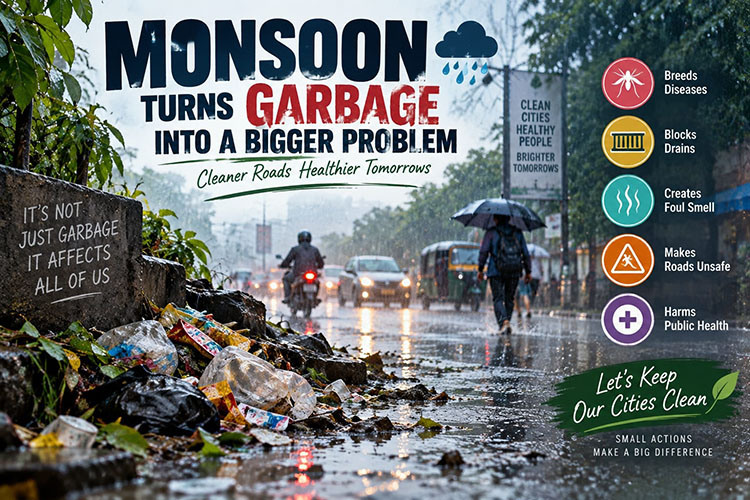
Bhubaneswar: There is something particularly unpleasant about seeing a familiar road after a heavy spell of rain. The rainwater that should have flowed through a clean drainage system instead moves around plastic bags, food waste, discarded bottles, leaves and other rubbish lying along the roadside. Within hours, what was already an ordinary garbage problem can become a much more visible and serious public nuisance. The waste becomes soaked, scattered and mixed with muddy water, while the smell of decomposing organic matter begins to spread through the neighbourhood.
During the rainy season, garbage does not simply look worse. Water changes the way waste behaves. Plastic wrappers, bottles and other lightweight materials can be carried by runoff into drains, ponds, streams and low lying areas. Organic waste becomes wet and decomposes more quickly, producing unpleasant odours and creating conditions that attract flies, rats and other pests. The World Health Organization notes that poor waste collection can block drainage systems, contributing to flooding and standing water, while accumulated waste can create conditions favourable to disease carrying vectors.
The problem becomes particularly visible on urban roads. A garbage pile beside a road may initially appear to be an eyesore, but once rain begins, its contents can spread across the street. A plastic packet may travel several metres. Food waste can mix with stagnant water. Mud can conceal broken glass, metal pieces and other sharp objects. For pedestrians, this creates an uncomfortable and sometimes unsafe journey. People are forced to walk through contaminated water or move closer to traffic to avoid flooded sections of the road.
There is also a less visible problem beneath the surface. Garbage can obstruct stormwater drains. Plastic bags and other solid waste can accumulate at drain openings and restrict the movement of rainwater. When drainage capacity is reduced during intense rainfall, water can remain on roads for longer periods. The connection between waste and flooding is well established: the WHO specifically identifies blocked drains caused by poor waste collection as a factor that can contribute to flooding and standing water.
Standing water creates another chain of problems. Containers, discarded tyres, cans and other objects within garbage piles can collect rainwater and become potential breeding sites for mosquitoes. This is particularly important in places where mosquito borne diseases are already a concern. The WHO has noted that mosquito populations can increase during monsoon and post monsoon periods and recommends eliminating standing water and cleaning up discarded containers and other waste that can hold water.
The health consequences can extend beyond mosquitoes. Waste accumulation attracts flies and rodents, which can come into contact with food and household surroundings. Floodwater and stagnant water may also become contaminated with microorganisms and other pollutants. Depending on local conditions, exposure to contaminated water can increase the risk of gastrointestinal and other infections. Flooding can also increase exposure to rodents and the risk of diseases such as leptospirosis.
For sanitation workers and waste collectors, the situation can be even more difficult. They may have to handle wet, decomposing and mixed waste while working in flooded or slippery surroundings. If sharp objects, sanitary waste, broken glass or other hazardous materials are mixed with ordinary household waste, the risks increase further. Proper segregation at the source therefore matters not only for recycling and waste management but also for the safety of the people who collect and process the waste.
Yet blaming the rainy season alone would miss the real issue. Rain does not create the garbage problem. It exposes how poorly we manage it. A clean street with an efficient collection system can withstand heavy rain far better than a street where waste is routinely left in open piles. The monsoon simply magnifies weaknesses that already exist in everyday waste management.
The first solution is remarkably simple: garbage should not be allowed to accumulate beside roads in the first place. Municipal bodies need more frequent collection before and during periods of heavy rainfall, particularly from markets, residential areas and known dumping points. Waste collection schedules should be adjusted according to rainfall forecasts, while vulnerable drains and road crossings should be inspected and cleaned before major rain events.
Waste segregation at source is equally important. Wet waste should be separated from dry recyclable material, while sanitary waste and other potentially hazardous materials should be handled through appropriate systems. When different types of waste are thrown together, rainwater can turn an otherwise manageable pile into a contaminated mixture that is much harder to collect and process.
Drain maintenance must also become a routine activity rather than an emergency response. Clearing accumulated plastic and other solid waste from drain entrances before the monsoon can prevent blockages. Local authorities can identify locations where flooding repeatedly occurs and examine whether waste accumulation is contributing to the problem. The objective should be prevention rather than repeatedly clearing the same road after every heavy shower.
Citizens have an equally important role. Carrying waste home or placing it in designated collection systems may seem insignificant when viewed individually, but thousands of small decisions determine whether a neighbourhood remains clean. Shops and street food vendors can make a major difference by preventing packaging and food waste from spilling onto roads. Residents can report overflowing bins and illegal dumping instead of simply accepting them as part of urban life.
The rainy season should therefore be seen as a test of a city’s waste management system. If a few hours of rain can turn a roadside garbage pile into a health and drainage problem, the weakness existed long before the clouds arrived. Better collection, segregation, drain maintenance, public participation and timely municipal action can prevent much of this from happening.
A clean road during the monsoon is not merely a matter of appearance. It means fewer blocked drains, less stagnant water, safer movement, better working conditions for sanitation workers and a healthier environment for everyone. Rain will always fall. The question is whether the waste we leave behind has to become part of the problem.
