

Ipsa Tripathy
Bhubaneswar: A river can look clean and still be polluted. Its water may appear clear, yet contain excess nutrients, dissolved chemicals or microorganisms that pose risks to aquatic life and human health. Conversely, a naturally muddy river is not necessarily unhealthy. Sediment can be a normal part of its ecosystem, particularly during the rainy season.
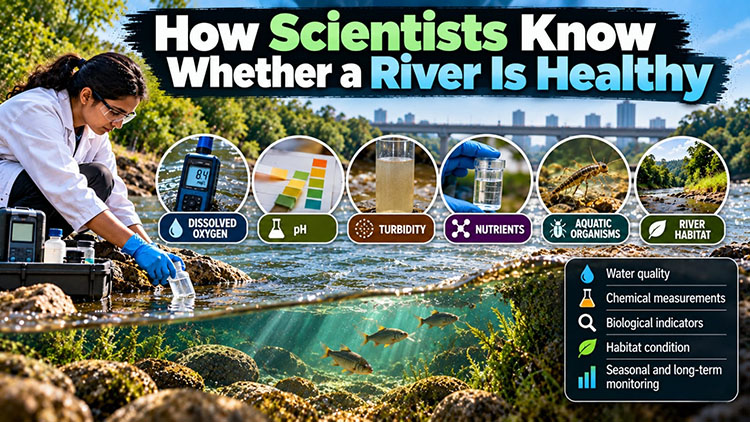
To understand the condition of a river, scientists look beyond its appearance. They examine the water’s physical and chemical properties, study the organisms living in it and assess how the river’s ecosystem functions. Together, these measurements provide a more reliable picture of river health than any single test.
One of the first measurements scientists make is dissolved oxygen. Fish and many other aquatic organisms need oxygen dissolved in water to survive. Its concentration depends on factors such as water temperature, turbulence, photosynthesis and the decomposition of organic matter.
When sewage, food waste or other biodegradable organic material enters a river, microorganisms break it down and consume oxygen in the process. If oxygen consumption exceeds the rate at which oxygen enters the water, dissolved oxygen levels can fall. Severe oxygen depletion can stress or kill aquatic organisms. However, oxygen levels also change naturally throughout the day and between seasons, so scientists interpret readings in their environmental context.
Another important measurement is biochemical oxygen demand, commonly called BOD. It estimates how much dissolved oxygen microorganisms consume while breaking down biodegradable organic matter under specified test conditions. A high BOD can indicate a substantial load of biodegradable material, although the result must be considered alongside other measurements to understand the source and severity of pollution.
Scientists also measure pH, which indicates how acidic or alkaline the water is. Most freshwater organisms function within particular pH ranges, although their tolerance varies by species. Changes in pH can affect aquatic life and influence how certain metals and other substances behave in water. Electrical conductivity is another useful measurement. It indicates how readily water conducts electricity, which depends largely on the dissolved ions it contains. Unusual changes can signal changes in mineral content, salinity or the influence of wastewater and other sources. Neither measurement identifies a specific pollutant on its own.
Water clarity provides another piece of evidence. Scientists measure turbidity, which describes how suspended particles scatter light in water. High turbidity can result from sediment, algae or other suspended material. It can reduce light penetration, affect aquatic plants and interfere with the feeding of some organisms. However, naturally sediment-rich rivers can have high turbidity without necessarily being polluted. Scientists therefore compare measurements with the river’s natural conditions and seasonal patterns.
Nutrients are equally important. Nitrogen and phosphorus support plant and algal growth, but excessive amounts can promote algal blooms. When large quantities of algae die and decompose, microorganisms consume oxygen, potentially reducing its availability for fish and other aquatic organisms. Some algal blooms can also produce toxins. Scientists measure nutrient concentrations and examine algal growth to determine whether these processes may be affecting the river.
Yet even detailed chemical measurements provide only a partial picture. A water sample represents conditions at a particular place and time. Pollution levels may change after rainfall, during dry periods or following a discharge. Some pollutants enter rivers intermittently, meaning a single visit may miss an important event. For this reason, scientists also examine the organisms living in the river. Biological monitoring can reveal the effects of environmental conditions over longer periods.
One widely used approach is to study benthic macroinvertebrates, small animals without backbones that live on or within riverbed sediments. These include insect larvae, snails, worms and small crustaceans. Different species have different tolerances to pollution and habitat disturbance. A diverse community that includes pollution-sensitive organisms can indicate favourable conditions, while a community dominated by a few tolerant groups may suggest environmental stress. However, the interpretation must account for natural differences in river habitats and species distributions.
Fish communities provide additional information. Scientists may examine which species are present, their abundance and the structure of the community. Fish depend on suitable water quality, food, spawning grounds, shelter and routes for movement. A river may have acceptable chemical measurements at one sampling point but still support fewer species if habitat has been damaged or migration is obstructed. Studying organisms alongside water chemistry helps identify problems that a water sample alone might not reveal.
The physical condition of the river matters, too. Scientists assess streambed sediments, bank stability, vegetation along the river and the availability of habitats such as pools, riffles and submerged woody material. These features influence water movement, provide shelter and support feeding and reproduction. Excessive sediment can fill spaces between stones, alter habitat and affect organisms that depend on clean gravel or rocky surfaces. Removing riverside vegetation can also increase erosion and reduce shade.
Ultimately, river health cannot be reduced to one number or one test. Scientists combine physical, chemical and biological evidence, collect samples from different locations and repeat measurements across seasons. They compare the results with suitable standards, reference conditions and earlier observations to understand what has changed. A healthy river is not necessarily clear, odourless or free of sediment. It is a river whose water quality, habitats and biological communities can support the ecological functions expected under its natural conditions. Measuring those features together helps scientists distinguish normal variation from environmental damage and provides a stronger basis for deciding what needs protection or restoration.
