

Ipsa Tripathy
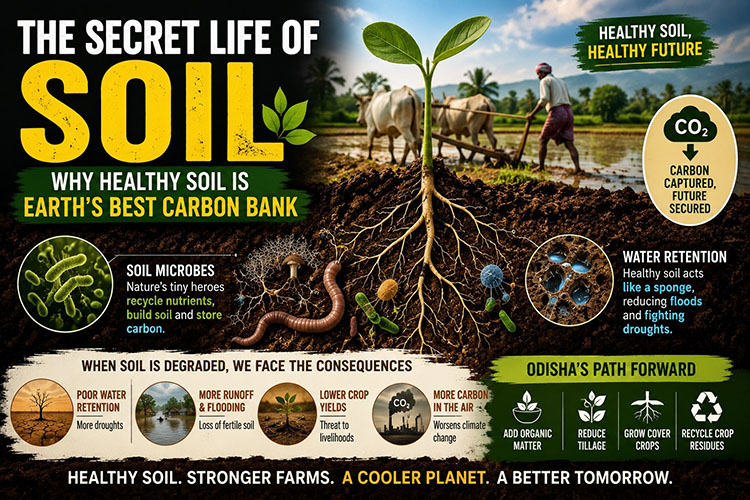
Bhubaneswar: When we think about fighting climate change, towering forests, renewable energy and electric vehicles often come to mind. Rarely do we think about the ground beneath our feet. Yet, hidden within a handful of healthy soil lies an extraordinary world teeming with life. Billions of microorganisms, bacteria, fungi, earthworms and countless other tiny organisms, work tirelessly every day to recycle nutrients, store carbon, support plant growth and regulate water. Together, they perform ecological services worth trillions of dollars each year, quietly sustaining life on Earth.
Healthy soil is far more than dirt. It is one of the planet’s largest natural carbon reservoirs, a living ecosystem that plays a vital role in combating climate change, ensuring food security and protecting communities from floods and droughts. As climate change intensifies and land degradation spreads, understanding the hidden life of soil has never been more important.
A Living World Beneath Our Feet
To the naked eye, soil appears lifeless. In reality, it is one of the most biologically diverse habitats on Earth. Just a teaspoon of fertile soil can contain billions of bacteria, kilometres of fungal filaments, thousands of microscopic organisms and numerous insects that constantly interact with plant roots.
These organisms break down dead leaves, crop residues and other organic matter, converting them into nutrients that plants can absorb. Earthworms improve soil structure by creating channels that allow air and water to move freely, while fungi form partnerships with plant roots, helping crops absorb water and minerals more efficiently.This underground ecosystem operates continuously, quietly supporting every forest, farm and grassland on the planet. Without healthy soil, life above ground would struggle to survive.
Soil: Earth’s Hidden Carbon Bank
Most people associate carbon storage with forests because trees absorb carbon dioxide from the atmosphere during photosynthesis. However, what many do not realise is that soil stores even more carbon than all the world’s vegetation combined and nearly three times more carbon than the atmosphere. Plants capture carbon dioxide from the air and convert it into leaves, stems and roots. When these plant parts die or shed naturally, much of that carbon enters the soil.
Soil microorganisms then transform this organic matter into stable forms of carbon that can remain underground for decades or even centuries. This process, known as carbon sequestration, removes carbon dioxide from the atmosphere and stores it safely in the soil, helping slow global warming. Healthy soil is therefore one of nature’s most effective climate solutions.
Tiny Microbes with a Massive Responsibility
The real heroes of soil are its microscopic inhabitants. Bacteria and fungi act as nature’s recyclers, breaking down organic matter into nutrients while helping build stable soil carbon. Some microbes produce sticky substances that bind soil particles together, creating aggregates that improve soil structure and reduce erosion.
Others form mutually beneficial relationships with plant roots, increasing crop productivity without relying heavily on chemical fertilisers. Scientists estimate that a single gram of healthy soil contains thousands of different microbial species, many of which remain undiscovered. Despite their invisible presence, these organisms influence everything from agricultural productivity to global carbon cycling. Protecting soil microbes means protecting the foundation of healthy ecosystems.
Healthy Soil Holds Water Like a Sponge
One of the greatest strengths of healthy soil is its ability to store water. Organic matter acts like a natural sponge, absorbing rainfall and gradually releasing moisture to plant roots during dry periods. Well-structured soils also allow rainwater to infiltrate deep into the ground, replenishing underground aquifers instead of rapidly flowing away.
This natural storage system benefits both agriculture and communities. During heavy rainfall, healthy soil reduces surface runoff, lowering the risk of flash floods and soil erosion. During droughts, the same stored water helps crops survive for longer periods without rainfall. In this way, healthy soil acts as nature’s own water management system.
When Soil Is Degraded, Everyone Pays the Price
Unfortunately, soils across the world are under increasing pressure. Excessive tillage, deforestation, overgrazing, unplanned urbanisation and the overuse of chemical fertilisers can gradually reduce organic matter and damage soil structure. As soil loses its organic content, it becomes compacted and less capable of absorbing water.
Instead of soaking into the ground, rainwater rushes across the surface, increasing the risk of flooding. Valuable topsoil is washed away, carrying nutrients into rivers and reservoirs. Later, when rainfall decreases, degraded soil dries out quickly because it cannot retain enough moisture. The result is a dangerous cycle where landscapes become more vulnerable to both floods and droughts. The same land that floods rapidly during the monsoon may struggle to support crops just a few months later.
Why This Matters for Odisha
Agriculture remains the backbone of Odisha’s rural economy, supporting millions of farming families. The state cultivates rice, pulses, oilseeds, vegetables and millets across diverse landscapes ranging from fertile river valleys to upland rain-fed farms. However, changing rainfall patterns, increasing temperatures and recurring floods and droughts are placing growing pressure on agricultural productivity.
Healthy soils can help farmers adapt to these challenges. Practices such as adding compost, retaining crop residues, reducing excessive tillage, growing cover crops and adopting integrated nutrient management improve soil organic matter and microbial activity. These methods increase water retention, reduce erosion and make farms more resilient to weather extremes. For a state where agriculture depends heavily on the monsoon, investing in soil health is not merely an agricultural strategy-it is a climate adaptation strategy.
Unlike machines or infrastructure, healthy soil cannot be built overnight. It develops slowly through the interaction of plants, microorganisms, climate and careful land management. Every decision made on a farm whether it involves leaving crop residues, reducing unnecessary ploughing or planting diverse crops, affects the long-term health of the soil.
Governments, researchers and farmers increasingly recognise that restoring soil is among the most cost-effective ways to improve food security while reducing greenhouse gas emissions. The future of sustainable agriculture depends as much on the unseen world below the surface as it does on innovations above it.
The Ground That Sustains Us All
Soil rarely receives the attention given to forests, rivers or wildlife. Yet every meal we eat, every forest that grows and every ecosystem that flourishes begins with healthy soil. It quietly stores carbon, filters water, nourishes crops and supports an astonishing diversity of life, all without asking for recognition.
Perhaps that is why soil has often been called Earth’s silent workforce. As climate change challenges food production and water security across the globe, protecting soil is no longer simply about improving harvests. It is about preserving one of the planet’s greatest natural allies against global warming. The next time you walk across a field after the rain, remember that beneath your feet lies a living world, working every moment to keep our climate stable, our rivers flowing and our future secure.
