

Ipsa Tripathy
Bhubaneswar: For most of human history, darkness was a natural part of the environment. After sunset, the landscape was illuminated mainly by the Moon, stars and occasional natural sources of light. The expansion of electric lighting has changed that environment substantially. Today, artificial light reaches many places that were once naturally dark. The resulting increase in night-time brightness is known as light pollution, or more broadly artificial light at night (ALAN). It is increasingly studied as an environmental pressure because it changes not only what humans can see in the night sky, but also the conditions experienced by nocturnal ecosystems.
What Is Light Pollution?
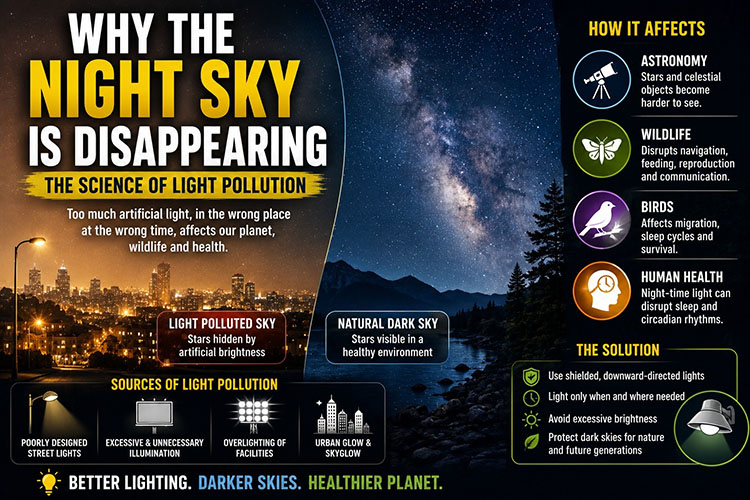
Light pollution is not simply the presence of artificial lighting. Lighting becomes a pollution problem when it is excessive, poorly directed, unnecessarily bright or used at inappropriate times. Scientists generally identify several forms of light pollution. Skyglow is the brightening of the night sky over populated areas. Light trespass occurs when illumination reaches places where it is not required, such as homes or natural habitats. Glare reduces visual comfort and can interfere with the ability to see clearly.
Much of skyglow occurs because artificial light is scattered by molecules and particles in the atmosphere. Light directed upwards or reflected from buildings and roads can therefore brighten large areas beyond the location where the light source is installed.
Why Are the Stars Disappearing?
The problem becomes particularly obvious to astronomers. The night sky has a natural background brightness produced by sources including starlight, airglow and scattered sunlight. Artificial illumination increases this background brightness, reducing the contrast between astronomical objects and the sky. As the sky becomes brighter, faint stars disappear from ordinary view.
This does not mean that the stars themselves are disappearing. They are still present, but their light is increasingly difficult to distinguish from the artificial brightness of the surrounding sky. Astronomical observatories therefore require locations with very low levels of artificial skyglow. Increasing light pollution can make some observations more difficult and can reduce the number of celestial objects visible from the ground.
A Rapidly Changing Night-Time Environment
Artificial light at night has expanded considerably with urbanisation and the widespread adoption of electric lighting. A 2026 meta-analysis notes that artificial light at night has been increasing globally at approximately 2.2% per year, although the rate varies between locations and depends on how lighting is measured.
The introduction of LED lighting has also changed the nature of artificial illumination. LEDs can be highly energy-efficient, but their environmental effect depends on how, where and when they are used. Broad-spectrum white LEDs can contain substantial short-wavelength light, which is particularly relevant to both skyglow and biological responses. Therefore, replacing older lighting with LEDs does not automatically eliminate light pollution.
Darkness is an environmental condition to which organisms have adapted. Many animals are nocturnal or active mainly during twilight. Artificial illumination can interfere with their natural behaviour, movement and biological rhythms. Insects are particularly important in this context. Many moths and other nocturnal insects are attracted to artificial light, a behaviour commonly called flight-to-light. Artificial illumination can alter their movement, feeding and reproduction and may increase their exposure to predators.
A scientific review of artificial light at night found evidence of effects on nocturnal insects involving spatial orientation, attraction, behaviour and recognition. Fireflies are of particular concern because their communication depends on bioluminescent signals that can be obscured by artificial illumination. The consequences can extend beyond individual insects. Since insects form important components of many food webs and contribute to pollination and nutrient cycling, changes in their behaviour can influence wider ecological interactions.
Birds Are Also Affected
Birds use natural patterns of daylight and darkness to regulate daily and seasonal behaviour. Artificial light can alter activity patterns, sleep and the timing of biological processes. Migratory birds can be particularly sensitive because many species migrate at night and use environmental cues for orientation. A 2026 meta-analysis covering 675 effect sizes from 36 studies involving 30 bird species found consistent physiological and behavioural changes associated with artificial light at night. The study reported reduced sleep, increased metabolic activity and changes in daily activity patterns, with stronger effects in migratory species in some analyses.
Research has also documented concerns about artificial light around migration routes because illuminated urban areas can attract or disorient birds and increase the risk of collisions with buildings. Importantly, scientists also emphasise that responses differ among species and that the long-term effects on population-level fitness remain an active area of research.
The Human Biological Clock
Humans are also biologically adapted to a cycle of light and darkness. The circadian rhythm regulates sleep, hormone production, body temperature and several other physiological processes. Light entering the eyes provides important information to the brain about the time of day. Exposure to light during the biological night can suppress melatonin, a hormone involved in regulating the sleep-wake cycle. The effect depends on factors such as intensity, duration, timing and wavelength.
This does not mean that every outdoor light creates a measurable health problem. However, artificial light at night is being studied because prolonged exposure to inappropriate night-time illumination can interfere with normal circadian regulation.
Reducing Light Without Losing Its Benefits
Artificial lighting is essential for many aspects of modern life. The scientific issue is therefore not whether society should eliminate lighting, but whether it can use light more efficiently and appropriately.
Several measures can reduce unnecessary illumination:
- Direct lights only where illumination is required.
- Use shielding to prevent light from being projected into the sky.
- Reduce excessive brightness.
- Use timers, dimming systems or motion sensors where appropriate.
- Avoid unnecessary illumination during late-night hours.
- Consider light spectrum when designing lighting near sensitive ecosystems.
These measures can reduce energy consumption while also limiting ecological and astronomical impacts.
Protecting the Darkness
Light pollution is different from many other environmental problems because its effects can often be reduced relatively quickly when unnecessary lighting is switched off or redesigned. The night sky is therefore not merely an astronomical resource. Darkness is also part of the natural environment. Scientific research increasingly shows that nocturnal darkness influences insects, birds, other wildlife and human biological rhythms. At the same time, artificial skyglow is changing what people can observe above them.
The challenge is not to return cities to darkness. It is to recognise that darkness itself has ecological and scientific value and to use artificial light only where, when and at the intensity that it is actually needed.
