

Ipsa Tripathy
Bhubaneswar: Biology is usually described through chemistry, genetics, thermodynamics and molecular interactions. Yet all biological matter is ultimately governed by the laws of quantum mechanics. The more interesting scientific question is whether some non-trivial quantum phenomena such as electron tunnelling, quantum coherence and spin dynamics play a direct functional role in living systems.
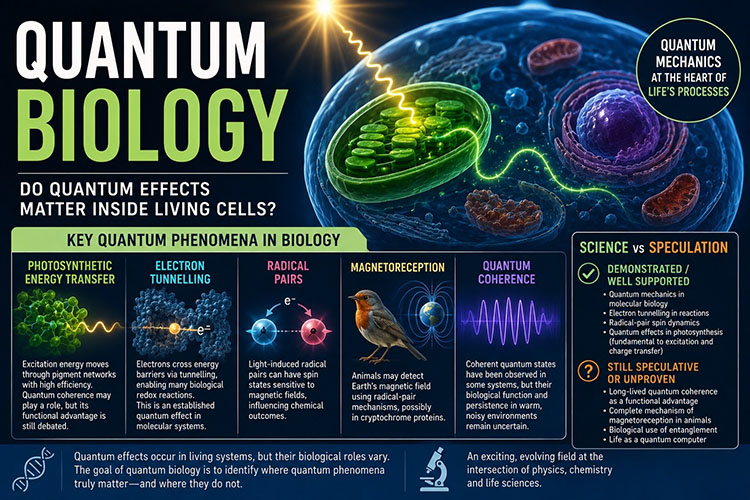
This field is known as quantum biology. It is an active area of research, but it is important to keep its current status in perspective. Some quantum effects in biological processes are well established, while the functional importance of others remains uncertain. Quantum biology is therefore not a claim that organisms behave like quantum computers. It is an attempt to determine where quantum mechanics provides a necessary or useful description of particular biological processes.
Photosynthesis: Quantum Effects in Energy Transfer
Photosynthesis provides one of the most extensively studied examples. When a photosynthetic organism absorbs light, photons excite molecules called pigments. The resulting excitation energy moves through networks of pigment molecules toward a reaction centre, where charge separation initiates the chemical processes that eventually store solar energy.
At these molecular scales, quantum mechanics is essential for describing electronic excitation and energy transfer. Experiments using ultrafast spectroscopy have observed oscillatory signals in photosynthetic complexes that have been interpreted as evidence of quantum coherence. A 2007 Nature study, for example, reported evidence for wavelike energy transfer in the Fenna–Matthews–Olson (FMO) complex of a photosynthetic bacterium.
However, an important scientific debate followed. Later research showed that some of the long-lived oscillations initially interpreted as electronic quantum coherence can instead arise from vibrational or vibronic dynamics. A major review concluded that inter-exciton electronic coherences are generally too short-lived to have established functional significance in photosynthetic energy transfer.
Therefore, the scientifically safe conclusion is that quantum mechanical processes are unquestionably involved in photosynthesis, but whether long-lived electronic coherence is deliberately exploited by organisms to improve photosynthetic efficiency remains unresolved.
Electron Tunnelling in Biology
Another established quantum phenomenon is electron tunnelling. In classical physics, a particle without sufficient energy cannot cross an energy barrier. Quantum mechanics allows a particle to have a finite probability of passing through such a barrier. This is known as tunnelling.
At the molecular level, electron transfer can occur through distances and energy barriers that are difficult to explain using a purely classical picture. Electron-transfer reactions are fundamental to biological chemistry, including processes associated with enzymes and cellular energy metabolism. Quantum mechanical descriptions are therefore routinely used to understand these reactions.
This does not mean that every biological reaction should be labelled “quantum biology.” Quantum mechanics is already part of modern chemistry. The more interesting question is whether particular biological systems have evolved structures that exploit tunnelling in a functionally important way.
There is experimental evidence for quantum tunnelling in some biochemical reactions, but its importance varies from system to system. It is therefore more accurate to describe molecular electron tunnelling as an established quantum process in biology, rather than suggesting that tunnelling controls biological activity in general.
Radical Pairs and Earth’s Magnetic Field
One of the most intriguing proposed applications of quantum physics in biology occurs in animal magnetoreception. Some migratory animals can detect Earth’s magnetic field and use it for orientation. Birds are among the best studied examples. One proposed mechanism involves light-sensitive proteins called cryptochromes.
When cryptochrome absorbs light, electron-transfer reactions can generate two radicals containing unpaired electron spins. These form what is known as a radical pair. The relative spin states of the radicals can influence their chemical reactions. The Earth’s weak magnetic field can affect the evolution of these spin states through interactions involving electron and nuclear spins. This is the basis of the radical-pair mechanism of magnetoreception.
Laboratory and behavioural studies provide evidence supporting a role for cryptochrome and radical-pair chemistry in magnetic sensing. However, scientists have not yet established a complete molecular and neural pathway that explains magnetoreception in animals. This distinction matters. The radical-pair mechanism is scientifically well developed, but the precise biological implementation of magnetic sensing remains an active research problem.
What About Quantum Coherence?
Quantum coherence describes a well-defined phase relationship between quantum states. It is central to many quantum phenomena, but biological environments are warm, chemically active and constantly interacting with their surroundings. These interactions generally cause decoherence, reducing quantum coherence over time. Experiments have nevertheless observed coherence-related signals in biological molecules using ultrafast spectroscopy. The major unresolved question is whether these coherences persist long enough, and function in the right way, to provide a biological advantage.
This is particularly important in photosynthesis. Some studies have proposed that coherent dynamics could help excitation energy explore different pathways, while other analyses indicate that the observed signals largely reflect vibrational motion rather than functionally important electronic coherence. Thus, observing quantum coherence is not the same as proving that an organism uses coherence as a biological strategy.
What Is Proven and What Remains Uncertain?
The distinction can be summarised simply:
| Phenomenon | Current scientific position |
|---|---|
| Quantum mechanics in molecular biology | Fundamental and established |
| Electron transfer and tunnelling in molecular systems | Well established in relevant reactions |
| Quantum effects in photosynthetic excitation and charge transfer | Established at the molecular level |
| Quantum coherence in photosynthetic complexes | Experimentally observed, functional significance debated |
| Radical-pair spin dynamics | Strong experimental and theoretical basis |
| Radical pairs as the complete mechanism of animal magnetoreception | Not conclusively established |
| Biological use of long-lived quantum entanglement | Not established |
| Organisms functioning as quantum computers | No scientific evidence |
This distinction is essential because quantum biology is sometimes presented more confidently than the evidence allows.
Where Could the Field Go Next?
The future of quantum biology will depend largely on better experiments rather than broader claims. Researchers are developing increasingly sophisticated tools, including ultrafast spectroscopy, high-resolution structural methods, quantum sensors and computational models, to observe molecular processes on extremely short timescales. These techniques could help determine whether particular quantum effects merely occur naturally at the molecular level or actually contribute to biological function.
There may also be technological value. Understanding how biological molecules transfer energy and electrons could influence artificial photosynthesis, molecular electronics and new approaches to energy conversion. Research inspired by photosynthetic systems is already investigating how their molecular organisation could inform artificial energy technologies.
Quantum biology is scientifically interesting precisely because many of its important questions remain open. There is no doubt that quantum mechanics governs the molecules from which living systems are built. There is also strong evidence that specific quantum phenomena, including electron tunnelling and spin-dependent reactions, occur in biological systems.
What remains to be established is how often organisms actually exploit these phenomena in ways that provide a measurable biological advantage. That is where the field is heading: not toward making biology sound more mysterious, but toward experimentally determining where quantum mechanics genuinely matters to life and where conventional chemistry and biology are sufficient to explain what we observe.
