

Ipsa Tripathy
Bhubaneswar: Tourism is often associated with relaxation, exploration and memorable experiences. A trip to a forest, beach, mountain or wildlife sanctuary can also create income for local communities and support conservation. But every journey has an environmental cost. The flight, car ride, hotel room, food, water use and waste generated during a holiday all require resources.
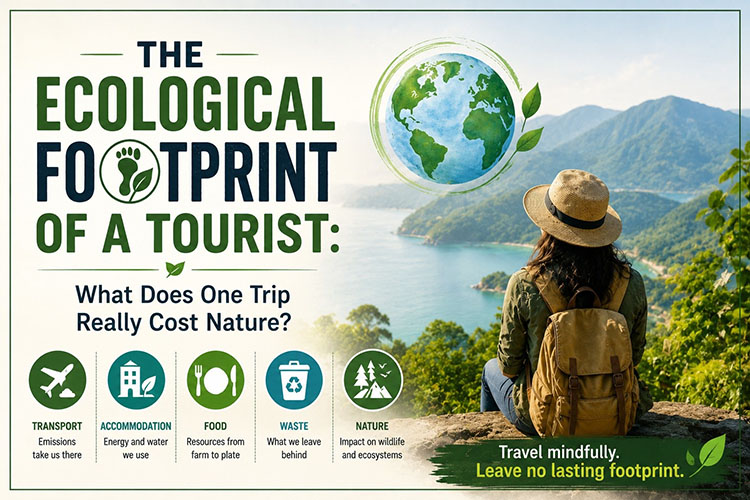
This is the ecological footprint of tourism, the environmental pressure associated with travelling and staying in a destination. Understanding it does not mean that tourism is inherently harmful. It means recognising that even a short trip connects individual choices with energy consumption, greenhouse-gas emissions, water use and pressure on ecosystems.
The Journey Often Has the Largest Footprint
Transportation is one of the most important sources of tourism-related environmental impact. Air travel is particularly significant because aircraft burn fossil fuels at high altitude, producing carbon dioxide as well as other emissions that affect atmospheric chemistry. The amount of emissions depends on factors such as distance, aircraft type, passenger occupancy and travel class.
Road travel also contributes to emissions, particularly when tourists use private cars over long distances. Trains and buses generally allow the emissions associated with a journey to be shared among more passengers. This makes the choice of transport an important part of a traveller’s environmental footprint. A destination itself may be well managed, but reaching it can still generate substantial emissions.
A Hotel Requires More Than a Room
Accommodation also consumes resources. Hotels and resorts require electricity for lighting, air conditioning, refrigeration, heating, elevators and other services. They also require water for drinking, cooking, cleaning, laundry, swimming pools and landscaping.
The environmental impact varies greatly between properties. Factors such as energy efficiency, electricity sources, building design, water management and occupancy all influence the overall footprint. In water-stressed destinations, tourism can create additional pressure because visitors may consume more water than local residents, particularly where hotels maintain swimming pools, landscaped gardens or other water-intensive facilities. The issue is therefore not simply how many tourists visit a place, but how much energy and water each visitor requires and whether the destination has sufficient resources to provide them sustainably.
Food Has an Environmental Cost Too
Food is another often overlooked part of tourism’s footprint. Restaurants and hotels need agricultural products, drinking water, refrigeration and transportation. The environmental impact of food varies according to what is produced and how it is produced.
Food production occupies land and uses water and energy. Livestock production can also generate significant greenhouse-gas emissions. Tourists can therefore influence environmental impacts indirectly through their food choices. Reducing food waste is particularly important because resources have already been used to produce, transport and prepare food that is ultimately discarded.
The Waste Problem
Tourism can increase the quantity of waste generated in destinations, particularly during periods of high visitor numbers. Plastic bottles, food packaging, disposable items and other forms of solid waste can place pressure on local waste-management systems. The problem becomes more serious where a destination lacks adequate collection, recycling or treatment facilities.
Waste that enters rivers, lakes or oceans can become an ecological hazard. Plastics can persist in the environment and break down into smaller particles, while discarded food can alter the behaviour of some wildlife. Good tourism management therefore requires adequate waste infrastructure as well as responsible behaviour from visitors.
Nature Tourism Is Not Automatically Sustainable
Visiting a forest, wetland, coral reef or wildlife sanctuary may be called ecotourism, but simply being in nature does not make an activity environmentally sustainable. Large numbers of visitors can disturb wildlife, damage vegetation and compact soil. Repeated foot traffic can cause erosion, while vehicles and boats can disturb animals and sensitive habitats.
In coastal areas, poorly managed tourism can contribute to pressure on beaches, dunes, mangroves and coral reefs. This is why protected areas often use measures such as visitor limits, designated trails, zoning, vehicle restrictions and seasonal closures. The objective is to allow people to experience natural areas without exceeding their ecological capacity.
Can Tourism Also Benefit Nature?
Tourism is not only an environmental burden. Properly managed tourism can provide financial resources for conservation. Entrance fees, accommodation charges, permits and tourism-related employment can generate income for protected areas and local communities. Tourism can also create economic incentives to preserve forests, wildlife and cultural landscapes rather than converting them to other uses. Local participation is particularly important. When communities receive a fair share of tourism-related income, conservation can become connected to local economic interests. However, these benefits are not automatic. Poorly planned tourism can concentrate profits while leaving local communities with environmental costs.
What Can an Individual Tourist Do?
The environmental footprint of tourism cannot be eliminated completely, but it can be reduced. Travellers can consider lower-emission transport where practical, stay longer rather than taking numerous short trips, choose accommodation with effective energy and water-management practices, avoid unnecessary single-use products and minimise food waste.
Visitors should also respect wildlife regulations, remain on designated trails, avoid feeding animals and follow local restrictions in protected areas. Perhaps the most important principle is to leave natural places with as little additional pressure as possible.
A More Sustainable Way to Travel
Tourism will continue to be an important part of the global economy, and people will continue to travel for recreation, education, culture and work. The objective does not have to be eliminating tourism. It is making tourism less resource-intensive and ensuring that destinations can withstand the pressure created by visitors.
A tourist’s ecological footprint is made up of many small components: the fuel used to reach a destination, electricity consumed in a hotel, water used for a shower, food that is eaten or wasted, and plastic or other waste left behind. Individually, these actions may seem insignificant. Multiplied by millions of travellers, however, they become an important environmental factor. Sustainable tourism begins with recognising that every journey uses resources. The challenge is to make those journeys compatible with the ecosystems and communities that make destinations worth visiting in the first place.
