

Ipsa Tripathy
Bhubaneswar: Every day, our planet quietly performs a remarkable task that most of us never notice. While we go about our lives, using GPS, watching the northern lights in photographs, or simply enjoying a sunny afternoon, Earth is constantly protecting us from an invisible stream of highly energetic particles racing through space at speeds of hundreds of kilometres per second. Without this protection, life on Earth would be dramatically different.
This unseen guardian is Earth’s magnetic field, a natural force that extends tens of thousands of kilometres into space, shielding our atmosphere from harmful solar radiation and making our planet hospitable for life. Although invisible, Earth’s magnetic field is one of the most important features of our planet. It influences everything from navigation and satellite operations to space weather and the long-term survival of Earth’s atmosphere.
Anyone who has used a compass has observed Earth’s magnetic field in action. The compass needle points north because our planet behaves much like a giant bar magnet, with magnetic poles near the geographic North and South Poles. However, Earth is not actually a giant permanent magnet buried inside a rock. Instead, its magnetic field is generated deep within the planet through an extraordinary natural process known as the geodynamo.
The Engine Hidden Beneath Our Feet
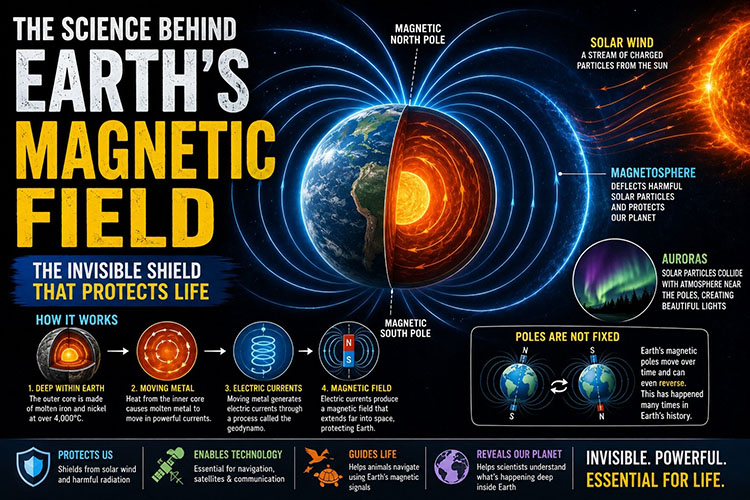
Earth is made up of several layers. Beneath the crust and mantle lies the outer core, a layer approximately 2,200 kilometres thick composed mainly of molten iron and nickel. Temperatures here exceed 4,000°C, making the metals liquid despite the immense pressure. The liquid metal is constantly moving.
Heat escaping from Earth’s inner core drives convection, causing molten iron to circulate continuously. At the same time, Earth’s rotation influences these moving fluids through the Coriolis effect, organising the flow into complex spiralling patterns. Because molten iron conducts electricity, its movement generates electric currents.
These electric currents, in turn, produce magnetic fields. Together, these processes sustain Earth’s global magnetic field in a self-perpetuating cycle known as the geodynamo. This remarkable mechanism has operated for billions of years.
An Invisible Shield Against the Sun
The Sun continuously emits a stream of electrically charged particles known as the solar wind. Travelling at speeds between 300 and 800 kilometres per second, these particles constantly bombard the Solar System. Without protection, they could gradually strip away Earth’s atmosphere and expose the surface to much higher levels of harmful radiation.
Fortunately, Earth’s magnetic field acts like a protective shield. As the solar wind approaches our planet, the magnetic field deflects most charged particles around Earth, creating a protective region called the magnetosphere. This enormous magnetic bubble extends tens of thousands of kilometres into space on the side facing the Sun and stretches much farther away from the Sun, forming a long magnetic tail. The magnetosphere prevents the majority of solar particles from directly reaching Earth’s atmosphere. It is one of the reasons our planet has remained suitable for life over geological time.
Not all solar particles are turned away. Near the magnetic poles, some charged particles travel along Earth’s magnetic field lines and collide with gases in the upper atmosphere. These collisions excite oxygen and nitrogen atoms, causing them to emit light. The result is one of nature’s most spectacular displays—the aurora borealis in the Northern Hemisphere and the aurora australis in the Southern Hemisphere. Green is the most common auroral colour, produced by oxygen atoms high in the atmosphere, while red, purple and blue colours arise under different atmospheric conditions. Although visually stunning, auroras are also evidence that Earth is constantly interacting with the Sun.
Why the Magnetic Poles Move
Many people assume Earth’s magnetic poles remain fixed. In reality, they are constantly moving. The magnetic North Pole has gradually shifted across the Arctic over the past century as the flow of molten iron inside the outer core changes. Scientists regularly update global magnetic models to account for this movement because accurate navigation systems depend on precise knowledge of the magnetic field. This natural wandering is expected and has occurred throughout Earth’s history.
When Earth’s Magnetic Field Reverses
One of the most fascinating discoveries in geology is that Earth’s magnetic field has reversed many times. During a geomagnetic reversal, the magnetic North and South Poles exchange positions. Evidence preserved in ancient volcanic rocks shows that these reversals have occurred repeatedly over millions of years. The most recent complete reversal, known as the Brunhes–Matuyama reversal, took place approximately 780,000 years ago. Contrary to popular myths, there is no scientific evidence that magnetic reversals cause mass extinctions or global catastrophes. Although the magnetic field may temporarily weaken during a reversal, geological records indicate that life has successfully survived numerous such events.
Why Scientists Study the Magnetic Field
Earth’s magnetic field is not only important for protecting life. It also influences modern technology. Strong solar storms can disturb the magnetosphere, affecting satellite communications, GPS navigation, radio transmissions and electrical power systems. Scientists therefore monitor space weather continuously using satellites and ground-based observatories.
Understanding Earth’s magnetic field helps improve satellite operations, aviation safety and power-grid resilience during periods of intense solar activity. It also provides valuable insights into the internal structure of our planet. Because the magnetic field is generated deep inside the outer core, studying its behaviour allows geophysicists to investigate processes occurring thousands of kilometres beneath Earth’s surface, regions that humans can never directly reach.
A Silent Guardian of Life
Earth’s magnetic field is easy to overlook because we cannot see it or feel it. Yet it is one of the greatest natural protections our planet possesses. Every second of every day, it deflects harmful charged particles, preserves our atmosphere, guides migrating animals such as birds and sea turtles, and enables technologies that modern society depends upon. Perhaps its greatest achievement is one we rarely appreciate.
It has quietly protected Earth for billions of years, allowing life to evolve beneath its invisible shield. The next time a compass needle points north or photographs of shimmering auroras appear across the night sky, they serve as gentle reminders that our planet is far more dynamic than it appears. Hidden beneath our feet, rivers of molten iron continue to flow, generating an invisible force that stretches far into space, a force that has made Earth not only unique, but habitable.
