

The Silent Threat Beneath the Waves
Ipsa Tripathy
Bhubaneswar: When we talk about climate change, we often picture melting glaciers, rising sea levels and extreme weather. Yet one of the most significant changes is taking place far from our eyes, beneath the surface of the oceans. The oceans, which cover more than 70% of Earth’s surface, have quietly absorbed a large share of the carbon dioxide (CO₂) released by human activities. This has helped slow the pace of global warming by preventing even more greenhouse gases from accumulating in the atmosphere.
But this natural service comes at a cost. As oceans absorb increasing amounts of carbon dioxide, their chemistry begins to change. The water becomes more acidic, a process known as ocean acidification. Although this change is invisible, its effects are profound, threatening marine life, fisheries and the health of ecosystems that millions of people depend upon. Scientists now describe ocean acidification as one of the most serious environmental challenges facing our oceans.
How Does the Ocean Become More Acidic?
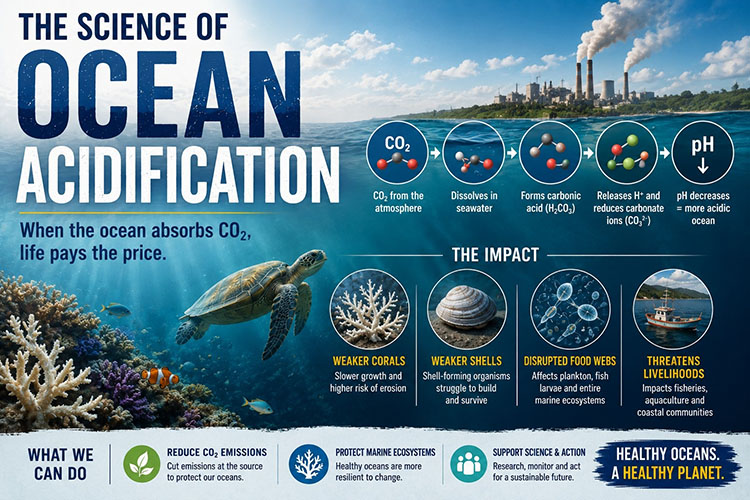
The process begins with carbon dioxide. Since the Industrial Revolution, human activities such as burning fossil fuels, cement production and deforestation have significantly increased atmospheric CO₂ levels. The ocean naturally absorbs about 25–30% of these human-caused carbon dioxide emissions, acting as a massive carbon sink.
When carbon dioxide dissolves in seawater, it reacts with water molecules to form carbonic acid (H₂CO₃). This weak acid then breaks down into bicarbonate ions and hydrogen ions. It is the increase in hydrogen ions that lowers the pH of seawater, making it more acidic. Although seawater remains slightly alkaline, its pH has declined by about 0.1 units since the beginning of the Industrial Revolution. This seemingly small decrease represents roughly a 30% increase in acidity, because the pH scale is logarithmic. The chemistry may seem complex, but the consequences are very real.
Why Marine Life Is Under Threat
Many marine organisms build shells or skeletons from calcium carbonate, a mineral naturally present in seawater. Corals, oysters, clams, mussels, sea urchins and many microscopic plankton depend on carbonate ions to construct these protective structures. As ocean acidification progresses, carbonate ions become less available because they react with the excess hydrogen ions.
This makes shell formation increasingly difficult. Young marine organisms are particularly vulnerable because they require large amounts of calcium carbonate during their early development. Scientists have observed slower growth, weaker shells and reduced survival rates in several marine species under more acidic conditions. For coral reefs, the situation is especially concerning.
Coral Reefs: Cities Beneath the Sea
Coral reefs occupy less than 1% of the ocean floor, yet they support approximately 25% of all marine species at some stage of their lives. Often called the “rainforests of the sea,” these ecosystems provide shelter, breeding grounds and food for thousands of fish and invertebrates. Ocean acidification slows the ability of corals to build their limestone skeletons.
At the same time, rising ocean temperatures trigger coral bleaching, creating a double challenge for reef ecosystems. Weaker reefs become more vulnerable to storms and erosion, reducing their ability to protect coastlines from powerful waves. For communities dependent on reef fisheries and tourism, the consequences can be severe.
One of the less visible impacts involves microscopic marine organisms known as plankton. Certain plankton species also produce calcium carbonate shells. Although tiny, these organisms form the foundation of many marine food webs. They feed fish larvae, which in turn support larger fish, seabirds and marine mammals.
Some plankton also play an important role in the global carbon cycle by transporting carbon from the ocean surface to deeper waters after they die. Changes in plankton populations therefore have the potential to influence both marine biodiversity and Earth’s climate.
Ocean acidification is not only an ecological issue. Millions of people rely on healthy oceans for food, employment and coastal protection. Commercial shellfish industries are particularly sensitive because oysters, mussels and clams become more difficult to cultivate under acidic conditions. Declining coral reefs can reduce fish populations, affecting food security in coastal communities. Healthy reefs also act as natural barriers that reduce wave energy during storms and cyclones. As reefs weaken, coastlines may become increasingly vulnerable to erosion and storm surges. The economic consequences extend well beyond the ocean itself.
What About India?
India possesses a coastline stretching over 7,500 kilometres, supporting diverse marine ecosystems including coral reefs in the Gulf of Mannar, Lakshadweep and the Andaman and Nicobar Islands. These ecosystems contribute to fisheries, tourism and coastal livelihoods.
Scientists are actively studying how rising temperatures and ocean acidification together may affect India’s coral reefs, shellfish and marine biodiversity. Although many uncertainties remain, researchers agree that reducing carbon dioxide emissions remains the most effective long-term solution.
Can the Oceans Recover?
Unlike many local pollution problems, ocean acidification cannot be solved simply by cleaning beaches or removing waste. Its primary cause is the increasing concentration of atmospheric carbon dioxide. Reducing greenhouse gas emissions through cleaner energy, improved energy efficiency and sustainable land management is essential.
Protecting marine ecosystems also improves resilience. Healthy seagrass meadows, mangroves and salt marshes absorb carbon dioxide and help support marine biodiversity. Scientific monitoring is equally important, allowing researchers to track changes in ocean chemistry and identify vulnerable ecosystems before irreversible damage occurs.
The Ocean Is Quietly Speaking
Ocean acidification does not produce dramatic headlines like hurricanes or floods. There are no visible warning signs from the shore. Yet beneath the waves, seawater chemistry is changing in ways that affect organisms from microscopic plankton to magnificent coral reefs. The ocean has protected humanity for centuries by absorbing enormous amounts of our carbon dioxide emissions.
Now, it is paying the price. Understanding ocean acidification reminds us that climate change is not only warming the planet, it is reshaping the chemistry of Earth’s largest ecosystem. The future health of our oceans depends not only on protecting marine life but also on reducing the emissions that are silently changing the sea itself. Because if the chemistry of the ocean changes, the future of life within it changes too.
