

Ipsa Tripathy
Bhubaneswar: On the night of November 25 last year, more than 50 police and administrative officials raided the Kilipal sand ghat on the Mahanadi in Jagatsinghpur district. They seized 48 trucks carrying sand illegally extracted from the riverbed. Officials described it as possibly the largest seizure of its kind in Odisha. A few weeks later, the district mining officer was suspended over allegations of collusion with leaseholders and the sand mafia.
The raid exposed a problem that has been building along the Mahanadi for years. Sand is essential to the construction industry, but its extraction has become a lucrative trade in which illegal mining, weak enforcement and environmental damage often go hand in hand. The operation at Kilipal made headlines, but it did little to settle the larger question: who is profiting from the river, and what is being lost in the process?
Sand is among the most heavily extracted natural materials in the world. Odisha’s growing construction industry has increased demand, creating opportunities for both licensed operators and illegal miners. Government figures give an indication of the scale of the problem. Between 2022 and October 2025, authorities registered 3,219 cases involving illegal mining and transportation of minor minerals, carried out 15,187 seizures and collected more than ₹126 crore in fines.
The Mahanadi is at the centre of much of this activity. In the Sambalpur region, local residents have reported traders occupying stretches of the riverbed and building up large stockpiles of sand. The material is often stored during the dry season, when extraction is easier, and sold at higher prices during the monsoon, when digging becomes difficult. Heavy vehicles, including Hyva tippers, then transport the sand out of the district.
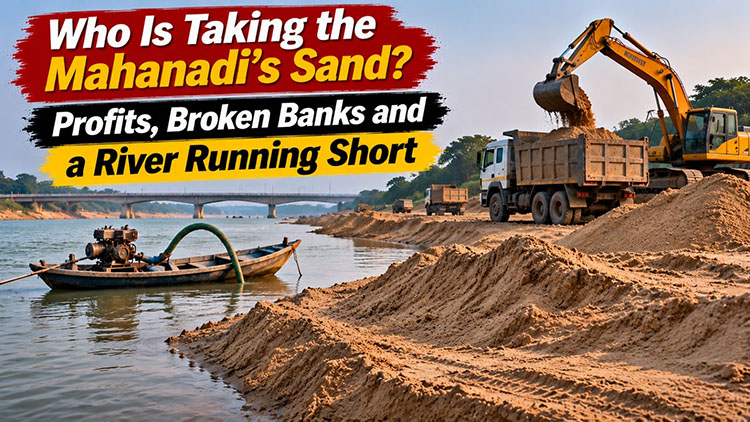
The profits are greatest for operators who extract sand without valid permits or go well beyond the limits of their authorised leases. A case before the National Green Tribunal illustrates how such operations can continue despite complaints and enforcement action. On November 3, the tribunal considered a petition filed by Shivaji Patel concerning illegal sand extraction at Chikhili in Bargarh district. The complaint alleged that sand was being removed from the Mahanadi using suction pumps mounted on boats, without a valid lease, and supplied to construction projects and brick kilns.
During separate raids, enforcement teams reportedly found 8,688 cubic metres of illegally extracted sand. Yet, according to the case details, there were no prosecutions and no machinery was seized. The local administration dealt with the violations by imposing fines.
This is one of the central weaknesses in the enforcement system. When the financial penalty is small compared with the money earned from illegal extraction, paying a fine can become just another operating expense. The threat of punishment then loses much of its deterrent value.
The state government has attempted to address some of these problems through changes to the sand trade. In November 2025, Odisha introduced a minimum support price for sand, which the government described as the first such initiative in the country. It also replaced open auctions of sand leases with an e-lottery system and made licences compulsory for sand storage. Mining Minister Bibhuti Bhusan Jena described the measures as a major reform intended to bring down prices and weaken the influence of illegal operators. The opposition BJD, however, criticised the lottery system and alleged that it could favour ruling party workers.
Whether these changes have significantly reduced illegal mining remains to be seen. The real test will be whether extraction is monitored effectively, violations lead to meaningful consequences and the sand trade becomes more transparent.
The environmental damage is already visible in several stretches of the river. Around Cuttack, a four-year study by the geology department of Ravenshaw University examined sand mining along the Mahanadi and Kathajodi using satellite imagery and field observations. It found that the area affected by mining on the Kathajodi increased from approximately 2 square kilometres in 2017–18 to a peak of 2.862 square kilometres in 2024 and 2025.
The researchers also examined groundwater conditions around the city. Their findings indicated that groundwater levels remained above the standard level between 2017 and 2019 but began declining from January 2021. They linked at least part of this decline to the loss of sand from the riverbed.
Sand is not simply material waiting to be removed. It plays an important role in the river’s natural functioning. Riverbed sediments help store water and allow it to seep gradually into the ground, contributing to groundwater recharge. When excessive quantities are removed, this natural storage capacity can be reduced. The consequences may extend beyond the river itself, affecting nearby wells and the availability of groundwater.
The study raised another concern about the location of mining activity. Some of the most intensive extraction was taking place close to bridges across the Kathajodi. Removing large amounts of sediment near bridge foundations can increase the risk of erosion and affect the stability of supporting structures. Professor Sandeep Narayan Kundu and his colleagues also warned that excessive mining could alter river flow patterns and threaten the embankments that protect Cuttack from flooding.
Deep excavation creates further risks. When miners dig large pits into the riverbed, they change its natural profile. During high flows and floods, these depressions can influence the movement of water and sediment, potentially contributing to changes in the river’s course and increasing erosion in vulnerable areas.
The problem becomes even more serious when viewed alongside the long-term decline in sediment reaching the Mahanadi. As discussed in our earlier article, What Happens When a River Carries Less Sediment?, the river was already experiencing a reduction in the amount of sand and other material flowing downstream before large-scale extraction became a major concern.
Since the construction of the Hirakud Dam in 1957, the Mahanadi basin has accumulated around 254 mostly small and medium-sized dams. These structures trap sediment that would otherwise move downstream. Research indicates that the combined effect of dams has reduced the sediment reaching the Mahanadi delta by approximately 67 per cent. Estimates suggest that between 1980 and 2010, the amount of sediment carried by the river to the sea declined by around 0.515 million tonnes annually. Over the same period, the number of dams in the basin increased from 70 to 253.
Changes in the river’s physical structure offer further evidence of this sediment shortage. Research has found that, following the decline in sediment supply after the 1990s, the main low-flow channel of the Mahanadi became approximately 0.5 to 2 metres deeper in some stretches.
The relationship is straightforward, even if the underlying processes are complex. Dams trap sediment upstream, while mining removes sand from the riverbed downstream. The river receives less replacement material from above and loses more of what remains through extraction. When sediment supply falls below what is needed to maintain the riverbed and banks, erosion can increase as the river adjusts to the imbalance.
The effects do not stop at the riverbanks. The Mahanadi carries sediment towards its delta, where it helps maintain coastal land and counter the natural forces of erosion. When that supply declines, the delta becomes more vulnerable to shoreline retreat. Research has identified reduced sediment delivery and human interference with the river system as important factors in the changing condition of the Mahanadi delta.
This is part of the wider story behind the erosion affecting coastal villages such as Satabhaya, where several settlements have faced the loss of land to the sea. Sand mining is not the sole cause of coastal erosion, but it adds pressure to a river system already struggling to deliver the sediment needed to maintain its delta.
The National Green Tribunal’s November 3 ruling could strengthen enforcement if its directions are properly implemented. The tribunal made clear that paying a fine should not protect violators from criminal proceedings. It directed police and mining officials to register FIRs for mineral theft under the Bharatiya Nyaya Sanhita. It also asked the Chief Secretary to review mineral monitoring every quarter and make the meeting minutes publicly available.
The directions include stronger tracking of sand transportation. GPS trackers and RFID tags are to be installed on sand-carrying vehicles to improve monitoring and help authorities identify illegal movement. The tribunal also directed that seized sand be auctioned, with the proceeds going to the pollution control board for ecological restoration.
These measures could make it harder for illegal operators to move sand without being detected. But enforcement alone will not address the underlying problem. The river needs a clear limit on how much sand can be extracted without damaging its natural processes.
That requires a scientific assessment of the Mahanadi’s sediment budget: how much sand enters the river system, how much moves downstream, where it accumulates and how much can be removed without affecting the riverbed, banks and delta. Extraction limits should be based on that assessment, rather than simply on the demand from the construction industry or the availability of mining leases.
The Mahanadi is not an endless supply of construction material. Its sand supports groundwater recharge, helps maintain river channels and carries sediment towards the coast. Removing it faster than the river can replace it creates costs that are eventually borne by farmers, riverside communities and coastal residents.
The question is not whether Odisha needs sand for development. It does. The question is whether the state can meet that demand without steadily weakening one of its most important rivers. Until extraction is brought within the limits of what the Mahanadi can naturally replenish, the profits will remain private while much of the environmental cost is left to the river and the people who depend on it.
