

Ipsa Tripathy
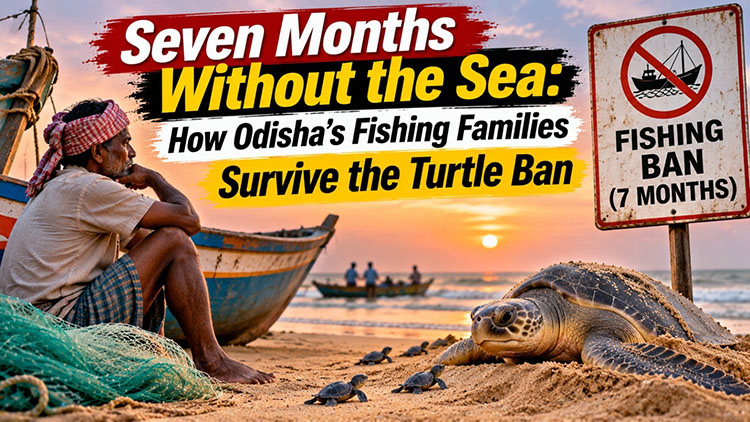
Bhubaneswar: On the morning of November 1, fishing boats at the Rushikulya river mouth remained tied up along the shore. The same scene unfolded at Dhamra and the Devi river mouth. Odisha had begun its annual seven-month fishing ban within 20 km of the coast around these three river mouths to protect olive ridley turtles during their breeding and nesting season. In Kendrapara, fishing restrictions along the Gahirmatha coast remain in force throughout the year.
For the turtles, the absence of fishing activity offers a safer passage through important breeding and nesting grounds. For the families who depend on the sea, however, the next seven months bring a difficult period of uncertainty. Their boats remain idle, their income disappears and many are forced to look for work elsewhere. This year, the government estimates that around 11,000 fishing families will be affected by the seasonal restrictions. Each eligible family is due to receive a one-time payment of ₹15,000 to compensate for the loss of income.
The compensation scheme has expanded over the years, although its coverage and adequacy remain contested. In 2016, the Fisheries Department provided ₹5,000 annually to around 2,000 fishermen in Kendrapara who were unable to fish within the Gahirmatha sanctuary. The amount increased to ₹7,500 in 2017–18 and was raised to ₹15,000 from 2022–23.
The scale of the programme has also grown. In February 2024, the government released ₹22.55 crore for 15,037 fishing families, with each receiving ₹15,000. The beneficiaries included 6,773 families in Kendrapara, 3,638 in Ganjam, 3,450 in Puri, 753 in Bhadrak and 423 in Jagatsinghpur.
Yet the payment is modest when spread across the entire restriction period. Only one member of an eligible family receives ₹15,000, generally in a single instalment between November and March. Over seven months, that works out to just over ₹2,100 a month for the entire household. For families with several dependants, this amount offers little financial security.
In some areas, the interruption to fishing lasts even longer. Around the Rushikulya river mouth in Ganjam, fishing restrictions for turtle conservation extend from November to May. The national monsoon fishing ban follows, leaving fishing communities with very few months of unrestricted activity. A fishing union representative has described the combined restrictions as an effective ban lasting around eight months of the year.
The problem extends beyond the amount of compensation. Fishing communities argue that official beneficiary lists fail to include everyone whose livelihood depends on the sea. The president of the Odisha Traditional Fish Workers’ Union has said that at least 50,000 fishermen in Kendrapara and Jagatsinghpur alone are affected, far exceeding the approximately 16,500 families the department planned to support in the year he referred to. He has described the existing payment as inadequate.
Documentation is one reason some families are excluded. Fisherman Arabinda Swain has pointed out that many people in fishing communities do not possess the identity cards required to establish their eligibility. Without the necessary documents, they can miss out even on the limited assistance available.
The restrictions also affect people who never go out to sea. Boat builders, mechanics, small fish traders and women who dry, process and sell fish all depend on the fishing economy. When boats stop operating, their work and earnings are affected as well. K. Alleya, general secretary of the fishing workers’ union, has argued that these groups should also receive support. Women from fishing communities have similarly raised concerns that their contribution to the sector is often overlooked when compensation is calculated.
Trawler crews and operators face their own difficulties. Jogi Behera, a trawler operator from Rambha in Ganjam, has called for trawler operators to be included in livelihood assistance because their boats also remain idle during the restrictions. In the district, fishers have also complained that families belonging to the Dhibar fishing community are excluded from existing relief schemes.
Even among those listed as beneficiaries, the delivery of assistance has been a concern. Fishing representatives in Ganjam have alleged that many fishermen have not received their compensation or have faced delays. When families have no regular income, late payments can make an already difficult period considerably worse.
For many households, migration becomes the only practical option. In Kendrapara, more than 20,000 fishermen were reportedly told by boat owners not to report for work during the ban. Union leader Narayan Haldar said thousands were preparing to travel to other states in search of employment because they had no alternative way to support their families for several months.
A similar situation is emerging in Ganjam. In Podampeta, a coastal village already struggling with erosion and the threat of the sea, families face the combined pressure of losing fishing income and dealing with the effects of coastal displacement. Residents have said that ₹15,000 is insufficient when alternative employment is scarce and facilities for processing and selling dried fish remain inadequate. Some families have begun travelling to Bengaluru and Visakhapatnam for seasonal work.
Others are tempted to continue fishing despite the restrictions. Those caught fishing illegally risk arrest, fines and the seizure of their boats. For families already struggling with debt, these penalties can make their financial situation worse. Fishing organisations argue that restrictions imposed without adequate livelihood support place an unfair burden on the people expected to follow them.
The demands made by fishing unions have remained largely consistent. They want the annual compensation increased to ₹30,000 and extended to everyone whose livelihood depends on fishing, including small traders and workers involved in processing and related activities. Earlier demands have included a monthly payment of ₹10,000 throughout the restricted period.
Fishing representatives have also called for changes to the duration and geographical extent of the ban. Some unions want the restriction reduced to five months, beginning in January, and the protected distance reduced from 20 km to 5 km. In Ganjam, fishers have argued that restrictions should be concentrated around the areas near the Rushikulya river mouth where olive ridley turtles gather to nest.
Another long-standing demand concerns alternative employment. Union leaders have referred to recommendations by the Supreme Court’s Central Empowered Committee that fishing communities should be provided with alternative livelihood opportunities before restrictions are imposed. They argue that this commitment has not translated into adequate employment programmes on the ground.
Protecting olive ridley turtles is essential to the health of Odisha’s coastal ecosystem. The annual mass nesting events at Gahirmatha and Rushikulya are among the most important wildlife spectacles along India’s coastline. Seasonal fishing restrictions help reduce the risk of turtles being caught in fishing nets during a particularly vulnerable period. The fishing communities themselves have also played an important role in protecting nesting beaches and supporting conservation efforts.
But conservation cannot depend indefinitely on the willingness of families to sacrifice their livelihoods without adequate support. The people who live beside these nesting grounds are not separate from the conservation effort. Their cooperation is central to its success.
If Odisha wants the fishing ban to remain effective, livelihood support needs to match the scale of the restrictions. Compensation must reach all eligible households, including those whose work is connected to fishing but who do not own boats or hold formal fishing identities. Payments must arrive on time, and alternative employment opportunities must be available during the months when fishing is prohibited. Training, support for fish processing, local market facilities and other income-generating activities could help reduce the pressure on families to migrate or fish illegally.
The purpose of the ban is to protect a species that depends on Odisha’s coast for survival. That objective should not be weakened. But the cost of conservation should not fall almost entirely on the people who depend on the same sea for their survival.
For seven months, the boats remain on the sand and the fishing villages wait for the season to reopen. Whether those families can continue supporting turtle conservation will depend not only on the strength of the restrictions, but also on whether the government provides them with a fair and dependable way to make a living while the sea rests.
