

Ipsa Tripathy
Bhubaneswar: In Angul, coal is difficult to separate from everyday life. It moves out of Talcher in long freight trains, settles as ash on village rooftops and provides livelihoods for thousands of families. It also generates revenue that helps fund public services across the state. As new coal-fired power units are planned in Angul and Jharsuguda, Odisha faces an increasingly difficult question: should it stop building new coal plants, or would doing so put too much pressure on an economy that has depended on coal for decades?
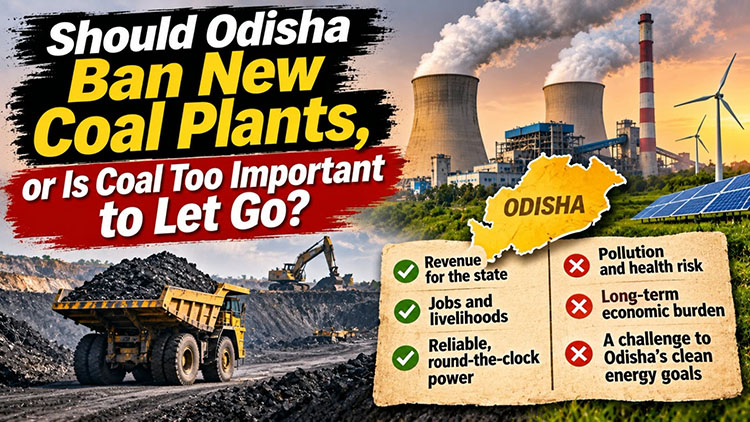
There are strong arguments on both sides. For some, coal remains essential to the state’s revenue, employment and electricity supply. For others, expanding coal capacity will deepen pollution, increase long-term financial risks and make Odisha’s clean energy commitments harder to achieve. The debate is not simply about energy. It is about the future of the communities, industries and public finances built around coal.
The question is already taking shape through projects on the ground. NTPC is constructing Stage III of the Talcher Thermal Power Project, comprising two 660 MW ultra-supercritical units within the premises of the old Talcher plant. An expert committee has also recommended that NTPC be allowed to begin studies for a further 800 MW Stage IV unit. If developed, this would take the site’s total capacity to 2,120 MW. In January, the same committee reviewed an amendment request from the Odisha Power Generation Corporation for its proposed 1,320 MW expansion at the Ib Thermal Power Station.
These projects bring the debate into sharp focus. Should Odisha continue expanding its coal infrastructure, or should it begin setting limits while there is still time to develop alternatives?
The strongest argument for continuing coal expansion is economic. Mining revenue is one of the foundations of Odisha’s finances. Excluding the District Mineral Foundation, the state’s mining revenue increased from ₹5,134.90 crore in 2016–17 to ₹46,710.57 crore in 2025–26. Mining as a whole, including iron ore and bauxite, contributes around 90 per cent of the state’s own non-tax revenue and 45 per cent of its total own revenue. Coal is only one part of this industry, but it remains a significant contributor.
Odisha produced 239.4 million tonnes of coal in 2023–24, compared with 185 million tonnes two years earlier. This production supports power generation and a wider industrial network that includes transport, equipment, contractors and other services. A sudden reduction in coal activity could therefore affect more than the mining companies themselves. It could have consequences for local businesses, workers and government revenue.
Employment is another major consideration, particularly in Angul. The district accounts for around 12 per cent of India’s coal production and 56 per cent of Odisha’s. A study by the think tank iFOREST suggests that Angul is unlikely to experience major coal-related job losses before 2040. In fact, employment linked to the coal sector is expected to increase significantly over the coming decade.
For families living in mining areas, these projections are not abstract economic figures. Coal provides income in places where alternative employment can be difficult to find. A community worker in Angul has pointed out that many women in mining-dependent villages have limited educational opportunities and rely financially on other family members. If the mines close without alternative livelihoods in place, these women could be among those most severely affected. A transition away from coal, therefore, cannot be planned only around power stations and mining companies. It must also account for the people whose lives depend on them.
Electricity supply provides a third argument for retaining coal. Coal-fired power stations can generate electricity continuously, regardless of whether the sun is shining or the wind is blowing. Industries and electricity grids need a dependable supply, and supporters of coal argue that a ban on new plants could make Odisha less attractive to industrial investment. If industries move to other states, they argue, the demand for coal will not necessarily disappear; it may simply be met elsewhere.
NTPC has also argued that its new Talcher units will use less coal per unit of electricity generated and produce lower carbon emissions than older plants. More efficient technology can reduce the amount of fuel required for a given level of generation. For supporters, this makes modern coal plants a better option than continuing to rely on older and less efficient units.
But the case against building more coal capacity is equally serious, particularly when the environmental and health costs are considered. Angul–Talcher has been identified as a critically polluted industrial area. Residents around mines and power stations have repeatedly raised concerns about polluted air, dust and damage to agricultural land. Fly ash is another persistent problem. Breaches in ash ponds, unsafe disposal and dust settling over fields have shown how the waste generated by coal-based power can affect communities long after electricity has been produced.
The concern is not limited to the quantity of pollution. It is also about whether existing environmental safeguards are being strengthened or weakened. OPGC has sought an exemption from installing flue gas desulphurisation units for its additional 1,320 MW capacity, referring to a 2025 notification that relaxed sulphur dioxide requirements for certain power plants. Flue gas desulphurisation systems are designed to reduce sulphur dioxide emissions, which contribute to air pollution and can harm human health. Critics argue that requests for exemptions raise questions about how seriously the industry is pursuing cleaner power generation.
The financial risks of new coal plants also deserve attention. A power station built today is expected to operate for several decades. Its construction involves substantial investment, and the project depends on the plant remaining economically useful over a long period. But the energy sector is changing. If renewable electricity, battery storage and other technologies continue to become more affordable, coal plants could face increasing competition. Plants that are unable to operate economically may become expensive assets for companies and, potentially, a burden on consumers and public finances.
There is also a question of whether Odisha’s energy plans are consistent with its environmental ambitions. The state has set a target of reaching around 11 GW of renewable energy capacity by 2030 and aims to source 74 per cent of its energy from renewables by 2047. In February, it attracted investment commitments worth ₹67,000 crore for 6.8 GW of renewable energy and storage capacity. These commitments suggest that Odisha wants to become a significant player in the clean energy sector.
Yet expanding coal generation at the same time raises an obvious question. Can the state continue adding coal capacity while pursuing a substantial shift towards renewable energy? Supporters may argue that both are necessary during the transition. Critics, however, warn that every new coal plant creates a long-term commitment that could make the shift more difficult.
Between an immediate ban and unrestricted expansion, there is another possibility: a gradual transition that gives the state time to build alternatives without abandoning coal-dependent communities. Some experts favour this approach.
NTPC, for instance, follows a policy of avoiding coal plants at entirely new locations and expanding capacity at existing sites instead. The proposed Talcher Stage III project fits this pattern, as it is being developed within the premises of an older plant that has closed. Expanding at existing sites may allow companies to use established infrastructure, although it does not remove the need to assess the environmental impact of additional capacity.
The iFOREST study proposes a phased transition for Angul. In its first phase, the district could use the economic benefits of its existing coal industry to build the foundations of a greener economy. Investment could be directed towards coal gasification, electric vehicles, battery storage and other emerging industries. After 2035, the region could move towards a green industrial phase, with greater emphasis on renewable energy and cleaner production processes.
The study estimates that even with a faster reduction in coal activity, nearly ₹3 trillion could be available by 2050 to support a just transition. The important point is that planning for the end of coal does not have to mean abandoning the people who depend on it. Revenue generated during the remaining years of coal production could help create new industries, train workers and support communities through the change.
Local participation will be essential. Women in coal-dependent villages, in particular, need a meaningful role in deciding what comes next. Researchers have argued that women should be included in transition planning through gram panchayats, where constitutional provisions guarantee representation. Their concerns may extend beyond direct employment to household income, access to services, education and the availability of work for younger generations.
Ultimately, neither side can avoid the difficult questions. Those who support continued coal expansion must explain why communities in Angul and Talcher should continue to bear the costs of polluted air, damaged farmland and industrial waste in return for the state’s revenue and electricity supply. Those who favour an immediate ban must explain how Odisha would replace the income, employment and dependable electricity that coal currently provides, and how quickly alternative opportunities could reach the affected families.
The choice is not simply between coal and renewable energy. It is about how Odisha manages an economy that has grown around mining while preparing for an energy system that may look very different in the coming decades. New coal plants could provide power and economic activity in the short term, but they also extend the state’s dependence on a fuel that carries substantial environmental costs.
Odisha does not have to choose between protecting its economy today and preparing for a cleaner future. But it does have to decide how much new coal capacity it is willing to commit to, what environmental standards those plants must meet and how the benefits of the transition will reach the communities most affected by it.
The more important question may not be whether Odisha can stop using coal tomorrow, but whether it is prepared to reduce its dependence on coal before economic and environmental pressures make that decision for it. A planned transition would give workers, businesses and communities time to adapt. Delaying that preparation could make the eventual change far more difficult.
