

Ipsa Tripathy
Bhubaneswar: Hydrogen has long been part of the global energy conversation, but there’s a catch: most of it is still made using fossil fuels. Known as “grey hydrogen”, the process releases large amounts of carbon dioxide into the atmosphere.
Green hydrogen is different. It’s produced by using renewable electricity , usually from solar or wind power to split water into hydrogen and oxygen through electrolysis. No coal. No natural gas. And crucially, almost no carbon emissions.
That promise has pushed governments and industries around the world to invest heavily in the technology. India is now trying to position itself as a major player, and Odisha is quickly emerging as one of the states betting biggest on it.
Why hydrogen matters
For all the progress in electric vehicles and renewable power, some sectors remain stubbornly difficult to clean up. Heavy industries such as steel, fertilisers and shipping need intense heat or chemical processes that batteries can’t easily provide. That’s where hydrogen comes in. It can act both as a fuel and as an industrial feedstock, offering a possible route to cut emissions in areas where direct electrification falls short.
Experts say green hydrogen can reduce greenhouse-gas emissions dramatically compared with conventional hydrogen made from fossil fuels. It also has another advantage: storage. Renewable energy isn’t constant — solar panels don’t work at night, and wind turbines depend on weather conditions. Hydrogen can store excess renewable power and be used later when demand rises.
That makes it attractive not just as a fuel, but as part of a future low-carbon energy system.
India’s big push
India has moved surprisingly fast in this space. Under the National Green Hydrogen Mission, the Centre has committed nearly ₹19,744 crore to build a domestic green hydrogen industry. The target is ambitious: produce 5 million tonnes of green hydrogen every year by 2030.
The government has already rolled out incentives for electrolyser manufacturing and hydrogen production. Plans are also underway for hydrogen refuelling stations and “Hydrogen Valleys” , industrial clusters where production, transport and usage can develop together.
The thinking is strategic as much as environmental. India imports huge amounts of fossil fuel every year. Green hydrogen could eventually reduce that dependence while helping Indian industries stay competitive in a world moving toward cleaner production standards.
Why Odisha is drawing attention
Odisha sees an opportunity here.
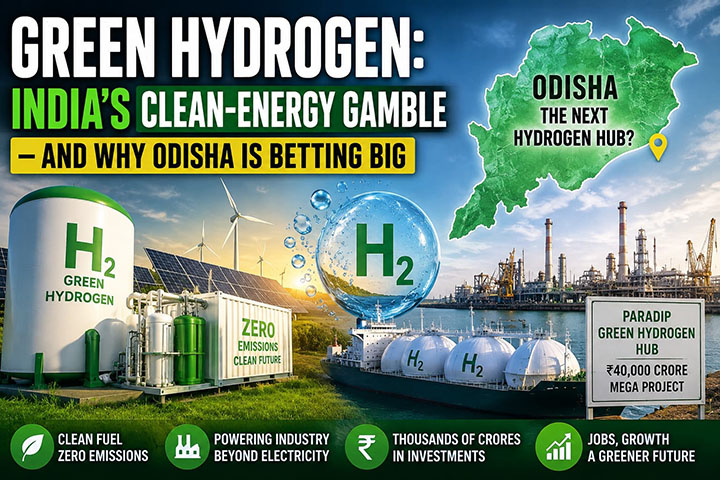
The state has announced subsidies, including support for capital investment and electricity costs, to attract companies working in green hydrogen and related sectors. The biggest proposal so far is the planned ₹40,000 crore Green Hydrogen Hub at Paradip, which is expected to become one of India’s major hydrogen centres.
Several companies have already signalled interest. NTPC has signed agreements linked to hydrogen projects in the state. Avaada is partnering with IIT Bhubaneswar on clean-energy research, while Jindal Stainless plans to explore the use of green hydrogen in steel production.
For Odisha, the timing matters. The state’s economy has long depended on mining, coal and heavy industry. Green hydrogen offers a chance to modernise that industrial base without abandoning manufacturing altogether.
There’s also a public-health angle. Cleaner industrial fuel could eventually help reduce pollution in urban and industrial zones.
The reality check
But for all the excitement, the sector is still in its early stages.
Many announced projects across India exist only on paper for now. Industry analysts estimate that the vast majority have yet to begin construction.
Cost remains the biggest hurdle. Producing green hydrogen is still expensive, largely because electrolysers and renewable electricity aren’t cheap enough yet at scale. Transport is another problem. Hydrogen is difficult to move and store, and India currently lacks dedicated infrastructure such as pipelines and large storage systems. Then there’s the market issue: industries may support green hydrogen in principle, but many are reluctant to switch while fossil fuels remain cheaper.
In short, enthusiasm alone won’t build the sector.
What happens next
The next few years will be crucial.
Industry experts say India needs to rapidly expand domestic electrolyser manufacturing, build transport infrastructure and create stronger demand through policy measures. Demonstration projects in sectors such as steel, fertilisers and shipping will also be important to prove the technology can work commercially. Equally important is renewable energy itself. Green hydrogen only works as a climate solution if the electricity powering it is genuinely clean and affordable.
Green hydrogen isn’t a magic solution to climate change. It won’t replace every fuel or solve every energy problem. But it may become one of the few practical ways to clean up industries that are otherwise difficult to decarbonise. India has recognised that early and is investing heavily to build capacity before global demand accelerates. Whether that gamble pays off will depend on execution, not announcements. And states like Odisha, which are pushing aggressively to attract investment and infrastructure, could end up playing a much bigger role in India’s clean-energy future than many expected.
