

Ipsa Tripathy
Bhubaneswar: India is rapidly evolving its adoption of renewable energy, mainly large-scale solar photovoltaics (PV) and onshore wind. This shift has been driven by two goals: cutting carbon dioxide emissions from energy uses and improving energy security since electricity demands are rising. By 2024, India’s total non-fossil-fuel power capacity had crossed 180 GW, restructuring the country’s energy domain.
This transition is not simple. It faces serious challenges about power storage, fair sharing of lands, upgrading the grid, balancing climate benefits with social and ecological costs. India’s experience shows that while “clean” energy is crucial for climate goals, its implementation is not automatically “neutral” or “just” on the ground.
Why is India shifting to Renewable Sources?
The drive for renewable energy is happening in response to hotter summers, strong industrial demand, and increasing air pollution. Intense heat waves (such as 50°C recorded in Delhi in May 2024) pushed the country’s peak power demand above 250 GW, revealing the weakness of coal-based thermal plants. These plants depend upon water for cooling and lose efficiency when the atmospheric temperature rises, making them less reliable in a warm climate.
Solar PV, on the other hand, can generate power close to where it is used, especially in distributed setups. This reduces the transmission losses and keeps the grid more stable during peak-demand periods.
Public health and jobs: Hidden Co-benefits
Diverting from coal-fired power to renewable energy sources can bring on health benefits. Coal plants usually emit harmful poisonous gas like sulphur dioxide, nitrogen dioxide, that would further worsen respiratory diseases.
Studies have suggested that reducing capacity in the Singrauli region (major coal-hub in Madhya Pradesh) could decrease local PM2.5 by 30 that would reduce the number of years of healthy life lost to chronic lung diseases like COPD.
Taking the employment side into consideration, renewables create more jobs per megawatt than coal. Solar PV generates roughly 0.7-1.2 jobs per MW across the value chain, from manufacturing to installation and operation compared to 0.3 jobs per MW for coal. These jobs are more concentrated in manufacturing, installation and maintenance, creating new opportunities even the coal employment declines.
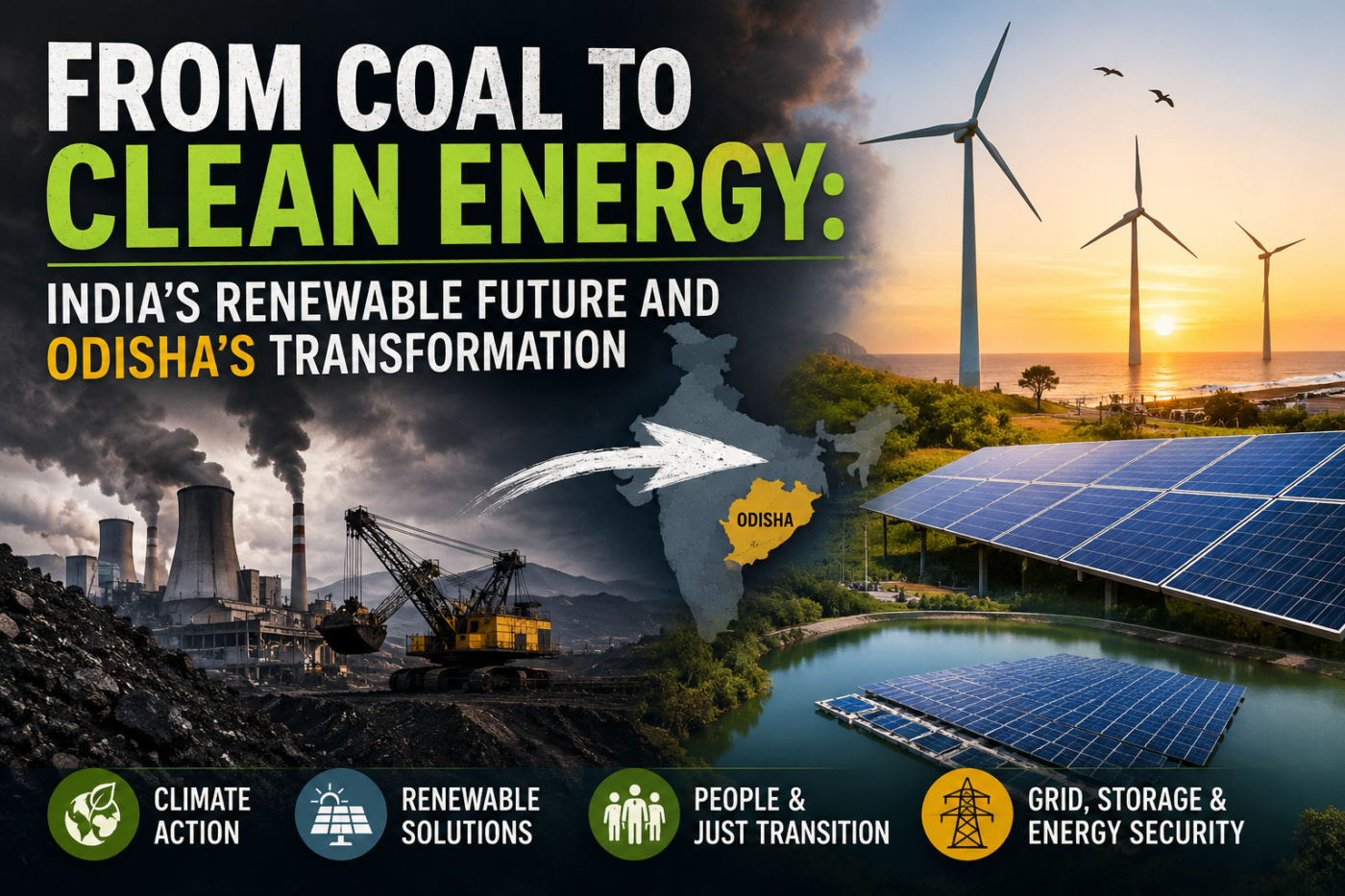
Odisha: From Coal Corridor to Coastal Wind Lab
Odisha is a powerful example of how India’s energy transition plays out in a single state, with clear trade-offs between coal-based growth and renewable potential, and strong environmental implications.
Odisha has long been part of India’s coal belt. The Jharsuguda-Sambalpur industrial corridor, home to NTPC’s Talcher Kaniha plant (about 3 GW) and several other thermal units, hosts over 10 GW of coal-based capacity. Large areas of land have been carved out for mines and power plants, leading to deforestation, altered water systems, and higher air pollution.
Coal-based development has powered jobs and industry, but it has caused degradation of landscapes, reduction in local air quality. Most importantly, it has contributed to Odisha’s Carbon footprint.
A New Opportunity: Solar and Wind
At the same time, Odisha is rich in renewable resources.
- Along the coastline, from Gopalpur to Balasore, average wind speed at 100 m height is in Class 4-5, making the area suitable for large-scale wind farms.
- The state also receives 5-5.5 kWh/m2/ day of solar radiation, opening doors for utility scale solar parks.
Odisha has already set an achievable target of 11GW of additional renewable capacity by 2030, combining solar, wind and some floating solar on reservoirs. Plans are in progress to use around 11,000 hectares of reclaimed coal-mine land for solar parks, which is presented as a way to reutilize damaged land for clean energy.
Environmental Wins and Worries
From the climate perspective, shifting from coal to solar and wind in Odisha shall significantly help. The power from sun and wind emits no combustion related gases or particles, once the plants are built. Studies show that realising Odisha’s renewable target reduces carbon dioxide emissions up to 32% in the coming years.
However, the environmental concerns are still complex than “coal = bad, renewable energy = good.”
- Land and habitat effects
Large solar parks need wide areas of land, including wastelands, agricultural land, and grazing areas. If projects are not planned properly, they can damage wildlife habitats, reduce forest connectivity, and affect soil and water systems. Solar farms may also disturb birds and local ecosystems. - Coastal and marine ecosystems
Coastal areas near Gopalpur and Puri are environmentally sensitive. Wind turbines and transmission lines may disturb bird migration, wetlands, and coastal ecosystems. Floating solar projects on reservoirs can reduce water evaporation, but they may also affect fish breeding, aquatic plants, and water temperature. - Water and pollution trade-offs
Solar and wind plants use much less water than coal plants, which is an advantage. However, manufacturing solar panels and wind equipment still requires water and energy. Poorly managed projects can also increase soil erosion and sedimentation in rivers and reservoirs. - Social dimensions: who gains and who loses?
The shift from coal to renewable energy affects workers and local communities. Coal workers may lose jobs, while renewable energy jobs often require different skills. Land acquisition for solar parks can also affect farmers and grazing communities if compensation and support are inadequate. - Energy storage and grid stability
Solar and wind energy are variable, so India needs better energy storage systems like batteries and pumped hydro storage. Without enough storage, thermal power plants must continue running, reducing efficiency. - Land acquisition and land-use conflicts
Large solar parks require huge amounts of land. In some areas, grazing lands have been converted into solar parks, affecting local livelihoods, biodiversity, and soil conditions. - Transmission bottlenecks and curtailment
Many renewable energy projects are located far from demand centres. Weak transmission systems can force grid operators to reduce renewable power generation, leading to energy wastage. - Socio-economic equity and coal’s long shadow
Even with renewable growth, many rural areas still face unreliable electricity supply. Coal remains cheaper in many situations, so India is likely to continue using coal during the long transition period.
Renewable energy shall help India reduce pollution and improve energy security. However, the country also needs better storage systems, proper land planning, stronger transmission networks, and community-focused policies to ensure a fair and sustainable energy transition.
