

Ipsa Tripathy
Bhubaneswar: Every cyclone year, Odisha becomes a masterclass in disaster management. We talk about evacuation routes, the resilience of concrete embankments. The location of relief camps, and the speed of restoration. The machinery of survival is often well-oiled and politically applauded. But in all this discussion about surviving cyclones, we rarely acknowledge the force that has been protecting Odisha long before modern disaster systems existed: Bhitarkanika.
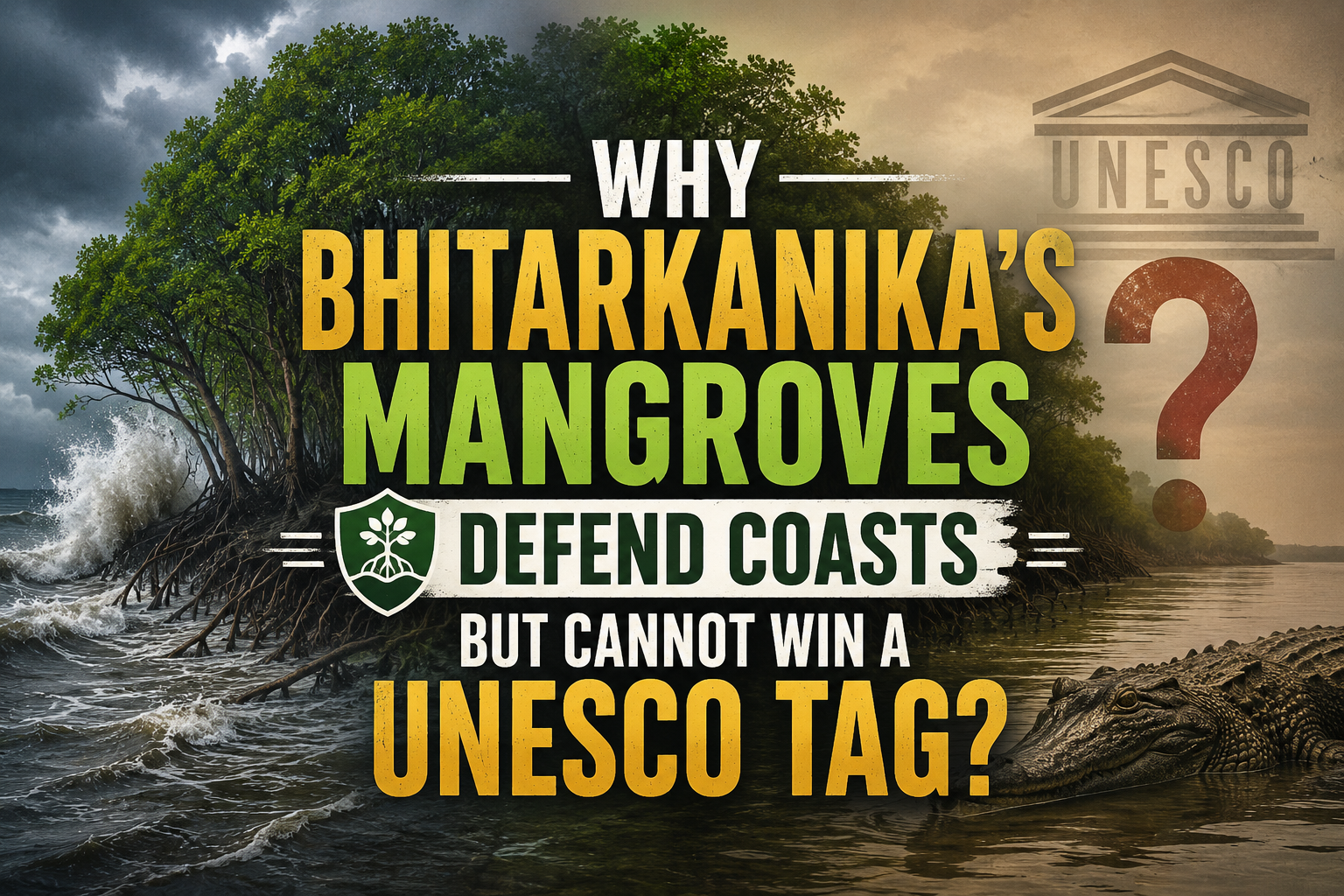
For decades, this vast mangrove ecosystem has quietly done what concrete structures often cannot. It absorbs storm surges, weakens tidal waves, prevents coastal erosion, and slows saline intrusion into farmland and freshwater systems. Long before embankments and flood-control projects, Bhitarkanika’s roots were already acting as nature’s shield for large parts of Kendrapara and Bhadrak.
And yet, despite its ecological importance, Bhitarkanika still is not a UNESCO World Heritage Site.
The Sundarbans, deservedly famous and internationally celebrated, holds the title. But many ecologists would argue that Bhitarkanika is no less significant. It is simply less visible on the global stage.
So why has UNESCO recognition remained out of reach?
Part of the answer lies in bureaucracy. Bhitarkanika was added to India’s Tentative UNESCO List in 2009, but the nomination process never gained serious momentum. UNESCO recognition demands extensive planning towards strong boundary protection, tourism management, conservation strategies, and clear integration of local communities into the ecosystem’s future.
The Sundarbans benefits from a powerful international narrative shared by both India and Bangladesh, along with the global appeal of the Royal Bengal Tiger. Bhitarkanika, by comparison, remains largely a regional story. Its iconic species, the saltwater crocodile, inspires awe, but not the same worldwide fascination.
But the deeper problem is not ecological or technical. It is political.
The Cost of Quiet Importance
Bhitarkanika suffers from a strange contradiction. It is too important to ignore completely, yet not commercially glamorous enough to become a political priority.
Highways bring ribbon-cuttings. Ports attract investment summits. Concrete embankments create visible symbols of governance. Mangroves, meanwhile, protect silently. There are no photo opportunities in a forest that prevents disaster before it happens.
As a result, conservation efforts remain fragmented and underfunded. There are environmental programs on paper, certainly, but where is the aggressive push for UNESCO status? Where is the dedicated high-level task force to fast-track the nomination? Why has there been so little urgency from either Bhubaneswar or Delhi?
Silence, in this case, has become a form of neglect.
The Tragedy of Invisibility
Perhaps the harshest irony is this, Bhitarkanika’s greatest strength lying in its quiet resilience, has also become its biggest disadvantage.
Because it protects consistently and without spectacle, people rarely notice what it prevents. But imagine the consequences if this ecosystem were severely damaged by industrial expansion, unchecked degradation, or a future super-cyclone. The loss would not remain invisible for long. Salinity would spread deeper into agricultural land. Erosion would intensify. Fishing ecosystems would collapse. Villages that once stood protected could suddenly face repeated flooding.
Only then would its true value become impossible to ignore. And that raises an uncomfortable question, why do we wait for destruction before recognizing what protects us?
What Needs to Change
Both the Odisha Government and the Central Government need to move beyond symbolic appreciation and take concrete action.
First, a joint task force involving the Ministry of Environment, Ministry of Culture, and Odisha Forest Department should be created with a fixed timeline to complete Bhitarkanika’s UNESCO nomination process. That includes stronger conservation planning, buffer-zone management, and meaningful participation of local communities.
Second, Bhitarkanika’s story needs to be told more forcefully, not just as a biodiversity hotspot, but as a frontline climate-defence system. Public campaigns should highlight how mangroves reduce storm damage, protect villages, and strengthen coastal resilience.
Third, India must prioritize Bhitarkanika within its UNESCO nomination pipeline. At the same time, Odisha should expand investment in eco-tourism, anti-poaching measures, and sustainable livelihoods for local fishing communities so conservation and economic survival can coexist.
Finally, mangroves must be recognized as natural infrastructure. Disaster management policies should formally treat mangrove health as part of coastal defence planning. What governments measure seriously, they usually fund seriously.
Cyclones come and go. Relief operations end. Headlines disappear.
But Bhitarkanika remains, season after season, storm after storm, quietly protecting Odisha’s coast without demanding attention or applause.
Yet something this significant deserves more than quiet appreciation. It deserves recognition, protection, and urgency. Not simply for tourism or international prestige, but because societies that fail to value their natural protectors often realize their importance only after they are gone.
The real question is no longer whether Bhitarkanika matters as much as the Sundarbans.
The real question is, why have we taken so long to treat it like it does?
