

Ipsa Tripathy
Bhubaneswar: When we talk about clean energy, solar panels are often presented as one of humanity’s greatest environmental success stories.Across India, solar farms are spreading across open landscapes. Rooftops are increasingly covered with gleaming panels that convert sunlight into electricity. Governments promote solar energy as a key solution to climate change, and rightly so. Unlike coal or oil, solar power generates electricity without releasing greenhouse gases into the atmosphere.
But there is a question that rarely enters the conversation. What happens when a solar panel reaches the end of its life? The answer reveals an environmental challenge that is quietly growing in the background, even as the world celebrates its transition to renewable energy.
The Solar Boom
Over the past decade, solar energy has become one of the fastest-growing sources of electricity in the world. Falling costs, government incentives, and growing concerns about climate change have accelerated adoption at an unprecedented pace. India has embraced this transition enthusiastically. Massive solar parks have emerged across several states, while residential and commercial installations continue to increase.
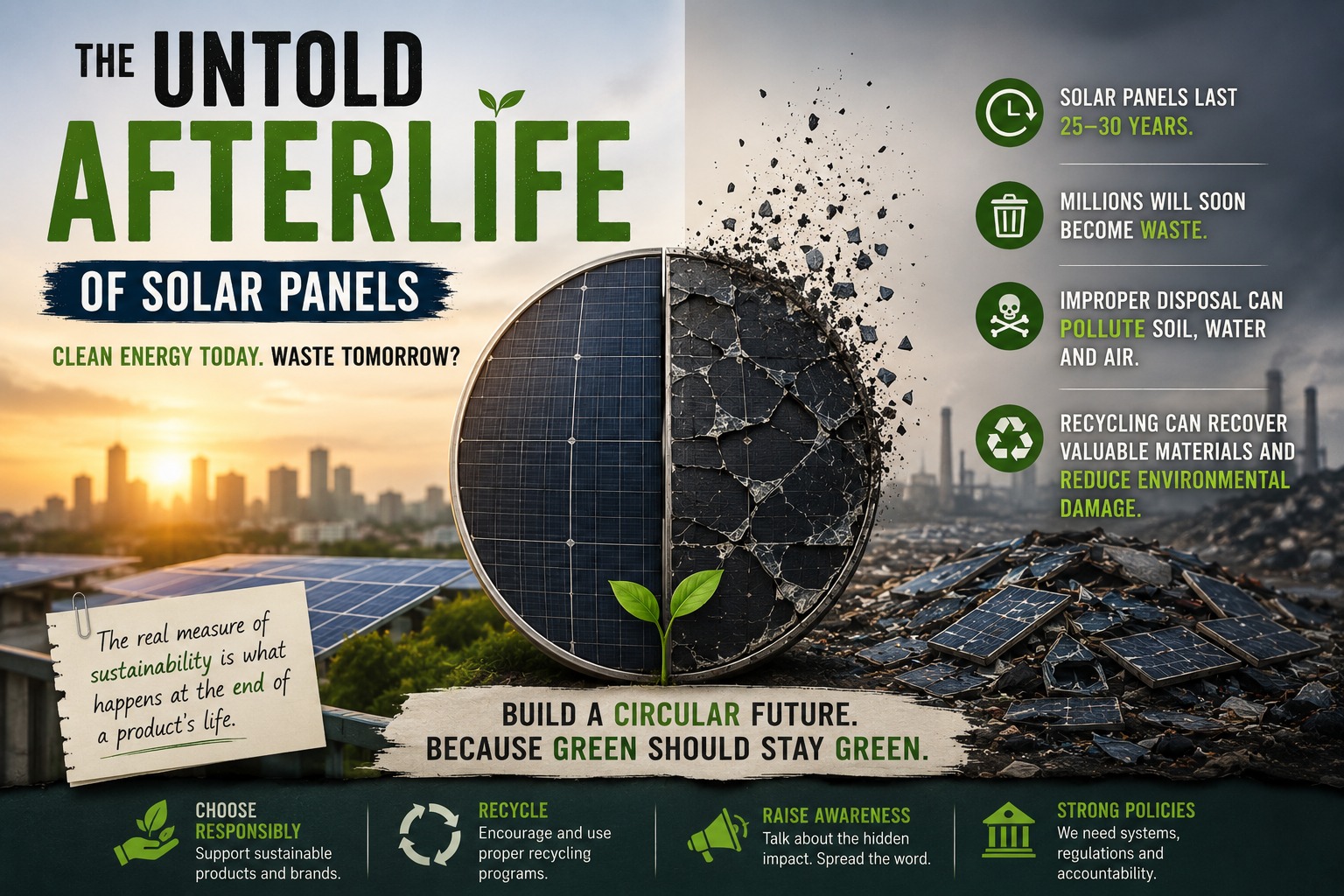
Most solar panels are designed to last between 25 and 30 years. That sounds reassuring today, especially since many installations are relatively new. However, the first generation of large-scale solar systems is gradually approaching retirement.
And when millions of panels reach the end of their lifespan, a new question emerges: where will they go?
The Waste Nobody Talks About
Unlike plastic bottles or paper packaging, solar panels are not something most people think about disposing of. A solar panel may appear simple from the outside, but it is actually a complex product made of glass, aluminum, silicon, polymers, and various metals. Some panels also contain small amounts of potentially hazardous materials.
When a panel becomes damaged, inefficient, or obsolete, it enters the waste stream. Globally, experts estimate that millions of tonnes of solar panel waste could accumulate in the coming decades. The International Renewable Energy Agency has projected that solar waste could become a significant global waste challenge as renewable energy infrastructure ages.
The irony is difficult to ignore.A technology developed to help protect the environment could eventually create its own waste management problem if proper systems are not established.
Can Solar Panels Be Recycled?
The good news is that much of a solar panel can be recycled. Glass, which makes up a large portion of a panel’s weight, can often be recovered and reused. Aluminum frames can also be recycled efficiently. Valuable materials such as silicon, silver, and copper may be extracted through specialized recycling processes. The bad news is that recycling solar panels is often expensive and technically challenging.
In many places, recycling infrastructure has not kept pace with the rapid growth of solar installations. As a result, some end-of-life panels are stored indefinitely, while others risk ending up in landfills. This is where the environmental concerns begin.
The Environmental Risks of Poor Disposal
When solar panels are disposed of improperly, they can create problems that are rarely discussed in public debates about renewable energy. Broken panels exposed to weather can gradually degrade. Over time, certain materials may leach into soil and groundwater, particularly if disposal sites are poorly managed.
Landfills are another concern. Solar panels occupy valuable landfill space, and discarding large numbers of panels means losing valuable materials that could otherwise be recovered and reused. From a sustainability perspective, sending recyclable solar panels to landfills represents a significant waste of resources.
There is also an energy dimension. Producing solar panels requires raw materials, manufacturing facilities, transportation, and energy inputs. If old panels are simply discarded rather than recycled, society loses the opportunity to recover part of that investment through material reuse.
In other words, poor disposal practices undermine some of the environmental benefits that solar energy seeks to achieve.
A Challenge for India
For countries like India, the issue deserves attention now rather than later. India is pursuing ambitious renewable energy targets and has become one of the world’s leading solar markets. This is a positive development for climate action. However, today’s installations will eventually become tomorrow’s waste.
Experts have repeatedly warned that planning for solar waste management cannot wait until the problem becomes visible.
Developing recycling facilities, establishing collection systems, and creating clear regulations will be crucial in the coming years. Without such measures, the country could face a growing volume of electronic and renewable energy waste that is difficult to manage sustainably.
The Opportunity Hidden in the Problem
Interestingly, solar waste is not only a challenge. It is also an opportunity. A strong recycling industry could create jobs, reduce dependence on imported raw materials, and support a circular economy in which valuable resources remain in use for longer periods.
Instead of viewing retired solar panels as garbage, policymakers and businesses can view them as a future source of recoverable materials. Several countries are already exploring advanced recycling technologies capable of recovering a larger percentage of valuable components. As these technologies improve, solar recycling could become an important industry in its own right.
Looking Beyond the Headlines
Climate action often focuses on replacing fossil fuels with renewable energy. That transition remains essential. Solar power will continue to play a critical role in reducing emissions and building a cleaner energy future. However, sustainability requires looking beyond immediate benefits.
Every technology has a lifecycle. What we build today eventually becomes tomorrow’s waste. The true measure of sustainability is not only how clean a product is while it is being used, but also how responsibly it is managed when its useful life ends. Solar energy remains one of the most powerful tools available in the fight against climate change. Yet the growing issue of solar panel waste serves as an important reminder that even green technologies require thoughtful planning.
The world has invested heavily in capturing the power of the sun. The next challenge is ensuring that the tools we use to harness that power do not become an environmental burden of their own.
