

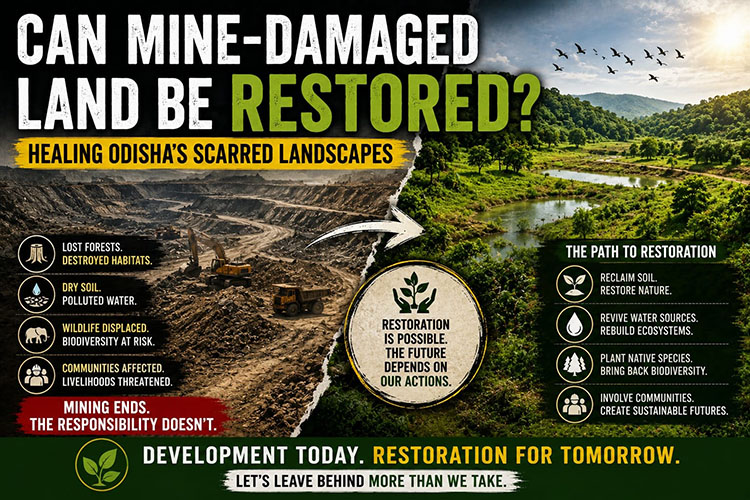
The Challenge of Healing Odisha’s Scarred Landscapes
Ipsa Tripathy
Bhubaneswar: Drive through parts of Keonjhar, Sundargarh, Angul, or Jajpur, and the story of Odisha’s development is impossible to miss. Loaded trucks move along highways carrying iron ore and other minerals. Industrial corridors continue to expand. Mining has helped fuel economic growth, generated employment, and supplied the raw materials that support modern life. The steel used in buildings, the minerals needed for infrastructure, and even components essential for renewable energy technologies all begin their journey beneath the earth.
But hidden behind this story of development lies another question, one that receives far less attention. What happens to the land after the minerals are gone? Once mining activities cease, what remains is often a dramatically altered landscape. Forests may have disappeared. Hills may have been reshaped. Large pits may remain where ecosystems once existed. For Odisha, one of India’s most mineral-rich states, this question is becoming increasingly important.
The Cost Beneath the Surface
Mining is not inherently the enemy of development. In fact, Odisha’s economic growth has been closely linked to its mineral wealth. Thousands of families depend directly or indirectly on mining-related employment. Industries, infrastructure projects, and public revenues all benefit from the sector.
However, mining inevitably changes the landscape. Before minerals can be extracted, vegetation is often cleared. Soil layers are removed. Natural drainage patterns may be altered. Wildlife habitats can become fragmented. In some cases, communities that have lived near forests and rivers for generations witness significant changes in their surroundings.
The environmental impact does not necessarily end when mining operations stop. That is where the real challenge begins.
When a Mine Closes, Nature Does Not Automatically Return
Many people assume that once mining activities cease, nature gradually reclaims the land on its own. Reality is often more complicated. A mined landscape may no longer possess the conditions required to support healthy ecosystems. Topsoil, which contains nutrients essential for plant growth, may have been removed or degraded. Water flow patterns may have changed. Native vegetation may struggle to re-establish itself.
Without intervention, abandoned mining sites can remain ecologically damaged for decades. The challenge becomes even greater when considering biodiversity. A forest is not simply a collection of trees. It is a complex ecosystem containing plants, insects, birds, mammals, fungi, and microorganisms that interact with one another. Replacing that complexity is far more difficult than planting a few saplings.
The Wildlife Question
One of the most sensitive aspects of mining is its impact on wildlife. Odisha is home to elephants, leopards, deer, numerous bird species, and a rich variety of flora and fauna. Many mining regions overlap with landscapes that support biodiversity and wildlife movement. When habitats become fragmented, wildlife faces increasing pressure.
Elephant corridors may become disrupted. Feeding grounds may shrink. Human-wildlife conflict can increase as animals move closer to settlements in search of food and space. Even after mining ends, these ecological disruptions do not automatically disappear. Restoring land therefore involves more than beautifying a landscape. It requires rebuilding habitats that can once again support biodiversity.
Water: The Hidden Concern
The condition of water resources is another critical issue. Mining can affect streams, groundwater systems, and natural drainage channels. Abandoned pits may collect water, while altered landscapes can influence how rainwater moves through an area. For communities living near former mining sites, water security often becomes a major concern.
Healthy ecosystems depend on healthy water systems. Restoration efforts that ignore water management are unlikely to succeed in the long term. This is why scientists increasingly emphasize landscape-level restoration rather than isolated rehabilitation projects.
Can Restoration Really Work?
The encouraging answer is yes, but only when it is planned carefully and supported over the long term. Around the world, examples exist of degraded mining areas being transformed into forests, wetlands, grasslands, and community-use landscapes. Successful restoration typically begins with rebuilding soil health. Native vegetation is reintroduced. Water systems are stabilized. Ecological monitoring helps track recovery over time.
The keyword here is “native.” Experts increasingly warn against treating restoration as a simple tree-planting exercise. A restored ecosystem should resemble the natural landscape that once existed there as closely as possible. This means using local species, protecting wildlife movement, and restoring ecological functions rather than merely improving appearances.
Odisha’s Opportunity
For Odisha, mine restoration is not just an environmental issue, it is a development issue. The state has an opportunity to demonstrate that economic growth and ecological responsibility can coexist. As mining projects mature and some eventually approach closure, restoration planning must become part of the development process itself rather than an afterthought. This includes stronger mine closure plans, long-term monitoring, community participation, and scientific restoration strategies.
Local communities can play a particularly important role. Many possess deep knowledge of native ecosystems and can contribute meaningfully to restoration efforts. The success of rehabilitation should not be measured by how quickly vegetation returns, but by whether the land can once again support biodiversity, water resources, and sustainable livelihoods.
Beyond Extraction
The conversation around mining often focuses on what is extracted from the earth. Perhaps it is time to pay equal attention to what is left behind. The true measure of responsible mining is not only the value of the minerals removed. It is also the condition of the landscape after extraction ends. For a state like Odisha, whose future is tied both to development and environmental stewardship, restoring mine-damaged land is not merely a technical challenge. It is a test of long-term vision.
Mining may be temporary. The land remains. The decisions made today will determine whether future generations inherit scarred landscapes or restored ecosystems capable of sustaining life once again. That choice may ultimately define what sustainable development means for Odisha in the decades ahead.
