

Ipsa Tripathy
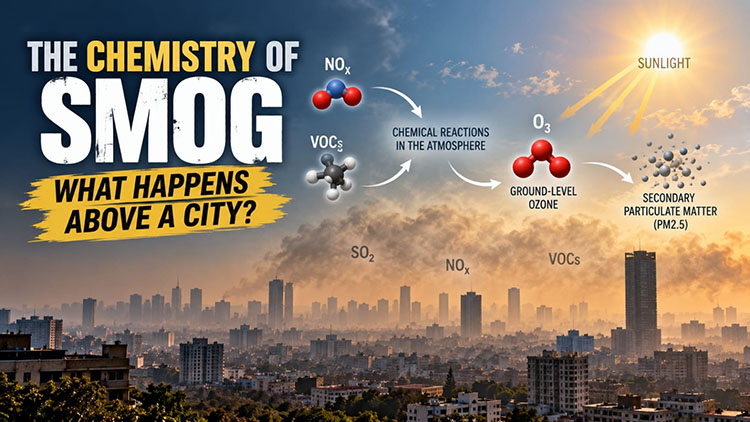
Bhubaneswar: A city can look perfectly ordinary from the ground while a complex chemical system is unfolding above it. Every vehicle, industrial facility, fuel burning process, paint, solvent and many other activities release gases and particles into the atmosphere. Once these emissions enter the air, they do not simply remain in the same form. Sunlight, temperature, humidity, wind and atmospheric chemistry begin transforming them.This is the chemistry behind smog.The word smog originally described a combination of smoke and fog, but the term is now commonly associated with polluted air containing ground level ozone and other pollutants. Modern photochemical smog is produced through atmospheric reactions involving nitrogen oxides, volatile organic compounds and sunlight. Ground level ozone is particularly important because it is not normally emitted directly from a source. It is formed in the atmosphere.
The chemistry begins with emissions. Nitrogen oxides, collectively called NOx, are produced mainly during high temperature combustion. Vehicles, power plants, industrial boilers and other combustion processes are important sources. Volatile organic compounds, or VOCs, come from numerous sources including fuels, solvents, paints, industrial processes and some consumer products. Carbon monoxide and methane can also participate in atmospheric ozone chemistry.
Sunlight then drives a series of reactions. One important step involves nitrogen dioxide, or NO₂, absorbing sunlight and breaking apart to produce nitric oxide and an oxygen atom:
NO₂ + sunlight → NO + O
The oxygen atom can then react with molecular oxygen:
O + O₂ → O₃
This produces ozone. But the chemistry does not stop there. In an atmosphere containing only NOx, ozone can also be rapidly consumed when it reacts with nitric oxide. VOCs change this chemical balance by generating highly reactive organic radicals during atmospheric oxidation. These radicals participate in reactions that convert NO back toward NO₂ without consuming ozone in the same way. The result can be a net accumulation of ground level ozone. The actual chemistry is considerably more complicated, involving hundreds of chemical species and reaction pathways.
This is why ozone pollution is a chemical problem rather than simply a pollution source problem. A vehicle does not need to emit ozone directly for it to contribute to ozone formation. It can release NOx and VOCs that later participate in atmospheric reactions. Similarly, emissions from an industrial facility can contribute to ozone formation downwind rather than only at the point where they were released.Meteorology controls much of this chemistry. Strong sunlight provides the energy required for photochemical reactions. Warm conditions can favour ozone formation, while stagnant air allows pollutants and their reaction products to accumulate. Under suitable conditions, ozone concentrations often rise later in the day after emissions released earlier have undergone atmospheric processing.
But ozone is only part of the story.The atmosphere above a city is also a chemical reactor for secondary particulate matter. Some particles are emitted directly from sources such as fires, construction activities, vehicles and industrial processes. These are called primary particles. Others are formed after gaseous pollutants undergo chemical transformation in the atmosphere. These are secondary particles.
Sulphur dioxide is one example. It can be released from combustion and industrial sources and subsequently oxidised in the atmosphere to form sulphuric acid. The acid can then condense onto existing particles or contribute to the formation of new particulate material. Nitrogen oxides can undergo oxidation and form nitrate compounds. Ammonia can react with acidic species to form ammonium salts. These reactions contribute to fine particulate pollution, including PM2.5.
Organic chemistry adds another layer. VOCs are oxidised by atmospheric oxidants such as the hydroxyl radical and ozone. Their oxidation products can have lower volatility than the original gases. Some can therefore condense into the particle phase and contribute to secondary organic aerosol, an important component of atmospheric fine particulate matter.
The chemistry also continues after sunset. Ozone production through sunlight driven reactions decreases at night, but the atmosphere does not become chemically inactive. Nitrate radicals and dinitrogen pentoxide can participate in nighttime reactions involving NOx and VOCs. These reactions can alter the chemical composition of pollutants and influence the conditions encountered the following day.
There is therefore no single chemical equation that completely describes smog. A polluted urban atmosphere is a constantly changing network of reactions. Pollutants are emitted, transported, oxidised, converted into new compounds, deposited on surfaces or removed by precipitation. Some products remain in the gas phase, while others become particles.An important consequence is that the pollution measured above a city does not necessarily represent only what was emitted within that city. Ozone and secondary particulate matter can form after precursor gases have travelled away from their original sources. Ground level ozone, for example, can affect areas hundreds of miles downwind from where its precursor pollutants were emitted.
Modern atmospheric science therefore treats a city not as an isolated container of pollution, but as part of a larger chemical and meteorological system. Scientists use ground measurements, aircraft observations, satellites and chemical transport models to understand these processes.What appears from the ground to be a layer of haze is therefore much more complicated than smoke hanging above buildings. Above a city, sunlight is driving chemical reactions, gases are being oxidised, particles are forming and pollutants are being transported simultaneously. Smog is not simply something released into the atmosphere. Much of it is produced by what the atmosphere does to the emissions after they leave their sources.That is what makes air pollution particularly difficult to control: we are not only dealing with what comes out of a chimney or exhaust pipe, but also with the chemistry that happens afterwards.
