

Ipsa Tripathy
Bhubaneswar: Along Odisha’s coastline, some of the most important natural structures are easy to overlook. They are not forests, seawalls or large engineering projects. They are ridges of sand formed by wind and waves, rising between the beach and the land behind it. Coastal sand dunes are geomorphological features created when wind transports sand inland from the beach and deposits it where vegetation or changes in the landscape slow the movement of sand. Over time, repeated deposition can produce elevated ridges and larger dune systems. Different types of dunes can develop depending on their position, shape and stage of formation.
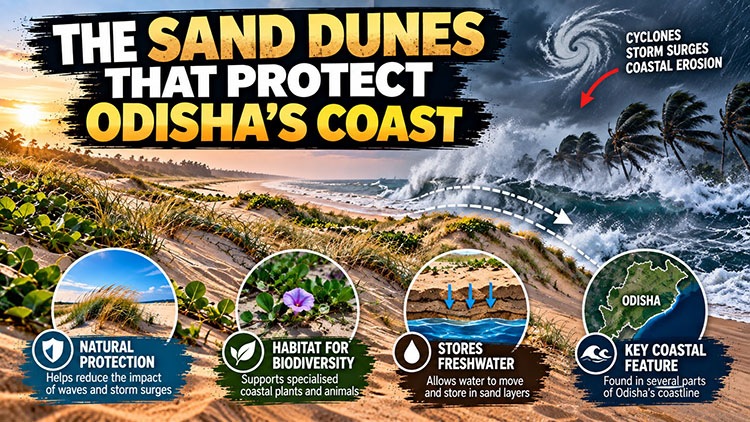
These dunes perform an important physical function. They form a natural barrier between the sea and areas further inland. During high-energy coastal events, including storms and storm surges, dunes can absorb part of the energy of waves and help reduce the direct movement of seawater and sand towards inland areas. The National Centre for Sustainable Coastal Management describes coastal sand dunes as physical barriers for coastal protection as well as habitats for coastal plants and animals.
The protection does not come from the sand simply sitting in one place. A dune is a dynamic system. Wind moves sand across its surface, while plants growing on the dune can trap and stabilise some of that sediment. Roots help hold sand together, while vegetation reduces the speed of wind close to the ground. At the same time, storms and strong waves can remove sand from a dune and redistribute it along the coast.
This movement is part of the natural behaviour of a sandy coastline. A dune can therefore change in height, shape and position over time. Its ability to absorb disturbance depends on the amount of available sand, vegetation, wind, waves, storms and the wider coastal sediment system.
Odisha has several areas where these formations occur. They are found along parts of southern Odisha, the Konark, Puri and Satapada coastline and sections of Ganjam. Sand dunes also occur along parts of the Balasore coast, including areas associated with casuarina vegetation.
Their ecological importance extends beyond coastal protection. Sand dunes support specialised plants and animals that can survive in conditions of shifting sand, strong winds, salt exposure and limited freshwater. A National Centre for Sustainable Coastal Management project recorded 21 plant species belonging to 15 families and 21 genera in the sand dune area of Shamuka Beach in Odisha. The same project identified threats including erosion, declining water tables, overgrazing, housing and industrial development, road construction, plastic waste and sand mining.
The physical structure of dunes also has a relationship with groundwater. Research on the southern Odisha coast found that sandy dune formations have high porosity and permeability, allowing water to move through the sediment. In some areas, these formations act as groundwater storage zones. The same study noted that freshwater stored in coastal dune systems can be used by people living in coastal areas where surface water and groundwater resources are affected by saline conditions.
This makes the loss of dunes an environmental issue rather than simply a change in the appearance of a beach. Odisha’s coastline is already experiencing significant changes. A National Centre for Coastal Research assessment covering 564.14 kilometres of the state’s coastline between 1990 and 2022 found that about 28.3 per cent of the analysed coast was affected by erosion. The assessment found considerable differences between districts, with erosion affecting 47.6 per cent of the analysed coastline in Jagatsinghpur, 45.7 per cent in Ganjam and 45 per cent in Kendrapara.
Coastal erosion has multiple causes and cannot be attributed to the loss of dunes alone. Waves, tides, currents, sediment movement, storms and human activities can all influence shoreline change. The National Centre for Coastal Research has also documented loss of vegetation and sand dunes along parts of the Pentha and Satabhaya coast. Human activity can interfere with the processes that maintain dune systems. Construction, roads, sand extraction, vegetation removal and other forms of coastal development can disturb the movement of sediment or damage dune vegetation. Once a dune system is fragmented or degraded, its natural ability to store and move sand can change.
This is why Odisha has now moved towards a dedicated Coastal Sand Dune Management Plan. The Odisha Coastal Zone Management Authority decided in 2026 to prepare the plan under the Coastal Regulation Zone Notification, 2019. Sand dunes are recognised as ecologically sensitive geomorphological features under India’s coastal regulation framework. Protecting these formations does not mean treating every dune as a permanent wall. Their value comes from being functioning, changing coastal systems. They move, store sediment, support vegetation and wildlife, and provide a physical buffer between the sea and the land.
For a state with a long coastline and repeated exposure to cyclones, storm surges and coastal erosion, preserving that natural system is an important part of coastal management. The sand may look ordinary. The function it performs is not.
