

Ipsa Tripathy
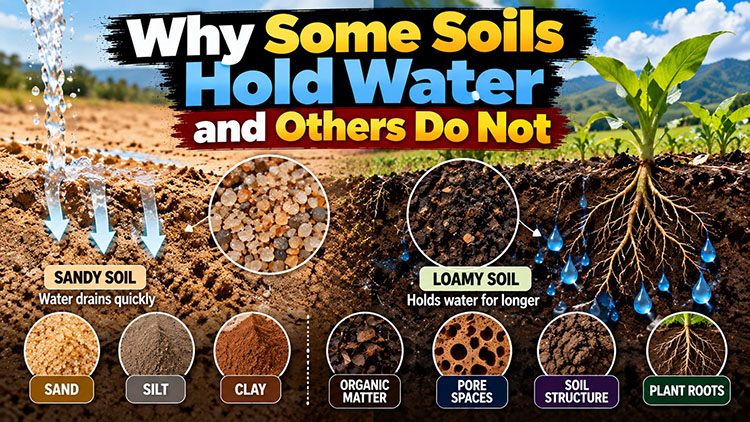
Bhubaneswar: Rain falls on the ground, but not all of it behaves in the same way once it reaches the soil. In one place, water may disappear quickly below the surface. In another, it may remain in the soil for days. The difference is not simply how much rain has fallen. It depends on the physical structure and composition of the soil. Soil is made up of mineral particles of different sizes, mainly sand, silt and clay, along with organic matter, water, air and living organisms. The relative amounts of sand, silt and clay determine soil texture, which strongly influences how water moves through and is stored in the soil.
Sand has the largest particles of the three. The spaces between individual sand grains are generally relatively large, allowing water to move through them quickly. Sandy soils therefore tend to have relatively high infiltration rates but generally hold less water than fine textured soils. Silt particles are smaller than sand and can hold more water. Clay particles are much smaller still and have a very large surface area relative to their size. Water is attracted to these surfaces, and soils containing larger proportions of clay and silt generally have greater water holding capacity than sandy soils.
But the size of the particles is only part of the story. What matters just as much is the space between them. These spaces are called soil pores. Large pores allow water and air to move relatively quickly through the soil, while smaller pores can retain water against gravity. A soil therefore needs a mixture of pore sizes to both accept water and retain some of it.
This helps explain why a soil that allows water to enter quickly does not necessarily hold the most water. Sandy soil can have rapid infiltration because of its larger pores, but water can also drain away rapidly. Fine textured soil can retain considerably more water, although some of that water may be held so tightly that plants cannot easily use it.
Scientists distinguish between the water a soil contains and the water that plants can actually use. After a saturated soil drains under gravity, it reaches what is known as field capacity. As plants continue to remove water, the remaining water becomes increasingly difficult for roots to extract. At the wilting point, plants can no longer obtain enough water to maintain their water needs. The amount between these conditions is commonly described as available soil water.
Soil structure adds another layer to this process. Structure refers to the way individual sand, silt and clay particles are arranged into aggregates or larger units. These aggregates create networks of pores through which water and air can move.
Two soils can therefore have similar proportions of sand, silt and clay but behave differently if their structures are different. Plant roots, organic matter and soil organisms contribute to the formation and stability of soil aggregates. Well developed structure can provide connected pores that allow rainfall to infiltrate while also creating smaller spaces where water can be retained.
Infiltration is the process by which water at the soil surface enters the soil. Its rate depends on several factors, including texture, structure, soil moisture, compaction and the condition of the soil surface. A soil with continuous pores leading from the surface can allow rainfall to enter relatively easily. Compaction can reduce pore space and restrict water movement.
Organic matter is also important. It comes from plant residues, roots, microorganisms and other biological material at different stages of decomposition. Organic matter contributes to the formation and stability of soil aggregates, which can improve pore structure and infiltration. It can also increase the soil’s ability to retain water, although the size of this effect varies with soil type and other properties.
The relationship between organic matter and water is therefore more complicated than simply saying that adding organic matter always increases water storage by a fixed amount. Research has found that its effect depends on texture, the amount and type of organic material and other characteristics of the soil.
Vegetation connects many of these processes. Roots create channels through soil and contribute organic material as they grow and die. Root activity and soil organisms can help form aggregates, while plant residues on the surface can protect soil from raindrop impact and reduce surface sealing. These processes can increase infiltration and reduce runoff under suitable conditions.
The importance extends beyond agriculture. When rainfall infiltrates soil, some of the water can remain available to plants, while some continues downward through the soil profile. Depending on local geology, soil properties and groundwater conditions, infiltrating water can contribute to groundwater recharge. Soil can also act as a physical and biological filter, although its ability to retain or transform pollutants varies with the contaminant and soil conditions.
This is why there is no single answer to the question of which soil is “best” at holding water. Sandy soils generally allow faster movement, clay rich soils generally retain more water, and loamy soils can provide a balance between drainage and storage. But texture alone does not determine how a soil behaves. The amount and arrangement of pore spaces, organic matter, soil structure, vegetation, roots, compaction and soil depth all influence what happens after rain reaches the ground.
A handful of soil may look like an ordinary mixture of earth. Beneath its surface, however, is a complex network of particles and pores that determines whether rainwater runs away, moves downward, remains stored or becomes available to plants. Understanding that hidden system is essential to understanding how landscapes respond to both heavy rainfall and periods of water scarcity.
