

Ipsa Tripathy
Bhubaneswar: When rain falls on a forest or open field, much of the water can enter the soil. Some is taken up by plants, some moves deeper into the ground, some evaporates, and some flows across the surface into streams and other water bodies.
A city changes that pathway.
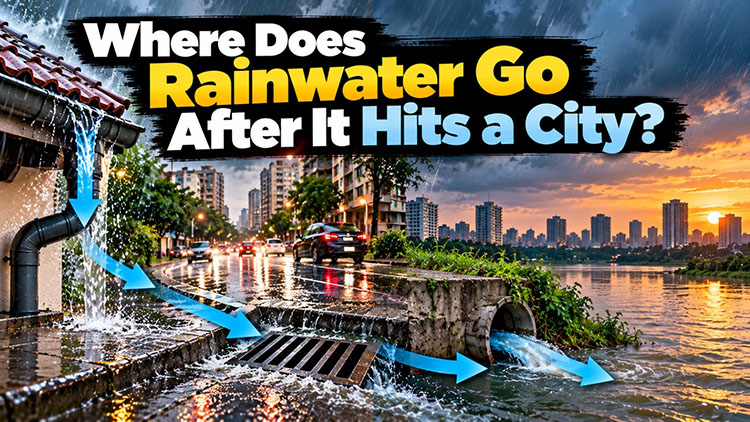
Roofs, roads, pavements, parking areas and other hard surfaces cover large parts of urban land. These surfaces are generally impervious, meaning that water cannot readily infiltrate through them. As a result, rainfall that might otherwise enter the soil is converted into surface runoff and moves across the built environment. The journey often begins on a roof. Rainwater flows towards gutters and downpipes and may be discharged onto the ground, collected in a drainage system or stored for later use. On roads and pavements, water follows the slope of the surface until it reaches a low point, roadside drain or stormwater inlet.
This movement is much faster than it would be across many natural landscapes. Urban drainage networks are specifically designed to collect and convey water, allowing runoff to reach streams and other receiving waters more quickly. Research by the US Geological Survey shows that urbanisation can increase both the speed and volume of runoff because vegetation and permeable soil are replaced by impervious surfaces and engineered drainage networks.
But not every drop necessarily disappears into a drain.
Some rainwater can still infiltrate through gardens, parks, exposed soil, tree pits and other permeable areas. How much enters the ground depends on factors such as soil type, soil moisture, vegetation, surface condition and the intensity of rainfall. If the soil is already saturated, its ability to accept additional water is reduced and more rainfall becomes runoff. The water that does infiltrate can move downward through the soil. Some remains in the soil and becomes available to plants. Some continues downward and, under suitable geological and hydrological conditions, contributes to groundwater recharge. When urbanisation reduces infiltration, less rainfall reaches the ground in the places where it falls, potentially reducing local groundwater replenishment.
The water moving across a city also collects material from the surfaces it crosses.
Rainwater flowing over roads can pick up sediment, oil, grease and other substances associated with vehicles and traffic. Runoff from gardens and landscaped areas can carry nutrients and pesticides. Construction areas can contribute large amounts of sediment. Litter and other waste can also be transported by stormwater. This is why the first water flowing from a city during a rainfall event can contain pollutants that accumulated on urban surfaces during dry periods. Stormwater can transport these materials into drains, streams, lakes, wetlands, rivers and coastal waters.
Storm drains, however, are not necessarily wastewater treatment systems. In many urban drainage arrangements, their primary purpose is to move excess water away from streets and buildings. Depending on the local system, collected stormwater may eventually be discharged into a nearby water body. The difference between natural and urban landscapes becomes particularly important during heavy rainfall. In a vegetated watershed, rainfall is slowed by plants and surface roughness, while soil can absorb part of the water. In a highly developed watershed, large areas of impervious surface can produce faster runoff and higher peak flows in nearby streams. This can increase the likelihood of urban and downstream flooding.
Fast runoff can also affect rivers themselves. Increased stormwater flow can increase erosion of stream channels and banks, alter sediment movement and change the physical conditions experienced by aquatic organisms. Runoff flowing over hot impervious surfaces can also transfer heat to receiving waters. Cities therefore do not simply have a problem of getting rid of rainwater. They have to manage where that water goes, how quickly it moves and what it carries with it.
One approach is to give rainwater more opportunities to behave as it would in a natural landscape. Rain gardens, vegetated swales, permeable pavements, green roofs, infiltration areas and rainwater storage systems can slow runoff, allow some water to infiltrate and, in suitable conditions, reduce the amount of water entering conventional drainage systems.
Vegetation is important in these systems because plants can slow water movement, while soil provides space for infiltration and storage. These systems can also help retain or remove some pollutants, although their effectiveness depends on their design, maintenance, soil conditions and the pollutants involved.
The path of rainwater through a city is therefore not a single journey. One drop may remain temporarily on a roof, flow through a drain and reach a river. Another may enter a garden, move through the soil and eventually contribute to groundwater. Another may evaporate or be taken up by vegetation. What happens after rainfall reaches a city depends largely on the landscape beneath it. The more a natural surface is replaced by roads, buildings and other impervious areas, the more the urban water cycle shifts towards rapid runoff and away from infiltration.
Rain does not simply fall on a city and disappear. It follows the pathways that the city has created.
