

Prof. Surendranath Pasupalak
- Introduction and Objectives
Weak or stalled monsoon phases are often attributed to inadequate atmospheric moisture or to large-scale climatic drivers such as El Niño. However, rainfall efficiency depends not only upon the availability of moisture but also upon the ability of the atmospheric circulation to convert stored thermodynamic energy into organised vertical motion and precipitation.
The present study examines the June 2026 monsoon from the perspective of vertical coupling and transport constraints. The principal objective is to determine whether the observed atmospheric conditions are better explained by a moisture-deficit paradigm or by a dynamically constrained system characterised by impaired conversion of stored energy into sustained deep convection. Specific propositions concerning moisture availability, convective potential, convective inhibition, synoptic forcing and upper-level ventilation are evaluated quantitatively.
- Methodology
The present investigation adopts a proposition-based framework grounded in moist thermodynamics, parcel theory and mass continuity. Individual propositions concerning moisture availability, convective potential, convective inhibition, synoptic forcing and upper-level ventilation are evaluated using standard atmospheric diagnostics and their consistency with the observed behaviour of the June 2026 monsoon.
The thermodynamic and kinematic analyses were based on representative upper-air profiles over Coastal Odisha and the north-west Bay of Bengal during the period 1–15 June 2026. Atmospheric parameters were derived from 0000 UTC and 1200 UTC radiosonde soundings, satellite-derived Atmospheric Motion Vectors and regional reanalysis products representative of the early monsoon environment.
Integrated diagnostics such as precipitable water vapour, Convective Available Potential Energy (CAPE), Convective Inhibition (CIN), Level of Free Convection (LFC), vertical wind structure and upper-level divergence fields were subsequently calculated from these atmospheric profiles. .
- Results and Discussion
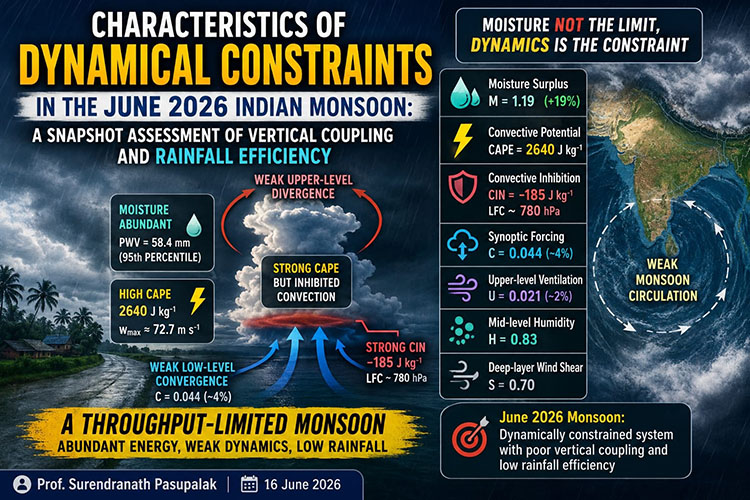
Proposition 1: Moisture supply was not limiting
The moisture efficiency factor was estimated as
M=\frac{22.1}{18.5}=1.19
It indicates a surplus moisture capacity of approximately 19 per cent.
Precipitable water vapour reached 58.4 mm, corresponding to approximately the 95th percentile for June conditions.The atmosphere, thus, contained abundant moisture, inconsistent with a simple moisture-deficit explanation.
Proposition 2: Significant convective potential existed
The Convective Available Potential Energy (CAPE) reached
2640 J,kg^{-1}
indicating a substantial reservoir of buoyant energy.
The theoretical maximum updraught velocity may be approximated by
w_{max}\approx \sqrt{2\times2640}
which yields
w_{max}\approx72.7 m s^{-1}.
The atmosphere possessed sufficient thermodynamic energy to support vigorous convection.
Proposition 3: Convective inhibition (CIN) represented a major barrier
CIN=-185 J,kg^{-1}
while the Level of Free Convection was elevated to approximately 780 hPa.
These values indicate that parcels required strong external lifting before free convection could be established.
Proposition 4: Synoptic forcing was severely deficient
The normalised convergence factor was estimated as
C=\frac{0.2}{4.5}=0.044.
Thus, low-level forcing operated at only about four per cent of the climatological benchmark.
It means, the mechanical lifting associated with monsoon lows, monsoon troghs, circulations and depression was exceptionally weak.
Proposition 5: Upper-level ventilation was strongly constrained
The ventilation factor was
U=\frac{0.08}{3.8}=0.021.
This corresponds to approximately two per cent of the climatological reference value.
Proposition 6: Mid-tropospheric humidity imposed secondary limitations
The humidity factor was estimated as
H=\frac{62}{75}=0.83.
Dry-air entrainment likely contributed to convective suppression, although its influence was smaller than that associated with deficient synoptic forcing and weak upper-level divergence.
Proposition 7: Deep-layer wind shear contributed additional constraints
The normalised shear factor was estimated as
S=0.70.
Enhanced shear may have reduced convective coherence and further diminished rainfall efficiency.
Integrated Interpretation:
The calculations collectively indicate that June 2026 was characterised by abundant moisture, elevated convective potential and substantial moist static energy. However, strong convective inhibition, deficient low-level convergence and weak upper-level divergence imposed severe bottlenecks on the vertical transport of mass and energy.
The observational evidence is therefore consistent with a throughput-limited monsoon state in which stored thermodynamic energy was inefficiently converted into organised rainfall.
- Conclusion
The June 2026 monsoon appears to represent a dynamically constrained atmospheric system rather than one limited primarily by moisture supply. Although thermodynamic conditions remained favourable, weak synoptic forcing and inadequate upper-level ventilation imposed severe restrictions on the conversion of stored energy into sustained deep convection.
The results suggest that rainfall deficits during this period were associated more closely with a failure of vertical coupling than with an absence of atmospheric moisture. The atmosphere possessed substantial convective potential, but the mechanisms required to release that potential efficiently remained impaired. El Niño acts at the background, but not as the primary cause of slow and weak monsoon 2026 - Limitations of the Present Study
The present analysis should be regarded as a quantitative hypothesis assessment rather than a definitive attribution study. The calculations are based upon representative atmospheric profiles over Coastal Odisha and the north-west Bay of Bengal during the first half of June 2026 and do not incorporate full spatial fields covering the entire Indian monsoon domain. Temporal evolution of the circulation has likewise not been examined in detail.
Although the diagnostics are physically consistent, broader analyses using ERA5 reanalysis, IMD rainfall observations, satellite-derived outgoing longwave radiation and velocity potential fields would be required to establish the robustness of the inferred mechanisms. Furthermore, the normalised efficiency factors employed in this study are intended only as conceptual indicators and should not be interpreted as fundamental physical laws.
