

Ipsa Tripathy
Bhubaneswar: When a tree dies, it may appear to have reached the end of its role in the forest. Its leaves disappear, its branches become brittle, and eventually its trunk may fall to the ground. But ecologically, the story is far from over. A dead tree can become a source of food, shelter and nutrients, supporting a range of organisms that depend on decaying wood to survive.
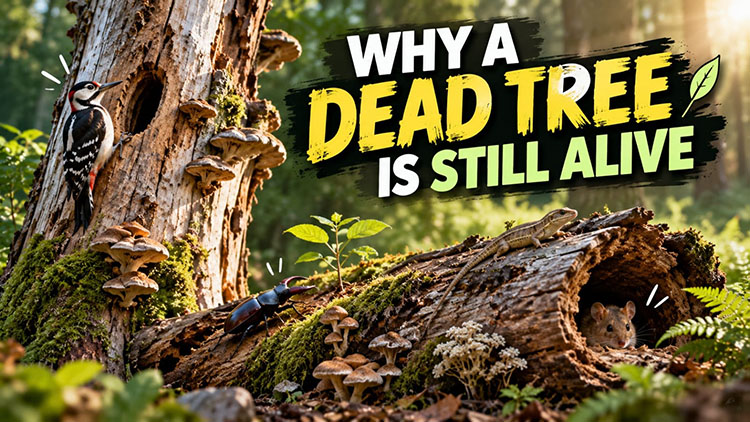
Standing dead trees, commonly called snags, and fallen logs are important components of forest ecosystems. They provide habitats for insects, fungi, birds, small mammals and other organisms. As the wood gradually breaks down, it also returns nutrients and organic matter to the soil.
What looks like the remains of a tree can therefore become an essential part of the forest’s continuing cycle of life.A living tree already supports a wide variety of life, from insects beneath its bark to birds nesting in its branches. After the tree dies, its physical structure continues to provide valuable habitat. Cracks, loose bark, hollow sections and cavities create spaces where animals can shelter, rest or reproduce.
Insects are among the organisms that exploit many dead trees. Certain beetles and their larvae feed on wood or the fungi growing within it, while other invertebrates use the spaces beneath the bark. These organisms, in turn, provide food for insect-eating birds and other predators. Woodpeckers and some other birds can excavate cavities in dead or decaying trunks, creating nesting sites that may later be used by different animals.
The importance of these structures changes as the wood ages. A newly dead tree may retain much of its original shape and bark, while an older snag may develop hollows and break apart. Once it falls, the trunk becomes part of the forest floor, where it offers a different combination of shelter, moisture and food. Not every dead tree supports the same species; its value depends on tree type, size, condition and the surrounding habitat.
Fungi play a central role in the transformation of dead wood. Their microscopic filaments, called hyphae, spread through the wood and release enzymes that break down complex materials such as cellulose and lignin. These substances form much of the structural framework of plant cell walls and can be difficult for many organisms to digest.
Different fungi break down wood in different ways. Some primarily decompose cellulose and hemicellulose, while others can also break down lignin. This gradual process softens the wood and makes it accessible to other organisms, including insects and microorganisms. Fungi are therefore not simply growing on dead trees; they are actively transforming plant material into forms that can re-enter the ecosystem.
Decomposition depends on environmental conditions. Moisture, temperature, oxygen availability, the type of wood and the organisms present all influence how quickly a log breaks down. A fallen trunk in a damp forest may decompose differently from one exposed to intense sunlight or prolonged dry conditions. Consequently, dead wood can remain in a forest for years or even decades, depending on its size, composition and environment.
As fungi, bacteria and other decomposers break down wood, nutrients and organic matter gradually become part of the forest floor. These materials contribute to soil formation and help sustain the biological processes that support plant growth. The process is not immediate: nutrients remain locked within the wood until decomposition releases them.
Fallen logs can also retain moisture. Their structure provides spaces that hold water, creating relatively damp microhabitats during periods when the surrounding forest floor may be drier. Mosses, fungi and small invertebrates can benefit from these conditions. In some forests, decaying logs also provide suitable surfaces for seedlings to establish, earning them the name nurse logs. A log may retain moisture, accumulate organic matter and offer a place for young plants to grow away from some of the competition found on the surrounding ground. These benefits vary with climate, species and local conditions.
Dead wood also contributes to the forest carbon cycle. The carbon stored in a tree during its life does not disappear when the tree dies. Some is gradually released into the atmosphere as organisms decompose the wood and respire, while some remains in dead material and soil organic matter for varying periods. The balance depends on decomposition rates and environmental conditions.
A forest’s ecological condition cannot be understood by counting living trees alone. Dead wood provides structures and resources that living trees cannot always replace. Species that feed on decaying material, nest in cavities or require damp spaces beneath logs may depend on these features for important stages of their life cycles.
Removing every dead tree and fallen trunk can therefore reduce habitat availability and interrupt natural decomposition processes. However, retaining dead wood also requires consideration of local conditions. In some places, large accumulations of dry woody material can increase available wildfire fuel, and standing dead trees near roads or frequently used areas can pose safety risks.
Forest management must balance these concerns with the ecological value of dead wood rather than assuming that all dead trees should either be removed or left in every situation.The next time a fallen trunk lies across a forest floor, it is worth looking beyond its weathered surface. Beneath loose bark, fungi may be breaking down wood; insects may be feeding or sheltering; and the damp surface may provide a place for mosses or seedlings to establish. The tree has stopped growing, but its materials and structure continue to support life.
A forest is sustained not only by growth, but also by decay. Dead trees connect wildlife habitat, nutrient cycling, soil development and carbon movement in one continuing ecological process. Protecting forest biodiversity therefore means recognising that a tree’s contribution to the ecosystem does not necessarily end when its life does.
