

Ipsa Tripathy
Bhubaneswar: For decades, humanity has relied on engineering, public policy, and environmental awareness to fight climate change and ecological degradation. These efforts remain essential. Yet today, a new scientific frontier is emerging that could dramatically change how we understand, monitor, and protect our planet: quantum science.
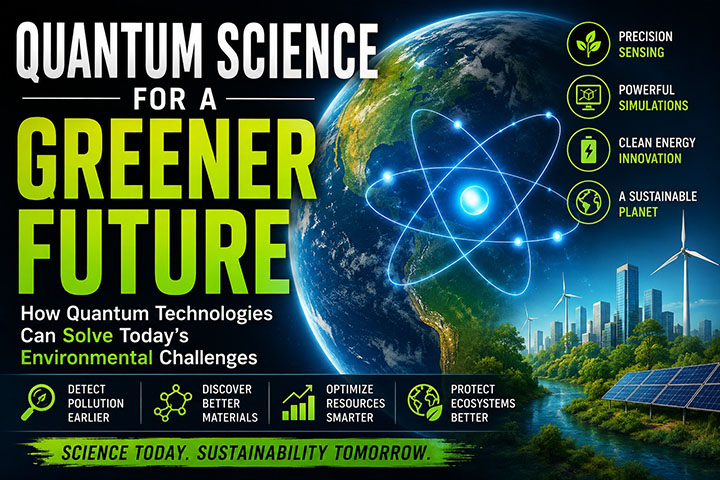
As a quantum physicist, I believe quantum technology is no longer a futuristic concept confined to research laboratories and scientific journals. It is rapidly evolving into a practical scientific tool with the potential to address some of the world’s most difficult environmental challenges. From climate monitoring and clean energy development to pollution detection and smarter resource management, quantum science may become one of the defining technologies of sustainable development in the 21st century.
The importance of quantum science does not lie in science-fiction fantasies or distant technological dreams. Its significance comes from a far simpler reality: nature itself operates according to the laws of quantum mechanics. When we learn to harness those laws, we gain entirely new ways to measure, simulate, and optimize the world around us.
Understanding the Quantum Advantage
Quantum science studies matter and energy at the smallest scales — atoms, electrons, and photons. At this level, particles behave very differently from the objects we interact with in everyday life. These unusual quantum behaviors are now being used to build technologies with extraordinary precision and computational power.
Today, the field is advancing across three major areas:
- Quantum computing
- Quantum sensing
- Quantum communication
Among these, quantum sensing and quantum computing hold particularly powerful applications for environmental science.
Modern environmental systems are incredibly complex. Climate behavior, atmospheric chemistry, groundwater movement, agricultural systems, and energy networks all involve millions of interconnected variables. Traditional technologies often struggle when systems become too large, too dynamic, or too sensitive to measure accurately.
Quantum technologies offer a new approach. They allow scientists to study environmental systems with a level of precision and computational capability that was previously impossible.
Quantum Sensors: A New Way of Seeing the Planet
One of the most promising environmental applications of quantum science lies in sensing technology.
Quantum sensors can detect extremely tiny changes in gravity, magnetic fields, temperature, and molecular composition. These minute variations often contain critical environmental information that conventional instruments fail to capture.
For example, quantum gravimeters can detect changes beneath the Earth’s surface caused by groundwater movement. In a country like India, where groundwater depletion is becoming an increasingly serious concern, such technology could become extremely valuable.
Quantum sensors could help scientists and policymakers:
- Monitor drought conditions
- Track glacier melting
- Predict floods more accurately
- Analyze soil moisture levels
- Detect underground water reserves
Similarly, quantum-based atmospheric sensors can measure greenhouse gases such as methane and carbon dioxide with exceptional accuracy. Methane leaks from industrial facilities and landfills are notoriously difficult to detect, but quantum sensors can identify them much faster and more precisely. This is critically important because environmental protection begins with accurate measurement. If we cannot properly measure environmental damage, we cannot effectively control it. In many ways, quantum sensing could become the next-generation microscope for planet Earth.
Quantum Computing and the Future of Clean Energy
Another major breakthrough area is quantum computing. Traditional computers process information using binary bits represented as either 0 or 1. Quantum computers use qubits, which can exist in multiple states simultaneously. This allows quantum systems to solve certain highly complex problems far more efficiently than classical computers.
One of the most exciting applications of quantum computing is material simulation.
Many technologies needed to combat climate change depend heavily on advanced materials:
- Electric vehicle batteries
- Solar panels
- Hydrogen fuel systems
- Carbon capture technologies
However, discovering new materials is extremely expensive and time-consuming because molecules themselves follow quantum mechanical laws. Classical computers struggle to accurately simulate such systems. Quantum computers, on the other hand, are naturally suited for molecular modeling.
This could significantly accelerate the development of:
- More efficient batteries
- Cheaper and stronger solar cells
- Low-cost hydrogen production systems
- Advanced carbon capture materials
- Cleaner industrial catalysts
The environmental impact of such developments could be enormous. Cleaner industrial chemistry alone could reduce emissions from sectors like fertilizer production, transportation, and steel manufacturing. Even small efficiency improvements at global scale can translate into major reductions in carbon emissions.
Building Smarter and Cleaner Energy Systems
The future of sustainability is not only about generating clean energy — it is also about using energy intelligently. As renewable energy sources like solar and wind continue to expand, energy systems are becoming more difficult to manage. Renewable power generation depends heavily on changing weather conditions, making energy distribution increasingly complex.
Quantum optimization algorithms could help solve these challenges by improving:
- Power grid management
- Renewable energy storage
- Transportation systems
- Supply chain logistics
- Smart city infrastructure
Better optimization means:
- Lower fuel consumption
- Reduced emissions
- Greater energy efficiency
- Improved renewable integration
In the future, quantum technologies could help cities become cleaner, more energy-efficient, and more environmentally sustainable.
Quantum Science and Environmental Protection
Quantum technology may also transform pollution monitoring and ecological conservation. Quantum sensors are capable of detecting extremely small concentrations of hazardous chemicals. This could significantly improve air quality monitoring, water contamination detection, and industrial safety systems.
At the same time, quantum imaging technologies may improve:
- Forest monitoring
- Biodiversity analysis
- Ocean observation
- Agricultural assessment
As climate change continues to affect ecosystems worldwide, access to highly accurate environmental data will become increasingly important.
Why India Must Invest in Quantum Science
India has already taken an important step through the National Quantum Mission, recognizing the strategic importance of quantum technology. This is a promising beginning. However, quantum science should not only be viewed as a technological competition among nations. It must also be seen as an investment in India’s environmental security, scientific capability, and economic future.
India continues to face major environmental challenges:
- Air pollution
- Water scarcity
- Agricultural vulnerability
- Energy demand
- Climate-related disasters
Quantum technologies have the potential to contribute solutions in each of these areas.
At the same time, the global quantum industry is expected to create enormous economic opportunities over the coming decades. Countries that invest early in quantum education, research, and innovation will likely become future technological leaders. India already possesses one of the world’s greatest strengths: a large and talented youth population. With the right support, Indian students and researchers can become global contributors in this emerging field.
Odisha’s Opportunity to Lead
Odisha has a unique opportunity to become a center for scientific and technological innovation in eastern India.
The state already possesses strong educational institutions, expanding industrial infrastructure, and growing interest in research and entrepreneurship. With strategic investment, Odisha could build a thriving ecosystem around quantum science and environmental technology.
The Odisha government can play a transformative role by:
- Establishing dedicated quantum research centers
- Supporting collaborations between universities and industries
- Creating fellowships for physics and engineering students
- Encouraging startups in deep technology and sustainability
- Promoting quantum education at university level
Most importantly, students must be exposed to these opportunities early. Young minds pursue science with confidence when they see clear pathways for growth, research, and employment.
Quantum science should not remain limited to a few elite institutions in major metropolitan cities. States like Odisha can become active contributors to India’s scientific future.
The Future of Sustainability May Be Quantum
The next phase of global development will depend heavily on advanced science and deep technology. Quantum science is likely to stand at the center of that transformation. But beyond technological progress, quantum science offers something even more valuable: the possibility of building a more sustainable civilization. Environmental protection today requires better measurement, better prediction, better materials, and better systems. Quantum technologies can strengthen all four.
Of course, quantum science alone will not solve climate change. Responsible policy, renewable energy adoption, conservation efforts, and sustainable industrial practices remain essential. Yet quantum technology can become a powerful force multiplier that makes these solutions far more effective.
The countries and states that invest in quantum science today will not only create jobs, industries, and technological leadership tomorrow, they will also develop the tools needed to protect the planet for future generations.
Quantum science is therefore not just a scientific revolution.
It is an environmental opportunity.
An economic opportunity.
And perhaps most importantly, a human opportunity.
