

Ipsa Tripathy
Bhubaneswar: Today, many people utilize Artificial Intelligence(AI) without even realizing it. Not long ago, few had used AI at all. Now, automated helpers answer questions online. Smart systems guide what we find in searches. Streaming services suggest shows based on our habits. Traffic-aware maps help us find routes quickly. AI is becoming part of daily life. Challenges that seemed impossible before are now changing. Systems learn patterns to improve efficiency. Data helps make better decisions, often without us realizing. Some solutions are quietly developed using logic that others overlook.
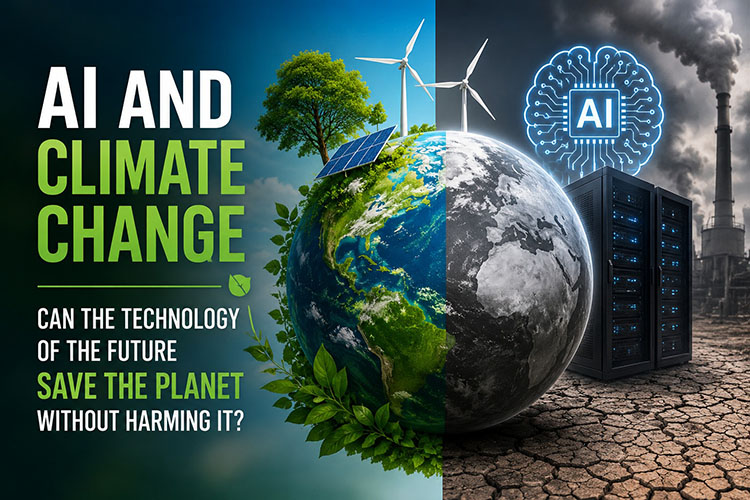
One such issue is climate change and changing weather patterns across the world. Machines that learn now help track the Earth’s weather, work once done only by humans. Forecasting disasters like heavy rain or wildfires now relies on clever algorithms instead of guesswork. Today, smart software helps optimize solar panels to reduce wasted energy. Behind many green solutions, there are unseen helpers processing large amounts of data quickly. However, this technological shift has some drawbacks. Systems designed to fight climate change can consume a lot of energy. As they learn faster, they also need more water—servers run constantly, using freshwater. Progress sometimes causes environmental problems, like water shortages. Growth continues, but at an environmental cost.
This raises an important question: Can machines help protect Earth without harming themselves?
The New Climate Helper
Climate change reveals unexpected issues. Rising seas, irregular rainfall, increasing gases, shrinking forests, and losing species are all connected. Small problems can quickly become complex.For years, researchers analyzed vast amounts of environmental data. Now, AI changes the approach. AI can process huge amounts of information much faster than people. It detects hidden patterns that allow better predictions. These insights help improve climate models and planning. Storms and extreme weather are increasingly common.
From heatwaves to floods, these events affect many lives each year. AI helps predict weather changes faster, giving communities time to prepare. For example, a small coastal village learns about a storm hours earlier than before, helping them protect their homes. This time, AI is not just about new gadgets; it’s about saving lives and helping the planet.
Smarter Energy for a Cleaner Future
Innovative approaches and AI aid in optimising sunlight and wind energy use. While cloud cover can quickly reduce sunlight, storms often increase wind speeds at night. However, sunshine mainly depends on clear skies, and breezes tend to slow when the weather calms. Power consumption must align with real- time household usage.
Most days, sunlight and wind fluctuate unpredictably. Today, machines predict energy output more accurately through studying historical data and current conditions. When clouds gather or breezes weaken, smart systems preemptively update forecasts. These predictions improve through data analysis of patterns and live sky observations. This technological approach enhances the predictability of solar and wind energy, including turbine gusts. This results in more efficient power grids, reducing energy waste and smoothing operations.
Some cities have adopted AI for traffic management, decreasing fuel use by adjusting signals dynamically. Public transit routing also benefits from algorithms that optimise routes daily. What seems minor can significantly impact overall efficiency when scaled across numerous users and urban areas, subtly driving large- scale change.
Helping Nature Defend Itself
Beyond climate variability, human activity impacts biodiversity. Habitat loss, pollution, and shifting weather patterns threaten ecosystems. Conservationists use AI creatively to address these issues.
In forests, motion- activated cameras identify animals automatically, removing the need for manual sorting – saving months of effort. These systems analyse images and sound clips rapidly, enabling quick data processing.
Similarly, smart systems detect illegal logging, and technology safeguards wildlife by tracking threats.
While no single device can save endangered species alone, intelligent tools help researchers develop better insights, revealing hidden ecological patterns rather than quick fixes. Understanding natural systems is crucial, and machine learning quietly assists in monitoring and protecting ecosystems.
The Hidden Price of Every AI Prompt
The benefits of AI are easy to see. What is less visible is the infrastructure that makes it all possible. Every time someone asks a chatbot a question, generates an image, or uses an AI-powered service, thousands of servers work behind the scenes to process that request. These servers are housed in massive data centers that operate around the clock. Unlike the devices we use every day, data centers consume enormous amounts of electricity. As AI becomes more popular, the demand for computing power continues to grow, leading companies to build larger and more powerful facilities.
This growing demand has raised concerns among environmental researchers. The environmental impact of AI depends heavily on how these data centers are powered. When electricity comes from renewable sources such as solar or wind energy, the impact is lower. However, when data centers rely on coal, oil, or natural gas, their carbon footprint can become significant. This creates an uncomfortable reality. A technology that has the potential to help solve environmental problems can also contribute to them if it is not powered responsibly.
The challenge is not AI itself. The challenge is how we choose to support and sustain it.
The Water People Rarely Talk About
Electricity is only part of the story. Data centers generate enormous amounts of heat and require constant cooling to operate safely. In many cases, this cooling process depends on large quantities of water. Because water use is less visible than electricity consumption, it often receives less public attention. Yet in regions already facing water shortages, growing demand from large computing facilities has sparked important conversations about resource management.Imagine a community trying to conserve water during a prolonged dry season while nearby facilities consume millions of litres to keep servers running. Situations like these raise difficult questions about balancing technological growth with environmental responsibility.
The issue is not whether AI is good or bad. The real question is how we can develop these technologies without placing unnecessary pressure on already strained resources.
A Lesson from History
History shows that every major technological breakthrough comes with both opportunities and challenges. Cars transformed transportation but contributed to air pollution. Plastic revolutionized manufacturing but created a global waste problem. The internet connected billions of people while introducing concerns about privacy and misinformation. AI appears to be following a similar path.
Its potential is enormous, but so are the responsibilities that come with it. The goal should not be to fear innovation or slow progress. Instead, it should be to guide new technologies in a way that maximizes their benefits while minimizing their costs.
Building a More Sustainable AI Future
Fortunately, solutions already exist. Many technology companies are investing in renewable energy to power their data centers. Engineers are designing more energy-efficient chips, while researchers are developing AI models that deliver better results using fewer resources. Governments can also play an important role by encouraging transparency and creating environmental standards for large-scale computing infrastructure. Consumers have a role to play as well.
People increasingly ask where their food comes from and how their clothes are made. In the future, they may begin asking similar questions about the digital services they use every day. What energy source powers a data center? How much water does it consume? What environmental footprint lies behind a simple online search or AI-generated response? These conversations are only beginning, but they will become increasingly important as AI continues to grow.
AI is often portrayed as either a revolutionary solution or a looming threat. In reality, it is neither. AI has the potential to improve climate science, strengthen disaster preparedness, optimize renewable energy systems, and support wildlife conservation. These capabilities could become invaluable as the world faces growing environmental challenges. At the same time, AI requires energy, water, and physical infrastructure. Ignoring these costs would be a mistake. The future of AI should not be judged solely by how intelligent it becomes, but also by how sustainably it is developed and deployed.
Technology and environmental responsibility do not have to be opposing forces. With thoughtful planning and responsible innovation, AI can help create a cleaner, safer, and more resilient future. The real challenge is ensuring that the tools we build to solve tomorrow’s problems do not become part of them.
