

Ipsa Tripathy
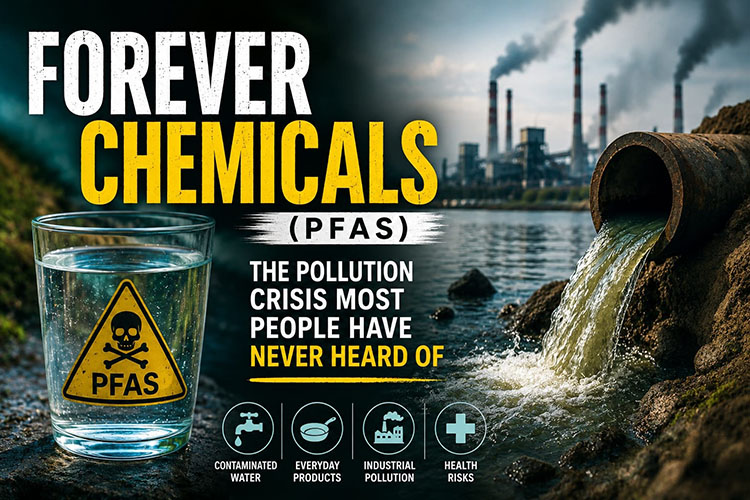
Bhubaneswar: When people think about pollution, they usually picture plastic floating in oceans, smoke rising from factory chimneys, or rivers choked with waste. Few imagine a threat that cannot be seen, smelled, or easily removed. Yet one of the most persistent forms of pollution on Earth may already be inside our bodies. These substances are known as PFAS, a group of synthetic chemicals used in thousands of everyday products. They can be found in non-stick frying pans, waterproof jackets, food packaging, cosmetics, and even some firefighting foams. For decades, they have quietly made modern products more convenient and durable.
The problem is that they do not go away. Scientists often refer to PFAS as “forever chemicals” because they can remain in the environment for decades, and sometimes much longer.
Unlike many pollutants that eventually break down, PFAS are remarkably resistant to natural processes. Once released into the environment, they tend to stay there, moving through water, soil, wildlife, and ultimately human communities. What began as a technological success story is now becoming a growing environmental concern.
A Chemical Legacy We Never Planned For
PFAS were first developed in the mid-20th century. At the time, they seemed revolutionary. Their ability to repel water, grease, and heat made them highly valuable across multiple industries. Manufacturers embraced them. Consumers benefited from products that lasted longer and performed better. Few people questioned what would happen after these chemicals entered the environment. Decades later, we are beginning to understand the consequences.
Researchers have found PFAS in rivers, lakes, groundwater, agricultural land, and oceans. They have been detected in wildlife ranging from fish and seabirds to polar bears living thousands of kilometers from major industrial centers. Perhaps most surprisingly, scientists have discovered traces of PFAS in the blood of people around the world. That realization has changed the conversation. This is no longer just an environmental issue. It is increasingly viewed as a public health issue as well.
The Pollution We Cannot See
One reason PFAS have remained outside public attention is that they do not create dramatic images. An oil spill blackens coastlines. Plastic waste washes up on beaches. Smog turns city skylines grey.
PFAS do none of these things. Their impact is largely invisible.
A family can drink contaminated water for years without realizing it. Farmers can unknowingly use affected groundwater on their crops. Wildlife can accumulate these chemicals throughout their lives without any obvious warning signs. This invisibility makes PFAS particularly difficult to address. Problems that people can see often generate public pressure. Problems hidden beneath the surface tend to remain unnoticed until the evidence becomes impossible to ignore.
Why Scientists Are Concerned
Researchers are still working to fully understand the long-term effects of PFAS exposure. However, growing evidence suggests that some PFAS compounds may be linked to a range of health concerns, including immune system disruption, hormone imbalances, developmental effects, and certain forms of cancer. Not all PFAS behave in exactly the same way, and scientists continue to investigate their impacts. Yet one fact is clear: these chemicals are widespread, persistent, and capable of accumulating over time. That combination has alarmed researchers across the globe.
As one environmental scientist famously observed, the problem with forever chemicals is not simply that they are everywhere. It is that they remain everywhere.
What Does This Have to Do With Climate Action?
At first glance, PFAS may seem unrelated to climate change. One concerns chemical pollution, while the other focuses on greenhouse gas emissions. But both tell a similar story. They remind us that environmental decisions made today can have consequences that last for generations. The carbon dioxide released into the atmosphere this year may influence the climate decades from now. Likewise, PFAS released today may remain in ecosystems long after the products that contained them have been forgotten. Climate action is ultimately about protecting the systems that sustain life; clean water, healthy ecosystems, safe food, and public health. PFAS threaten many of those same systems. That is why addressing forever chemicals should be part of a broader conversation about sustainability.
A Problem That Demands Action
The good news is that awareness is growing. Governments are introducing stricter regulations. Researchers are developing new methods to remove PFAS from water supplies. Companies are beginning to search for safer alternatives. But the scale of the challenge means there is no quick fix. The lesson from the PFAS crisis is simple: convenience should never come at the expense of long-term environmental health. For years, these chemicals remained largely invisible to the public. Today, the evidence is becoming harder to ignore. The world has spent decades creating forever chemicals. The next challenge is ensuring they do not become a forever problem.
