

Ipsa Tripathy
Bhubaneswar: When most passengers board a flight, they rarely think about what powers the aircraft beneath them. Their focus is usually on reaching a destination, catching a business meeting, visiting family, or beginning a vacation. Yet behind every takeoff lies a resource that has become the center of an important national conversation: aviation fuel.
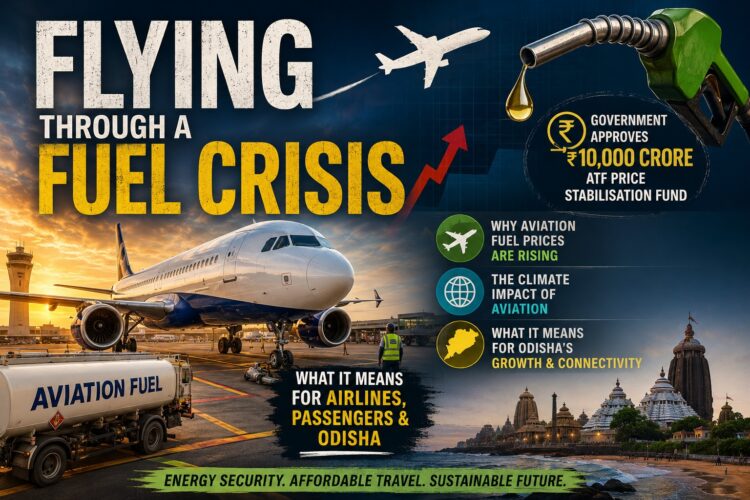
Yesterday, the Union Cabinet approved a ₹10,000-crore Aviation Turbine Fuel (ATF) Price Stabilisation Fund amid a sharp rise in global jet fuel prices. The move was welcomed by airlines, which have struggled to cope with soaring operating costs. While the announcement may appear to be a technical policy decision, its implications stretch far beyond the aviation industry.
It raises important questions about energy security, transportation, economic growth, and even climate action.
What Exactly Is Aviation Fuel?
Commercial aircraft do not run on ordinary petrol or diesel. They use Aviation Turbine Fuel, commonly known as ATF, a highly refined fuel designed to power jet engines safely and efficiently at high altitudes and extreme temperatures. ATF is the lifeblood of modern aviation. Without it, airports fall silent, supply chains slow down, tourism suffers, and connectivity between regions weakens.
What many people do not realize is that fuel is often the single largest expense for airlines. Industry experts estimate that fuel costs can account for up to 40 percent of an airline’s operating expenditure. When fuel prices rise sharply, airlines face difficult choices: absorb the losses, increase ticket prices, reduce flights, or postpone expansion plans.
This is why fluctuations in global oil markets are closely watched by aviation companies across the world.
Why Are Fuel Prices Rising?
The recent surge in aviation fuel prices is linked to growing geopolitical tensions and instability in energy-producing regions. Whenever global oil supplies become uncertain, prices rise. For airlines, the impact is immediate. Unlike many industries that can slowly adjust to changing costs, airlines consume vast quantities of fuel every day. A sudden jump in ATF prices can significantly affect profitability and passenger fares.
Recognizing this challenge, the Government of India stepped in with a ₹10,000-crore stabilization fund aimed at cushioning the impact on airlines and ensuring uninterrupted air connectivity. The decision is as much about economic stability as it is about transportation. Air travel has become an essential part of India’s development story, connecting businesses, boosting tourism, facilitating trade, and improving access to remote regions.
The Climate Question Nobody Can Ignore
While the recent discussion has focused on prices, another important issue deserves attention. The aviation sector remains heavily dependent on fossil fuels. Globally, aviation contributes around 2–3 percent of carbon dioxide emissions. Although this may seem modest compared to other sectors, aviation emissions are expected to grow as air travel becomes more accessible and passenger numbers increase.
This creates a difficult balancing act.
On one hand, affordable air travel supports economic growth and regional development. On the other hand, greater reliance on conventional jet fuel adds to the climate challenge. The recent fuel crisis serves as a reminder of how dependent modern transportation remains on fossil fuels. Every spike in oil prices exposes the vulnerability of systems built around finite and volatile energy sources.
Around the world, governments and researchers are exploring alternatives such as Sustainable Aviation Fuel (SAF), produced from agricultural waste, used cooking oil, biomass, and other renewable feedstocks. While these technologies are still developing, they represent a possible pathway toward cleaner aviation in the future.
Why Odisha Should Pay Attention
For Odisha, this discussion is particularly relevant.
Over the last decade, the state’s aviation landscape has changed dramatically. Bhubaneswar’s Biju Patnaik International Airport has expanded its reach, while airports in Jharsuguda, Rourkela, and Jeypore have improved regional connectivity. New routes have connected Odisha’s industrial centers, tourist destinations, and remote regions more effectively than ever before. Air connectivity is no longer a luxury for the state. It is becoming an important pillar of economic development.
Industries in sectors such as steel, mining, manufacturing, information technology, and tourism increasingly depend on reliable air transport. During natural disasters such as cyclones, airports also play a critical role in emergency response and relief operations. Any prolonged increase in aviation fuel prices could therefore affect more than airline profits. It could influence ticket affordability, regional connectivity, business investment, and tourism growth.
Consider Odisha’s growing tourism ambitions. Destinations such as Puri, Konark, Chilika Lake, Similipal, and Bhitarkanika are attracting increasing numbers of domestic and international visitors. Affordable flights are essential to sustaining that momentum. Higher fuel costs ultimately translate into higher travel expenses, potentially affecting visitor numbers and local economies.
Could Odisha Benefit from the Green Aviation Transition?
Interestingly, the aviation fuel debate also presents opportunities. Odisha possesses significant agricultural resources, biomass potential, and an emerging renewable energy sector. As India explores sustainable aviation fuels, states with strong agricultural and bio-resource bases could become important contributors to future supply chains.
Crop residues, agricultural waste, and other biomass sources may one day help produce cleaner alternatives to conventional jet fuel. While such a transition will take time, it highlights an important point: climate action and economic development do not always have to compete. In some cases, they can reinforce each other. For Odisha, investing in clean energy innovation could create new industries while supporting national efforts to reduce emissions.
Looking Beyond the Crisis
The government’s stabilization fund may provide temporary relief to airlines facing rising fuel costs. However, it does not eliminate the underlying challenge. The recent crisis has exposed how closely aviation remains tied to global oil markets. It has also highlighted the need for long-term solutions that improve both energy security and environmental sustainability.
For Odisha, the message is clear. As the state expands its aviation network and strengthens its economic connections with the rest of India and the world, conversations about fuel, energy, and climate will become increasingly important. The planes taking off from Bhubaneswar, Jharsuguda, and Rourkela represent more than transportation. They symbolize development, opportunity, and connectivity. Ensuring that these benefits remain affordable and sustainable will be one of the key challenges of the coming decades. The current aviation fuel crisis may eventually pass. The larger questions it raises, however, are likely to remain with us for years to come.
