

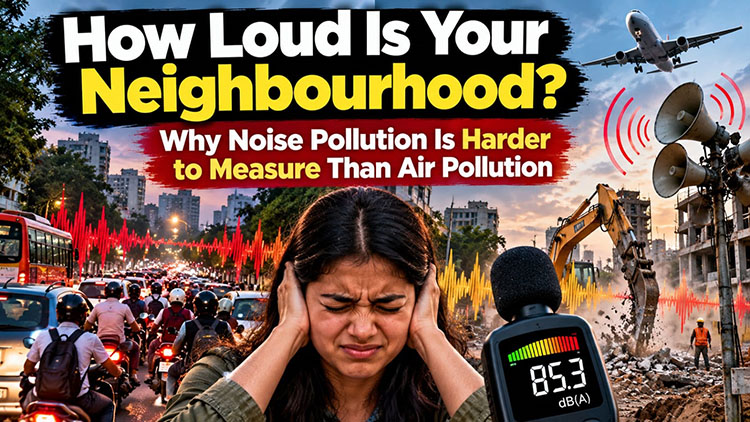
Why Noise Pollution Is Harder to Measure Than Air Pollution
Ipsa Tripathy
Bhubaneswar: Air pollution has become familiar through numbers. We talk about PM2.5, PM10, nitrogen dioxide and air quality indices. Monitoring stations produce measurements that can be compared across locations and over time. Noise pollution also has a measurement system, but the reality is more complicated. A single decibel figure does not always describe the way people actually experience environmental noise.
This matters because noise is not simply a question of whether a place is loud or quiet. How loud it is, how long it lasts, how often it occurs, what frequencies it contains and whether the sound is continuous or sudden can all affect exposure. The World Health Organization identifies environmental noise from roads, railways, aircraft, construction and leisure activities as a public health concern, linking excessive exposure with annoyance, sleep disturbance, hearing impairment, tinnitus, cardiovascular effects and cognitive impacts.
India already has a regulatory system for measuring ambient noise. Under the Noise Pollution (Regulation and Control) Rules, 2000, limits differ according to land use. The standards are 55 dB(A) during the day and 45 dB(A) at night for residential areas, while silence zones have limits of 50 and 40 dB(A), respectively. The A weighting, written as dB(A), is intended to reflect the sensitivity of human hearing, while Leq represents an energy-based average over a specified period.
That last part is important. An average can hide what actually happened.
Imagine a neighbourhood where traffic produces a relatively steady background sound, interrupted by occasional horns, construction activity or amplified music. Two locations could have similar average measurements while experiencing very different patterns of noise. One could have relatively continuous traffic noise, while another could have long periods of relative quiet interrupted by intense short events. Scientific guidance recognises continuous, intermittent and impulse noise as different exposure patterns and states that measurement needs to account for the characteristics of the sound.
Recent research and expert discussion in India have brought this problem into sharper focus. A 2026 Nature India report noted that many monitoring systems rely heavily on average sound levels and can miss short-duration, source-specific characteristics. Researchers quoted in the report called for more continuous and hyper-local monitoring, along with measurements that capture features such as peaks, frequency and variability.
This is where noise pollution differs from the way people usually think about air pollution. Air pollution also changes with time and location, but the concentration of a pollutant can be represented as a mass concentration such as micrograms per cubic metre. Noise is a physical wave phenomenon whose measurement depends on time, frequency and the characteristics of the sound source. Environmental noise can also change rapidly within a very small area.
A road junction illustrates the problem. A monitoring instrument placed several metres away from the traffic may record one level. Move it closer to a busy intersection, a construction site or a loudspeaker and the exposure can change. Buildings, roads, vegetation, wind, temperature and the shape of the surrounding urban environment can also influence how sound travels. Recent Indian research discussed in Nature India has highlighted these factors in relation to urban noise propagation.
The problem is not merely technical. Measurement determines what becomes visible to regulators.
India’s National Ambient Noise Monitoring Network was established in 2011, and the 2026 Nature India report described limitations associated with fixed monitoring stations, including sensor placement and their ability to capture short-duration events. Researchers have argued that city-specific noise maps and more localised monitoring could provide better information about where and when exposure occurs.
Odisha provides a useful example of why local measurement matters. A study published in 2026 examined noise pollution in Sundargarh City using measurements collected across five locations during 2022 and 2023. The research examined variations across seasons and times of day, rather than treating the city’s acoustic environment as a single number.
Odisha’s own pollution-control infrastructure also shows that noise monitoring is an established regulatory activity. The Odisha State Pollution Control Board states that its laboratory conducts ambient noise monitoring and festive-occasion noise assessment, and provides training related to noise-level monitoring and its effects on human health. The Board also publishes ambient monitoring information and maintains a system through which sound-related complaints can be registered.
Those complaints show that noise is not restricted to major highways or industrial areas. Odisha’s pollution-control complaint database contains recent complaints categorised under “Sound”, including complaints concerning neighbours and noise pollution. The existence of complaints does not by itself establish that every alleged violation occurred, but it demonstrates that noise remains an active environmental complaint category.
The issue has also reached the courts. In September 2026, the Orissa High Court directed the Jagatsinghpur district administration to formulate guidelines regulating DJs and other sound systems at public functions. The court did not set aside the district administration’s restriction on DJ use during Ganesh Puja and immersion and directed that future guidelines be framed within six weeks.
The scientific concern behind these debates is broader than hearing loss. WHO identifies sleep disturbance, annoyance, cardiovascular effects and cognitive impacts among the health effects associated with excessive environmental noise. For hearing specifically, WHO states that both the intensity and duration of exposure matter, and repeated exposure to loud or prolonged sound can cause permanent noise-induced hearing loss.
This makes the question “How loud is your neighbourhood?” harder to answer than it appears. A single number can tell us something important, but it cannot necessarily tell the whole story. A meaningful assessment needs to consider where measurements are taken, when they are taken, how long measurements continue, what sources dominate and what characteristics the sound has.
The challenge for cities is therefore not simply to measure more noise. It is to measure it in ways that reflect how people are actually exposed. India already has standards and monitoring systems. What recent research is questioning is whether existing measurement approaches capture the full complexity of modern urban soundscapes.
For residents, a noisy neighbourhood can feel like an everyday nuisance. For scientists and regulators, it is a measurable environmental exposure. The gap between those two perspectives is precisely why noise pollution is harder to understand than simply looking at a decibel reading.
