

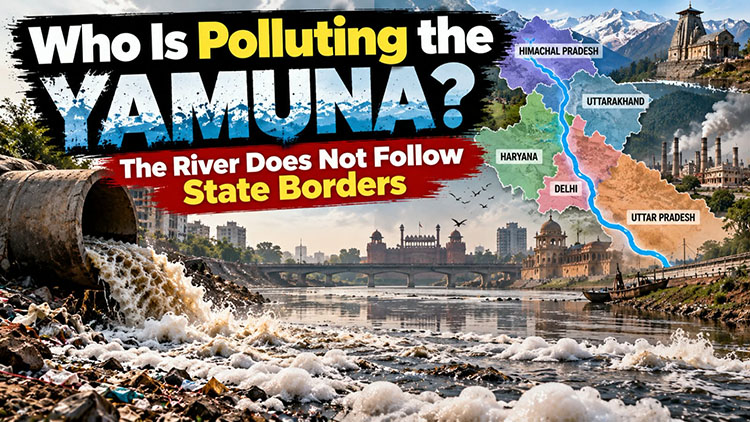
The River Does Not Follow State Borders
Ipsa Tripathy
Bhubaneswar: The Yamuna does not recognise the boundaries drawn on a political map. It begins in the Himalayas, flows through several states and eventually joins the Ganga at Prayagraj. Pollution entering the river at one location can therefore become part of a much larger river-basin problem. That is one reason the question of who is polluting the Yamuna cannot be answered simply by naming one city or one state.
The river passes through Uttarakhand, Himachal Pradesh, Haryana, Delhi and Uttar Pradesh, with tributaries and drainage systems connecting different parts of the basin. In February 2026, the Supreme Court was dealing with the Yamuna as part of wider proceedings concerning pollution of rivers by sewage effluents, with the governments and pollution-control authorities of Uttarakhand, Himachal Pradesh, Haryana, Delhi and Uttar Pradesh involved in the proceedings.
Delhi, however, remains a particularly important part of the story. Government monitoring has repeatedly shown that water quality changes sharply as the river passes through the city. A CPCB assessment placed before the Delhi High Court found that Yamuna water at Palla, where the river enters Delhi from Haryana, met the dissolved oxygen criterion, while pollution indicators increased by the time the river reached Asgarpur after passing through Delhi. The assessment attributed this deterioration to untreated or partially treated domestic and industrial wastewater entering through drains.
More recent government data show that the problem has not disappeared. A 2025 Ministry of Jal Shakti release reported that Delhi generated an estimated 3,596 million litres of sewage per day. Although the city had 37 operational sewage treatment plants with a combined installed capacity of 3,474 MLD, the ministry reported that about 641 MLD of sewage remained untreated and entered the river or drainage network. It also reported that 14 of the 37 operational plants were non-compliant with Delhi’s discharge standards at that time.
The pollution is not limited to sewage. Industrial wastewater is another documented source. The same 2025 government assessment reported that CPCB inspected 189 grossly polluting industries along the main Yamuna in Delhi during 2024. Of the 158 operational industries, 49 were found to be non-compliant with discharge norms or lacked valid consent to operate.
But stopping the investigation at Delhi would give an incomplete picture.
The Yamuna receives wastewater through drains and tributaries beyond Delhi. The Delhi Pollution Control Committee has previously documented wastewater entering Delhi’s drainage network from neighbouring areas. Its annual report recorded that large quantities of wastewater entered the Najafgarh and Shahdara drainage systems, including flows originating from Haryana and Ghaziabad. These drainage systems ultimately affect the Yamuna.
Haryana has also acknowledged the need to prevent polluted water from reaching the Yamuna. In May 2026, the state government reported an action plan involving sewage treatment, industrial-waste management and monitoring of drains carrying water toward Delhi. The programme included measures to reduce BOD and monitor industrial discharge.
Uttar Pradesh is another important part of the basin. The Yamuna continues through the state after leaving Delhi and receives water from tributaries and drainage systems along its course. Government monitoring has identified polluted stretches of the Yamuna in Uttar Pradesh as well. A Central Water Commission assessment of water-quality hotspots, for example, included locations such as Mathura, Agra and Etawah along the Yamuna.
This makes the idea of a single polluter scientifically difficult to defend. Pollution loads vary between locations, seasons, drains and stretches of the river. Some sources are domestic sewage, others are industrial effluents, and the amount of available river water also affects pollution concentrations.
That last factor is particularly important. The Yamuna does not carry the same amount of water throughout its course and throughout the year. The Delhi Pollution Control Committee has reported that during the dry season, the stretch downstream of the Wazirabad barrage can have very little fresh river water, meaning treated and untreated wastewater forms a much larger proportion of the flow.
The result is a river in which pollution and water availability are closely connected. Reducing sewage discharge is essential, but river health also depends on maintaining adequate flow, protecting tributaries and preventing pollution from entering the river system in the first place.
This is why the Yamuna increasingly has to be treated as a river-basin problem rather than a Delhi-only problem. A sewage treatment plant in one state cannot solve pollution entering from another. A drain cleaned upstream can still be followed by another polluted drain downstream. And a river cannot be restored by focusing only on the location where pollution becomes most visible.
The response is already becoming more interstate in structure. In 2026, the central government constituted a committee involving the chief secretaries of the five Yamuna basin states to oversee rejuvenation measures, including sewage treatment, waste management, water quality and wetlands across the basin.
The numbers make the problem clear, but they also reveal why assigning blame is not enough. Delhi has major documented sources of pollution. Haryana and Uttar Pradesh also have wastewater pathways connected to the river system. Upstream water management affects the amount of water available for dilution. Industrial discharge and inadequate sewage treatment add further pressure.
The Yamuna therefore exposes a fundamental problem in managing rivers in a federal system: the river is continuous, but responsibility is divided. Until pollution is measured and controlled across that entire connected system, cleaning one stretch cannot guarantee a clean river downstream. The Yamuna carries water across state borders, and its pollution does the same.
