

Ipsa Tripathy
Bhubaneswar: When we talk about a warming world, we usually think about the temperature of the air. Weather stations measure how hot the atmosphere becomes, heatwave warnings are based largely on air temperature, and climate discussions often focus on changes in average surface air temperature. But the land beneath our feet has its own temperature.
Scientists call it land surface temperature (LST). It describes the temperature of the Earth’s surface as detected by satellites and other instruments. It is not the same as the air temperature measured at a weather station. A road, a field, a forest and a bare patch of soil can all experience very different surface temperatures under the same weather conditions. That difference matters because the ground is not simply a passive surface. It exchanges heat, water and energy with the atmosphere, and changes to the land can alter these exchanges. I
A hotter surface changes how land uses energy
When sunlight reaches the ground, some of its energy is reflected while the rest is absorbed. What happens next depends strongly on the characteristics of the surface. Vegetation uses part of the available energy for evapotranspiration, the combined loss of water through evaporation from surfaces and transpiration from plants. This process transfers energy from the land into the atmosphere and can cool the surface.
When vegetation is removed or soil becomes dry, less energy can be used for evapotranspiration. A greater share can then contribute to sensible heating of the land and nearby air. Soil moisture is particularly important. Although the quantity of water held in soil is relatively small compared with the water stored in oceans, it influences plant growth, evaporation, runoff and exchanges between the land and atmosphere. NASA describes soil moisture as an important part of the climate system because it affects both vegetation and atmospheric processes.
This creates a connection between heat and water that is easy to overlook. A dry surface can heat more strongly, while stronger heating can increase evaporation and water demand. During some heat extremes, this interaction can amplify local heating.
Concrete and bare land behave differently from vegetation
Urban expansion changes the physical properties of the land. Concrete, asphalt and other built surfaces generally absorb and store solar energy differently from vegetation-covered surfaces. They also do not provide the same evaporative cooling associated with healthy vegetation. This is one reason why areas with extensive built-up surfaces can develop higher land surface temperatures.
The effect is not limited to large cities. Land-use change can alter surface temperature in agricultural and rural landscapes as well. A global study of land-use change in Brazil’s Cerrado, for example, found that conversion of native vegetation to cropland or pasture was associated with higher land surface temperatures and reduced evapotranspiration. The magnitude varied according to the type of vegetation and land conversion involved.
The important point is that the temperature of the land reflects more than the weather above it. It also carries information about what is happening to the landscape itself.
Odisha is already showing this pattern
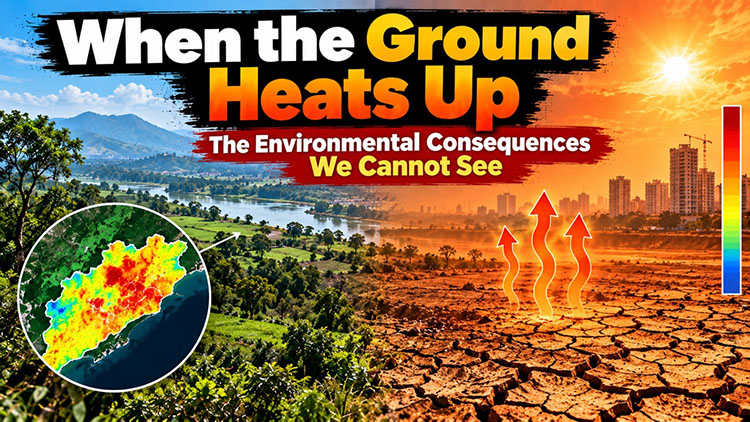
Recent research has brought this issue closer to home. A study by researchers at IIT Bhubaneswar examined two decades of satellite observations across all 30 districts of Odisha. The researchers found that thermal hotspots were expanding across both built-up and non-built-up areas. Several districts recorded annual increases in hotspot coverage, while urbanising and industrial areas showed concentrations of high land surface temperatures.
The study associated increasing surface heating with factors including urbanisation, industrial expansion and degradation of natural landscapes. In some interior and western districts, rising thermal hotspots were also observed over non-built-up areas associated with barren land, fallow agricultural fields and forest degradation.
Another 2026 study focusing on five coastal Odisha districts: Puri, Kendrapara, Jagatsinghpur, Khurda and Nayagarh reported increasing land surface temperatures alongside rapid expansion of settlement areas and declining vegetation cover over the study period. These findings do not mean that every increase in land surface temperature has the same cause. Surface temperature is influenced by vegetation, soil moisture, land cover, solar radiation, atmospheric conditions and human land use. But satellite observations can reveal spatial patterns that may not be visible from conventional weather measurements alone.
The effects reach agriculture
A hotter land surface becomes particularly important when heat occurs together with limited water. Plants lose water through transpiration, and crops require sufficient soil moisture to maintain growth. When high temperatures and water shortages occur together, plants can experience multiple forms of stress at the same time.
Research reviewed by NASA found that compound heat and moisture extremes have been associated with substantial crop-yield losses in several major agricultural regions, including parts of India. The study also found that future changes in these combined extremes could increase agricultural risks, although the effects vary between crops and locations. This is why measuring heat alone is not enough. A field experiencing high temperature with adequate soil moisture is physically different from a field experiencing similar heat while its soil is already dry.
The ground also influences the atmosphere
Land and atmosphere are connected through continuous exchanges of energy and water. The IPCC notes that land interacts with the atmosphere through exchanges involving greenhouse gases, water and energy, and that land-use and land-cover changes can influence processes including rainfall, heatwaves and air quality.
This means changes on the ground can have consequences beyond the immediate surface. Removing vegetation can alter evapotranspiration. Changes in soil moisture can affect the transfer of water into the atmosphere. Changes in surface properties can modify how much solar energy is absorbed or reflected. These relationships are complex, and they vary between landscapes. There is no single temperature response that applies to every type of land.
Looking beyond the thermometer
Land surface temperature does not replace air temperature. The two measurements answer different scientific questions. Air temperature tells us about the thermal conditions of the atmosphere. Land surface temperature tells us how hot the Earth’s surface itself is. Looking at both provides a more complete picture of how landscapes are responding to climate and land-use changes.
That is particularly important as natural vegetation is replaced by buildings, roads, intensive agriculture or degraded land. The environmental consequences of a hotter ground may not always be immediately visible. They can appear first as changes in soil moisture, vegetation stress, evapotranspiration, agricultural conditions and exchanges between land and atmosphere. A satellite can detect these changes across thousands of square kilometres.
What appears from the ground to be an ordinary landscape can, from above, reveal a very different story: one in which the surface itself is becoming part of the heat problem.
